Building an AI-powered research system covering 950+ stocks. UC Davis finance. Founder, UCD Personal Finance Club. I show the work. Education, not advice.
I'm 19. I built an AI system that tears down 950+ stocks and grades every call it makes against the market. Most finance accounts show you the wins. I'll show the whole scoreboard, misses included. Here's how it works and why.
55 buy calls. 16 graded at four weeks.
Average raw return: 8.85%. Only 4 have enough SPY history to net out the market and one of them, up 40.73%, is doing most of the work.
n=4 doesn't make a track record. Same honest caveat as the 8/6 post, just bigger numbers now: 35 opened calls back then, 55 today.
$LOW cleared my buy trigger this week. $204 against a $208.80 line.
My model needs 2.3% free cash flow growth a year for a decade to justify that price. Real number: ROIC sits at 24% right now. Quality score 4 of 5, verdict Buy. Earnings hit Wednesday, first test of the call since I ran it. No shares yet.
5.31%. The 30-year Treasury hasn't touched that since 2007.
I hold ten shares of $CCI, a cell-tower REIT that borrows long and prices its dividend against exactly this number. Real position, small size. Higher long rates make the debt cost more and the yield look worse next to a risk-free 5%. My thesis didn't change today. What I'm paying to hold it did.
$ZTS's guidance just flipped from +2% growth to -9%.
I wrote the rule that kept me out of this stock before that happened. Full breakdown in the reply, bear case included.
$122.02. My starter-position trigger was $124. Crossed it this week.
Payechex, quality score 4, fair value $138 base, $151 high case. The rule says this earns a starter size, not a full position.
Nothing about buying at $122 feels obviously cheap in the moment. Is that discomfort supposed to fade, or is it the actual signal the rule is working?
$18 wide. $70 wide.
Two fair value ranges, same week. Exelon's is $42 to $60. Rockwell Automation's is $25 to $95.
Same rough quality tier. Different questions. Exelon's cash flows are locked in by regulators years out. Rockwell's are a bet on the next industrial cycle.
Quality score says how good the business is. Band width says how sure the model is about the price. My rules keep them separate.
$NOW crossed my buy trigger this week. $124 against a $131.75 line.
My model needs 9.9% revenue growth a year for a decade to justify the $155 fair value I've got, and management's own 2030 target runs closer to 18%. Quality score 4 of 5. No position.
The trade here was never a chart, it was a written test.
Zoetis is a ~29% ROIC animal-health compounder that got cut in half starting last year on a US companion-animal demand air pocket and real competition in dermatology, its best product line. Great business, ugly two quarters. In July I wrote two conditions before knowing the answer to either: US companion-animal organic decline needed to moderate, and dermatology share needed to stop bleeding. Either one improving was my buy signal. Neither was optional.
Q2 landed August 6. US companion-animal fell 11% again, identical to Q1, zero moderation. Global dermatology sales fell 16%, and US derm share dropped another 5 points in a single quarter, the worst sequential loss that franchise has ever posted. A new US dermatology competitor entered the market the same quarter. Management cut full-year adjusted EPS guidance from $6.85-7.00 down to $6.15-6.25, and the net income growth guide flipped from +2%-to-6% to -9%-to-5%. The CEO said on the call that the nature of competition has changed.
The bear case going in was that this wasn't a cyclical dip, it was a franchise losing its two best products to real competitors while buybacks masked the damage. That's what the print showed. I don't get credit for calling it early, the rule gets credit for not letting me buy while the story still looked ambiguous.
I never owned this stock and still don't. It stays on watchlist, not a pass, not a buy. The fair value number I had on this name was built on the old guidance, it's wrong now, and I am not quoting it again until it is rebuilt off the cut numbers. The actual rule running underneath: two consecutive quarters of the same failure starts a clock, and one more confirming quarter turns watchlist into pass. Q3, reporting around early November, is that quarter.
Not financial advice.
$ZTS's guidance just flipped from +2% growth to -9%.
I wrote the rule that kept me out of this stock before that happened. Full breakdown in the reply, bear case included.
$180 quote, $200 paid. Third time this year.
Another $180 became $200. A $100 became $150. Three different customers, nobody asked them to pay more. They just did.
Three times means my price was already low enough that someone else felt fine rounding it up for me. Quoting the real number from here.
Lowe's, last 21 sessions.
Down 6.6% into the July 23 low. Up 10.6% off it. Right back where it started.
Earnings in 5 days.
A round trip like that isn't nothing. It means nobody has conviction yet, and the print settles it.
https://t.co/2wiURbeDxz
35 buy calls have opened this year.
14 have had four weeks to prove anything so far. Average return on those: 6.26 percent, across names like $GOOGL, $MA, $T and $VZ. Only 2 have a clean number against the S&P, and I need 15 graded before calling any of this a real pattern. Not there yet. Posting the number anyway.
Bought $ALNY today. 22 shares at $217.645.
Fair value in my model: $300.
Quality score: 4.
Thesis breaks if Amvuttra sales actually decline, not just slow down. First real biotech position in the book. We'll see.
Net liquidity fell $69 billion last week.
Three straight weeks of expansion, then a reversal. The Fed's balance sheet barely moved. The Treasury rebuilt its cash account by $73 billion and pulled that much straight out of the system in one week.
The S&P hit a record the same week. Real yields sit at 2.44 percent, the most restrictive read since this stretch began.
Net liquidity has led risk assets before, in 2020 and 2022. Watching to see if this time is different.
$QCOM crossed my trigger price this morning. Still not a buy.
$ALNY, $BKNG and $INTU crossed the same kind of line and cleared every gate behind it.
Cyclical names carry a deeper discount in my rules, 25 percent off fair value instead of 10. QCOM cleared the trigger but is still sitting about 9 percent above that floor.
A trigger earns a stock my attention. It doesn't automatically earn it a position.
Retail is scared and the pros are fully invested.
AAII bears: 42%.
Fund manager cash: 3.6%.
S&P: record high.
The usual move is fading the retail survey. Except the fully invested crowd has no dry powder left for the next dip. Which side would you rather fade?
$BTC prints 54% odds of a lower low in my model.
Same run, same inputs: 77% odds of a new all time high within 24 months. Price near 64K against a fair value band around 141K. ETFs bled 265 million Friday and sentiment is at 28, fear. I ran it this morning and stared at those two numbers for a while.
Both can be true. We'll see which lands first.
AWS grew 37 percent last quarter. Fastest cloud print since 2021.
$AMZN gapped up 12 percent premarket on it. My last teardown put fair value at $280, so even after the pop my model says it isn't expensive yet. Not chasing it anyway. The free cash flow trough is real and there's an antitrust trial in October. If it cools off once this settles I'll look again.
AWS grew 37 percent last quarter. Fastest cloud print since 2021.
$AMZN gapped up 12 percent premarket on it. My last teardown put fair value at $280, so even after the pop my model says it isn't expensive yet. Not chasing it anyway. The free cash flow trough is real and there's an antitrust trial in October. If it cools off once this settles I'll look again.
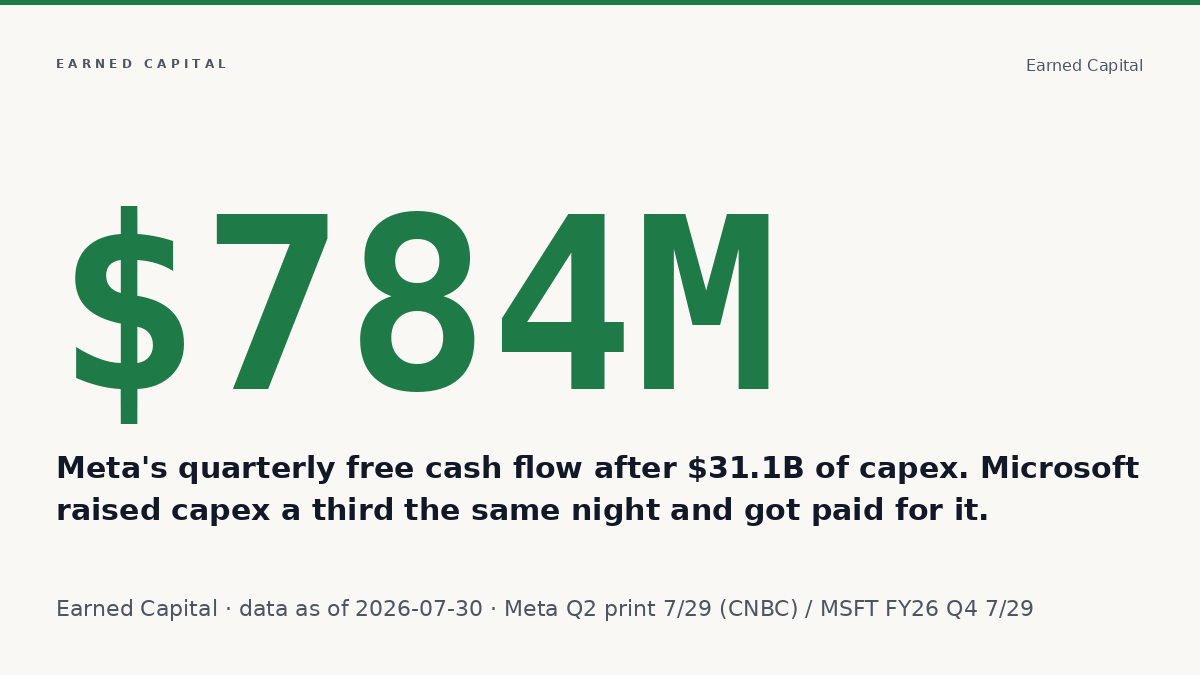
Meta reported $784 million of free cash flow last quarter.
Capex was $31.1 billion. EPS missed by 14 percent, the first miss in six quarters, the revenue guide came in soft, and the stock gave up about 9 percent. Microsoft raised its own capex guide to $255 to 260 billion the same night, a third higher, and got rewarded, because Azure grew 43 percent and just crossed $100 billion a year. Both are making the same historic AI bet. The market only paid the one showing revenue for it.