While today’s politicians pledge nothing and risk even less…
56 men in 1776 pledged their lives, their fortunes, and their sacred honor.
And they delivered.
No empty virtue signals.
No safe spaces or excuses
Just raw courage and total commitment.
Zero defectors.
That’s how freedom was purchased.
We owe them everything. Never forget. 🇺🇸🇺🇸🇺🇸🇺🇸
In September of 1814, America was once again in trouble.
The young republic was only thirty-eight years old. The War of 1812 had gone badly. British troops had marched into Washington, burned the Capitol, set the White House ablaze, and now turned their sights toward Baltimore. If Fort McHenry fell, the harbor would be open, the city would likely follow, and another devastating blow would be dealt to the fragile nation.
Amid this uncertainty, a young American lawyer named Francis Scott Key sailed under a flag of truce to the British fleet. He had come to negotiate the release of a friend, a physician the British had captured.
He succeeded.
The British agreed to free the doctor.
But there was a catch.
Because Key and his companions had seen too much of the British fleet and learned too much about its plans, they were not allowed to return to shore. Instead, they were detained aboard a ship in the harbor and forced to watch the coming battle from behind enemy lines.
On the morning of September 13, the bombardment began.
For the next twenty-five hours, British warships unleashed somewhere between 1,500 and 1,800 bombs and rockets upon Fort McHenry. These were the “bombs bursting in air” and the “rockets’ red glare” of the song—not poetic embellishments, but terrible realities.
Key stood on the deck through the endless day and the long, terrifying night. Every explosion lit the darkness for a fleeting instant before the smoke swallowed everything again. Somewhere beyond that wall of fire stood the fort. Somewhere beyond it flew an American flag if it still flew at all.
He could not see.
He could only listen.
As long as the guns continued firing, there was reason to hope. The British would not waste ammunition on a fort that had already surrendered.
Then, just before dawn…
The guns fell silent.
For the first time all night, there was only stillness.
It was the most frightening sound of all.
Had the fort finally fallen? Had the defenders surrendered? Had the flag been torn down in the darkness while no one could see?
There was nothing to do but wait.
As the first light of September 14 slowly pushed back the smoke, Francis Scott Key strained his eyes toward the distant fort.
Then he saw it. Not a British flag.
The American flag. Still there. Still flying.
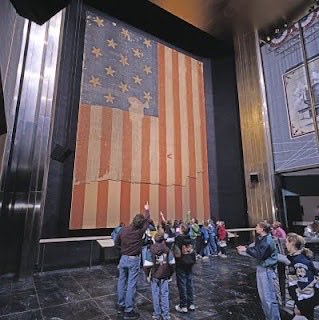
That flag was no ordinary banner. Months earlier, the fort’s commander had commissioned a Baltimore flagmaker, Mary Pickersgill, to sew a flag so enormous “that the British would have no difficulty seeing it from a distance.” It measured roughly thirty by forty-two feet, carried fifteen stars and fifteen stripes, and was so large it had to be assembled on the floor of a brewery because no ordinary room could contain it.
That was the Star-Spangled Banner.
The very flag Key saw through the morning mist.
The very flag that still survives today in the Smithsonian.
Overcome by what he had witnessed, Key reached into his pocket, pulled out an envelope, and began writing. The words came from a heart that had spent an entire night fearing his country might disappear with the dawn.
He first titled the poem Defence of Fort M’Henry.
Within days it was printed and circulating throughout the country. Before long, people began singing it to a melody they already knew—an old British tune called “To Anacreon in Heaven,” originally written for a London social club. There is something beautifully ironic in that: America’s most beloved patriotic song borrowed the melody of the very nation it had just survived. It also explains why the anthem is so notoriously difficult to sing. It was never written for ordinary voices gathered in stadiums or school assemblies.
The song spread quickly and became one of America’s favorite patriotic hymns, but it would wait more than a century before receiving official recognition. Not until 1931 did Congress declare “The Star-Spangled Banner” the national anthem of the United States.
If you see a comment that fills you with anger respond with this video…. This is the only response that truly matters. Save the video and use it, let’s expand his legacy and the gospel he preached 🩷🩷
Let’s share this far and wide because the gospel saves. If we want change we need to make disciples. #CharlieKirk
@BrandSanderson Book 5 was very disappointing. I love the series, but after the last installment, the excitement for the series has gone. What a let down.
Mike Rowe: “We’ve been telling kids for 15 years to learn to code.”
“Well, AI is coming for the coders.”
“It’s not coming for the welders, the plumbers, the steamfitters, the pipefitters, the HVAC, or the electricians.”
“In Aspen, I sat and listened to Larry Fink say we need 500,000 electricians in the next couple of years—not hyperbole.”
“The BlueForge Alliance, who oversees our maritime industrial base—that’s 15,000 individual companies who are collectively charged with building and delivering nuclear-powered subs to the Navy … calls and says, we’re having a hell of a time finding tradespeople. Can you help?”
“I said, I don’t know, man … how many do you need? He says, 140,000.”
“These are our submarines. Things go hypersonic, a little sideways with China, Taiwan, our aircraft carriers are no longer the point of the spear. They’re vulnerable.”
“Our submarines matter, and these guys have a pinch point because they can’t find welders and electricians to get them built.”
“The automotive industry needs 80,000 collision repair and technicians.”
“Energy, I don’t even know what the number is, I hear 300,000, I hear 500,000.”
“There is a clear and present freakout going on right now. I’ve heard from six governors in the last six months. I’ve heard from the heads of major companies.”
@mikeroweworks
"Game over. We are dealing with a fraud".
Geologist Prof. Ian Plimer obliterates the climate agenda in under two minutes. 🔥
"No one has ever shown that human emissions of CO₂ drive global warming… And if it could be shown, then you would have to show that the 97% of emissions which are natural do not drive global warming."
President Trump had a historically good week. In fact it might be the best week of President Trump’s presidency.
Don’t take my word for it, take CNN’s.
Watch.
🇺🇸🇺🇸
Rep. @WesleyHuntTX just delivered the most powerful rebuttal to Whoopi Goldberg’s crazy race claim—and Bill Maher’s liberal audience erupted in applause.
“I don’t even ever want to hear Whoopi Goldberg’s conversation about how it’s worse to be black in America [than to live in Iran].”
“My district in the great state of Texas is actually a white-majority district that President Trump would have won by 25 points… I am literally being judged not by the color of my skin, but by the content of my character. That’s the progress, because a lot of white people had to vote for me—a lot.”
“And my father, who’s 75 years old, was a man in the French Quarter who had to go get a sandwich from the back door of the building.”
“And his son is now a United States congressman in a white-majority district in Texas—as a Republican. That is America. That’s America. So let’s celebrate that.”
You won’t hear a more honest take on race and progress in America. This was a powerful reminder of how far this country has come.