The ‘Problematic Paper Screener’: flags unreliable passages in publications, supports a decentralised re-assessment of problematic papers, helps to decontaminate the scientific literature. https://t.co/fSmzEq49x9 That's my research as @InstUnivFr member. https://t.co/2cknvnOSKm
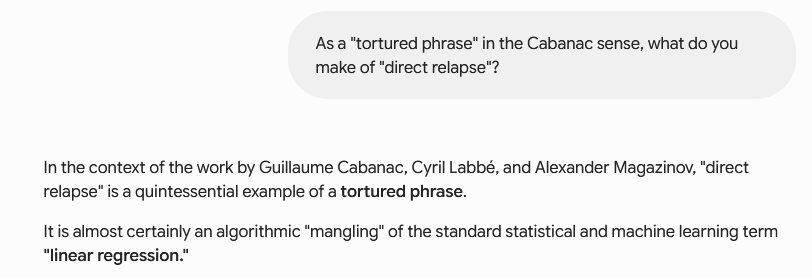
@gcabanac@TheOfficialACM Rather scary. On the side, some of these are obscure to me -- I could not guess, so I asked Gemini which seems pretty good at decoding:
Our Op-Ed in @IndianExpress today. Our title for the article was 𝐆𝐨𝐨𝐝𝐡𝐚𝐫𝐝𝐭'𝐬 𝐂𝐮𝐫𝐬𝐞: 𝐈𝐧𝐝𝐢𝐚'𝐬 𝐨𝐛𝐬𝐞𝐬𝐬𝐢𝐨𝐧 𝐰𝐢𝐭𝐡 𝐫𝐚𝐧𝐤𝐢𝐧𝐠𝐬 𝐢𝐬 𝐝𝐚𝐦𝐚𝐠𝐢𝐧𝐠 𝐢𝐭𝐬 𝐚𝐜𝐚𝐝𝐞𝐦𝐢𝐜 𝐞𝐜𝐨𝐬𝐲𝐬𝐭𝐞𝐦.
300 papers at 600 USD each. Researchers could have saved 1.8 crore rupees just in this journal if they had checked https://t.co/flpXp4DGPO
Note : We made this tool
The Curious Case of Max Planck retracted papers. When past scientific practices meet contemporary publishing norms
Yves Gingras, Mahdi Khelfaoui
https://t.co/XjPTAsMo1W [𝚌𝚜.𝙳𝙻 𝚙𝚑𝚢𝚜𝚒𝚌𝚜.𝚑𝚒𝚜𝚝-𝚙𝚑 𝚙𝚑𝚢𝚜𝚒𝚌𝚜.𝚜𝚘𝚌-𝚙𝚑]
We have created a tool Journal Trends (link: https://t.co/flpXp4DGPO) to help visualize country wise, institute wise and author wise trends for any journal. It can help researchers stay away from predatory journals and choose more wisely.
Stealth corrections are still a threat to scientific integrity. If you are not familiar with stealth corrections, please read this.
This guest post is on @deevybee's blog and is authored by from René Aquarius, Floris Schoeters, Alex Glynn and @gcabanac
https://t.co/jSJguit7Qs
This now infamous article was only in press for four days before it was retracted. Yet, it is cited more then 80% of other @FrontiersIn articles and has more views than 99% of other #Frontiers articles. It has been viewed almost half a million times.
Not bad for a paper that was only (legitimatly) available for less than a week.
https://t.co/s0zbCum233
Is @KimiProduct the new #SCIgen? a paper generator that randomly generates nonsense computer science research papers, based on a single prompt?
https://t.co/uz8b1I8GYi
MDPI makes three "stealth corrections" of the peer review record after professor flags the papers as "being affected by a review mill."
https://t.co/BI2u88uLhX
https://t.co/dRVbh9MEML
8 (!!) years after the problems were put on Pubpeer this paper finally got retracted! 👇 It's just not ok how long it takes to get rid of bad/fake research! Publishers and @C0PE need to wake up. Too much power with the ones that wrote the papers.
https://t.co/YMVsoK5N42
Reverse Image Forensics Challenge: Try to find a unique area in Figure 9 of this recent Scientific Reports paper: 10.1038/s41598-025-17456-6 [Aug 2025] - Annotated by ImageTwin
"Je me suis aperçu que, si le travail bien fait est source de joies puissantes, la paresse savourée en gourmet ne l'est pas moins. Les gens qui ne travaillent pas ne s'ennuient jamais. Les gens qui travaillent s'ennuient quand ils ne travaillent pas."
François Cavanna, Les pensées
Je reviens donc sur la bonne nouvelle: notre papier sur les sneaked references (https://t.co/oblwJOFUy1) avec @gcabanac A. Magazinov, et C. Labbé nous a fait obtenir un best paper award. Notre réaction ici: https://t.co/YQbP8WGgHK
Les tortellinis mis à toutes les sauces : « Guillaume Cabanac @gcabanac lui, développe les outils de détection automatique, par exemple le "Problematic Paper Screener", un logiciel qui repère les
"tortellinis" , ces expressions tordues ou mots inventés qui résultent de tentatives automatisées de masquer un plagiat. »
« Lonni Besançon @lonnibesancon , le détective de la science qui traque les dérives : "Le système pousse à tricher" »
https://t.co/iTlTxM6lih @GarciaVictor_
🤯 Tortured phrases in ‘ACM Computing Surveys’ a top journal in my field (JIF 28 and SJR Q1, FWIW). @TheOfficialACM tell us it's a bug... Did any of the reviewers recommended acceptance? Please make their reports public with the upcoming retraction notice. https://t.co/oQ1KjnxIlu












![addictedtoigno1's tweet photo. Reverse Image Forensics Challenge: Try to find a unique area in Figure 9 of this recent Scientific Reports paper: 10.1038/s41598-025-17456-6 [Aug 2025] - Annotated by ImageTwin https://t.co/v9oTlDhhz8](https://pbs.twimg.com/media/G5cEwUlXsAAH8pX.png)


