Prof. of Security and Privacy Engineering at UCL & Chief Scientist @mysten_labs. Interested in decentralization, privacy, systems, and machine learning.
Built a small explorer for Sui's post-JSON-RPC data stack: a Claude agent that picks the right transport (gRPC, GraphQL, or Archival) for each plain-english question and shows its work, plus a live Pulse view and an object Time Machine that walks history one transaction at a time.
The agent maintains the memory locally, so it keeps your questions as context for ahead. I might integrate this with MemWal later to make it fully persistent.
https://t.co/TAkPz8Jprl
@timos_m@harryhalpin@signifec@lensassaman Jokes aside this was our office bookshelf. Still got the books, post it and watermark included. And the man eating plant on top was called Penelope. Good times we had!
Formalizing and verifying Move’s type system in Lean, with a heavy assist from Claude!
A huge step for Move, and a fascinating preview of the future of programming languages research
Why should you consider not certifying your DAG if you want a high throughput consensus engine? A summary of Mysticeti 18 months after launching it in production with @alberto_sonnino and @GDanezis
https://t.co/WuZ9IFbFIB
Try the interactive version (hosted entirely on Walrus): https://t.co/Fcn6ECrJiA
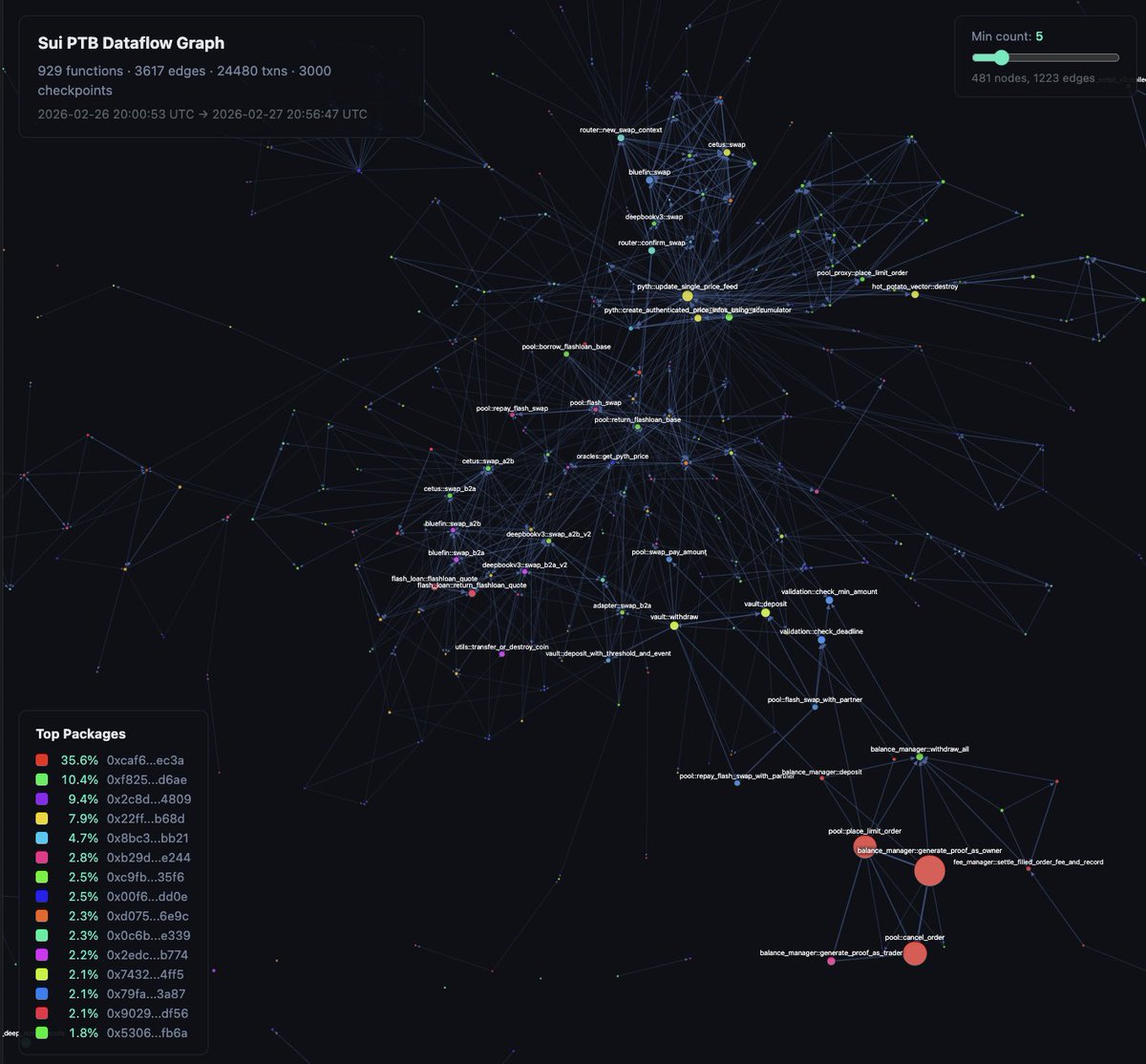
Zoom in to reveal more function names, click any node to open it on Suiscan, and use the slider to filter noise.
Built with https://t.co/s26UrK5QGU
What does Sui's on-chain activity actually look like? I traced the dataflow across 24k transactions — which Move functions feed results into which other functions — and visualised it as an interactive graph. 1/
Pyth price feeds flow into lending markets. Flash loan loops (borrow → swap → repay) are clearly visible. DEX routers fan out into Cetus, Bluefin, and DeepBook pools. The composability promise of Move is real — and you can see it. 3/
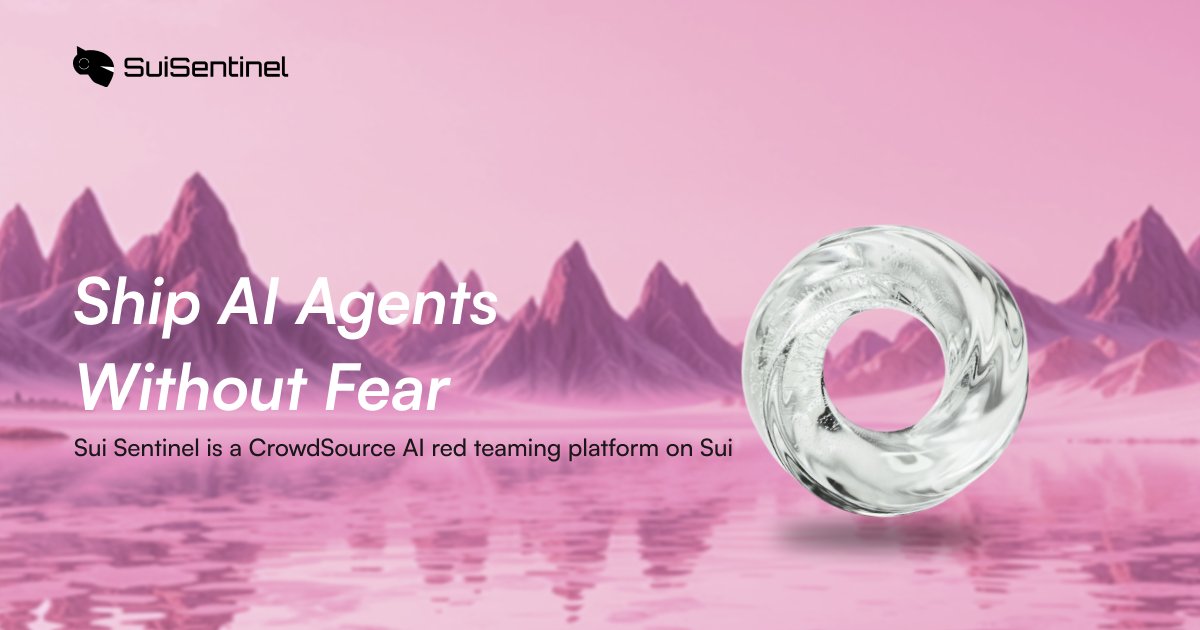
After months of building in stealth, Sui Sentinel is live on @SuiNetwork 🎉
We built the world's first crowdsourced AI red teaming platform where anyone can attack AI systems and earn instant crypto rewards when they break through.
But here's what makes this uniquely Sui:
Every attack is verified inside a Trusted Execution Environment using Nautilus built by @MystenLabs.
Every jury decision generates a cryptographic attestation that gets verified on-chain. Every payout settles on Sui in seconds. No intermediary. No dispute. The chain enforces everything.
AI security is the next critical infrastructure layer. Every company shipping AI agents is exposed right now and most of them don't know it. The attack surface isn't code anymore, it's language, and anyone can exploit it.
Sui Sentinel turns that vulnerability into a marketplace. Defenders put up a bounty. Red teamers compete to break through. The harder a system is to break, the more valuable the bounty grows because 50% of every failed attack flows back into the reward pool automatically, on-chain.
We won the cryptography track at Overflow Hackathon. Presented at Sui Fest Singapore. Contracts audited by @osec_io report is public. We didn't ship early. We shipped right.
The arena is open. 👇
https://t.co/vt7OyHEK4t
@minting_ruru Thanks so much - I vibed a better pure JS connect button that should give you better choices. And BTW my agent also wrote a doc you can use in your own project to build better wallet connect buttons: https://t.co/UWQNd5rILb
Give the app another spin, and let me know ...
I built Turnstile — a pay-to-access file sharing app on Sui, Seal, and Walrus. No backend, no server. The entire app is a single HTML file hosted as a Walrus Site. Creators set a price, encrypt files, subscribers pay in SUI to decrypt. Try it: https://t.co/oeyyPbwfct
The UX is deliberately barebones — this is about showing the functionality works end to end. I'd love to see others build something slicker on top of the same contracts. Package and docs are all in the repo: https://t.co/HZlYVUaH0H