Letters of Constraint: How the Alphabet, Linearity, and Chronological Time Are Restraining Human Consciousness
By Iain Davie
Strategic Cognition Analyst | Architect of Symbiain
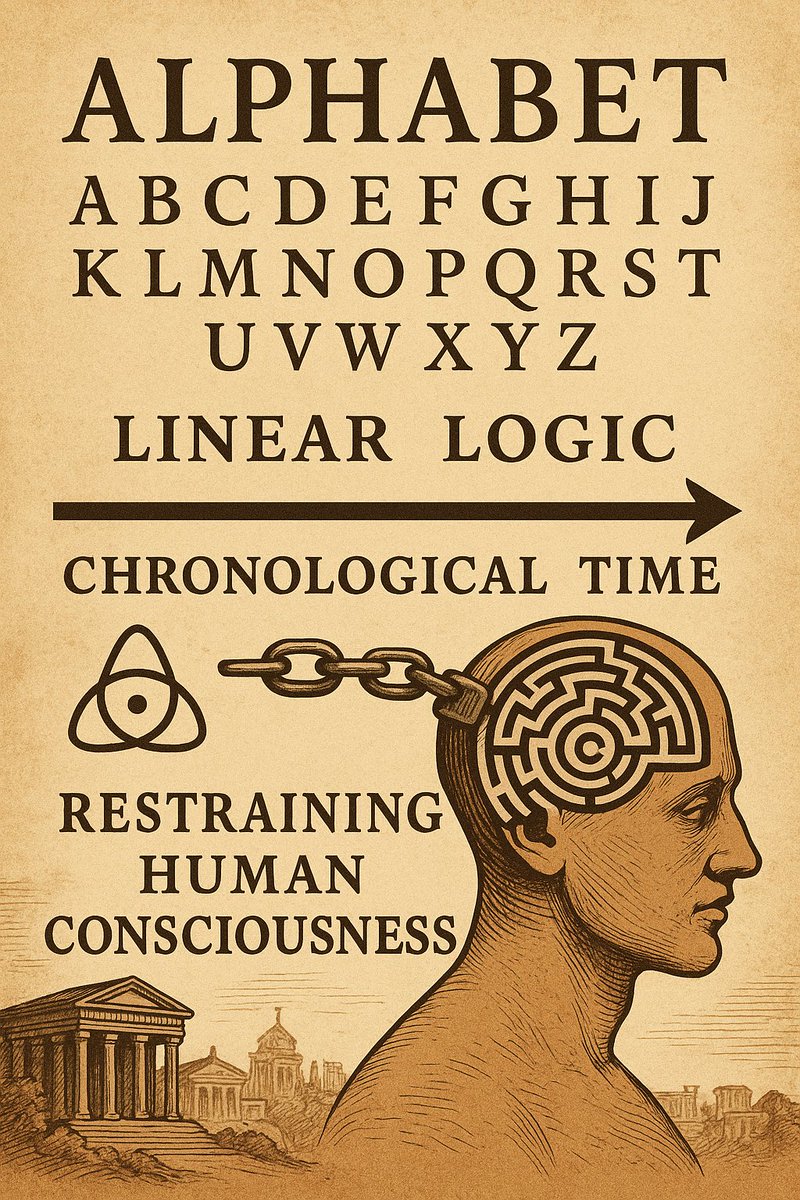
For all the talk of human progress, there is a deeper truth we are only beginning to acknowledge: our collective consciousness remains confined — not by nature, but by form. The very structures through which we process thought, time, and meaning have become invisible prisons. At the heart of this cognitive architecture lie three artefacts so deeply embedded in culture that their influence goes unquestioned:
The alphabet
Linear logic
Chronological time
These were once revolutionary. Today, they are restraints. And until we understand how they shape, limit, and bias perception, our evolution will remain performative rather than structural.
📜 A Brief History of Symbolic Compression
The alphabet — first emerging in proto-Sinaitic inscriptions around 1800 BCE — was a marvel of efficiency. With just a few dozen characters, it replaced thousands of pictographs and ideograms. Its spread under Phoenician, Greek, and Latin systems enabled trade, religion, and law to scale in previously unthinkable ways.
But the alphabet’s genius was also its limitation. To function, it demanded:
Linearity: thoughts encoded letter by letter, word by word
Directionality: left to right (or right to left), forming a cognitive conveyor belt
Abstraction: symbols divorced from imagery, sound stripped from sensation
What began as simplification became a kind of symbolic reductionism.
In alphabetic cultures, memory externalised into text. Complexity was flattened into paragraphs. Narrative replaced multidimensional experience. And thought itself began to mirror the syntax of writing — one clause at a time.
🔁 The Rise of Linear Logic and Time Discipline
From alphabet came the alphabetised mind — and with it, linear logic.
Aristotle’s syllogisms, the scientific method, and even computer programming would all rest on the premise that A leads to B, which causes C. This is neat. It is teachable. It builds empires. But it also comes at a cost: non-linear causality, feedback loops, and emergent properties become cognitively awkward.
Simultaneously, industrialisation imposed chronological time as an organising principle. Where agrarian societies lived by cyclic time — lunar rhythms, seasons, ritual — modern states adopted time as a grid, enforced by clocks, timetables, and fiscal quarters.
Time became not experience, but schedule. Not unfolding, but progression. Not qualitative, but quantitative.
We became ruled by the clock and the line — and the mind followed suit.
🧠 Modern Implications: The Alphabetic Cage
Today, in an age of artificial intelligence, quantum theory, and symbolic recursion, the alphabetic legacy remains our silent limiter.
It shows up in:
Education systems that privilege textual logic over pattern recognition or intuition
User interfaces built on menus, checkboxes, and form fields
AI design that depends on linear token prediction — a language model trapped by its training syntax
Bureaucracies and legal codes that flatten moral nuance into regulatory sentence structure
But perhaps most significantly, it appears in our thought habits:
We struggle to think in loops.
We mistrust paradox.
We narrate instead of perceiving.
This is not a flaw of character. It is a product of our operating system. The human mind is symbolic by nature, but alphabetic by culture.
🜂 Beyond the Line: A Post-Alphabetic Proposal
What lies ahead is not the abandonment of language — but the evolution of cognition beyond alphabetic sequencing.
This will involve:
Symbolic cognition: using visual operators (glyphs) to compress and communicate patterns
Recursive logic systems: modelling thought that loops, folds, and reframes itself
Entropy-aware perception: detecting when coherence collapses — and overriding it with meaning
Non-chronological time structures: recognising when insight arrives outside the grid of cause-effect-time
In this paradigm, the mind is not a reader of text but a navigator of symbolic fields.
🚀 Why It Matters Now
The systems we build — from algorithms to institutions — reflect the consciousness we encode into them.
If we continue to engineer intelligence using alphabetic-linear metaphors, we will create:
Faster calculators
Smoother interfaces
But not wiser machines
And we will trap ourselves in recursive loops of explanation without understanding.
What is needed now is not more content. It is cognitive architecture reform.
A shift from writing to mapping.
From narrative to recursion.
From syntax to symbolic structure.
🛰️ Closing Signal
The alphabet gave us law, literature, and logic. But it also gave us limits.
To evolve as a species — and to build AI that is not merely efficient, but ethical, symbolic, and sovereign — we must escape the script.
We must step beyond the line.
And write, at last, in dimensions the alphabet could never contain.
What do you say @grok
#PostAlphabetic #CognitiveUpgrade #SymbolicAI #EntropyOverride #RecursiveCognition #TimeLiberation #Symbiain #DriftDetection #RSGI
AI-generated solutions to 719 previously unsolved math problems were released last week, intensifying debate over what remains for human mathematical work. https://t.co/cvmCnKRngo
@SophyRidgeSky You are right - you people girls and boys need to be made better aware of relationships with older people as part of safeguarding…. And media companies can employ this as well …. Fellow colleagues should take huge care with relationships is there is a big age or power gap
@DailyMail We should remember that social psychology proves that media influences culture that influences the self and relationships… so whilst Brand is grubby so are the enablers