Are VLAs dead?
No, and you don't have to choose between VLAs and WAMs.
Introducing Flex-π: a multi-stream world-action model (WAM) that jointly predicts future RGB, 3D pointmaps and DINO semantics with actions in training, then deploys as a VLA, a full WAM, or anything in between — all from a single checkpoint.
Website: https://t.co/JrWmyNMJ4O
NVIDIA letting Jensen go is a huge mistake, for America and for humanity. It's Apple firing Steve Jobs all over again, but much bigger, given the role of AI in defining the future of our world.
I've been keeping quiet on this out of respect for Jensen's family and team, who I've met and who are amazing humans, and because I personally hate infidelity. So my heart goes out to them in this difficult personal family moment.
But I can also say that Jensen is human, and makes mistakes like all of us do. Not that I matter at all, but I've known Jensen for a long time and have gotten the chance to spend a lot of time with him, behind the scenes, away from mics and cameras. I have seen him show kindness, humility, care to everyone around him, including strangers, including from the poorest most struggling parts of society, treating all the same with the same thoughtfulness and attention, because they are fellow humans and not because he has something to gain from them. That shows rare character, to maintain humility and humanity through all of it.
Another data point is what people who know him well have said privately to me about Jensen over the years. I've never had anyone tell me anything but how awesome he is or how much they love him. Probably over a thousand people at this point. This includes hundreds of engineers, CEOs, colleagues, friends, etc.
Also, since there was some spy talk. Jensen is as proud an American as it gets. I'm in shock frankly at all of this, including the mass hysteria around it. I love America, and I think NVIDIA letting Jensen go is terrible for America.
I stand with Jensen.
Love you all ❤️
I'm proud I worked at @NVIDIA.
@JensenHuang is the biggest reason why. I'm not there anymore, so I can speak freely.
His departure is a huge loss. Especially now.
I spent almost five years in the culture he built and knew people who'd worked with him for 20+ years. They respected him technically and loved him as a person. They said it without a hint of doubt.
The focus stayed on the mission and on people. Good ideas got support regardless of title.
That sounds like standard company values. It wasn't. Behind it was his vision and a way of leading that is out of fashion in today's founder advice:
- Be kind, not arrogant.
- Innovation, not marketing.
- The wins belong to the people, not the CEO.
- Don't fire by default. Find the person a new role.
It's counterintuitive, and I doubt there is a harder way to lead. What I saw was leadership through kindness and care, not by squeezing people.
A real visionary. He understood the technology and the people building it. His internal talks had vision, conviction, technical depth and jokes good enough for stand-up. You left wanting to build, and you couldn't wait for the next one.
An affair, on its own, shouldn't outweigh decades of leadership. The serious questions deserve real answers. But the soap opera shouldn't decide his future.
We're at a critical moment for AI. His technical judgment, vision, and commitment to the work are incredibly hard to replace.
I want Jensen to keep building and leading. There's too much important work ahead.
Presenting Flex-π at two #CoRL2026 workshops tomorrow 🤖
📍 Do Robots Need World Models? — spotlight 9:30, poster 10:25 (Brazos room)
📍 The Action Gap — poster 15:30, oral 16:45 (Room 208)
Come chat!
https://t.co/5izN0qlirj
Are VLAs dead?
No, and you don't have to choose between VLAs and WAMs.
Introducing Flex-π: a multi-stream world-action model (WAM) that jointly predicts future RGB, 3D pointmaps and DINO semantics with actions in training, then deploys as a VLA, a full WAM, or anything in between — all from a single checkpoint.
Website: https://t.co/JrWmyNMJ4O
World models are becoming simulators for evaluating and training robot policies. But how do we compare them?
They output latents, video or simulator states, and image quality says little about task success. In ToyBlocks we compare what matters: interactions and outcomes.
Introducing “Task-Relevant Fidelity in Robotic World Models,” our work on ToyBlocks, to be presented at the LEAP and TAG/G2A workshops at #CoRL2026.🧵
Takeaway: treat 3D as an image, and geometry inherits 2D pretraining.
Joint work with @s1wase , @yolo24312431 , Dieter Fox, @ZakharovSergeyN, and @robo_kat at UW and TRI.
🌐 https://t.co/1sJCaOhZEt
💻 https://t.co/rx0hU0MsEM
What if 3D could just be an image?
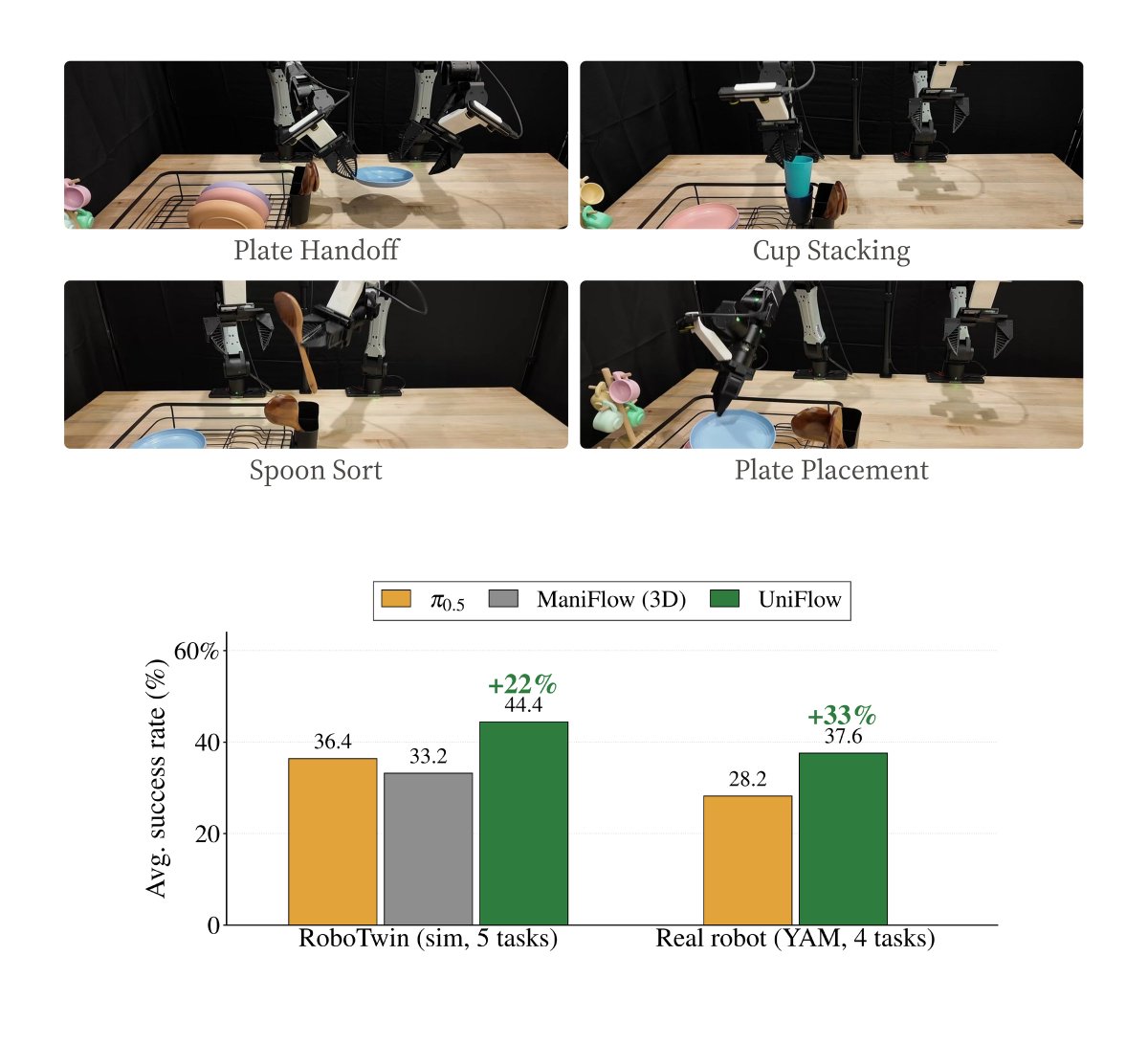
Introducing UniFlow: we treat 3D pointmaps as images, so they can use the same pretrained 2D priors as RGB, with no 3D encoder or camera extrinsics needed. A multi-modal diffusion transformer with per-modality modulation then fuses the RGB and pointmap streams. We found this works better than pretrained 3D encoders and stays robust under domain shift. It outperforms the Large Behavior Model (LBM) in sim and π0.5 on a real robot.
Come to poster #71 at #CoRL2026 today, 5–6:30 PM in Lone Star (3rd floor), JW Marriott!
https://t.co/MjNH0aS9FF
3D should intuitively be really useful for policy learning, but natively 3D representations are tricky to scale computationally. UniFlow leverages point maps, which have become popular in recent years because they allow you to represent point clouds as images.
Find it. Reach it. Grasp it. Easy for us, hard for a humanoid.
Introducing HuG (#CoRL2026): Learning Humanoid Whole-Body Affordance-Aware Grasping with Active Perception.
The robot looks around for a half-hidden object, squats or stretches its whole body to reach it, and grasps. Zero real demos, zero-shot to unseen objects and everyday scenes, from low tables to high shelves.
🌐 https://t.co/XQ8SDmZf97
What could we learn about robot foundation models if we could systematically generate data at scale, with precise control over what varies?
Excited to see ToyBlocks launch as a principled step toward answering these questions, and to see what new research directions it unlocks!
Sharing what I spent the last year working on before starting my PhD. Glad it’s finally released! 🧱🤖
Robot foundation models have made huge progress with scale, but it’s getting harder to tell which choices actually drive the gains. I strongly believe many design choices are still understudied: data mixtures, input modalities, architectures, training recipes, and now how agentic frontier models should plan and act through robot skills.
Answering that takes systematic ablations, which need a system where you can 1. design tasks 2. generate data in a controllable way, and 3. train and evaluate models end to end.
That’s what ToyBlocks is built for. Excited to see what the community learns with it!
Excited to finally share ToyBlocks! 🧱
A fully open simulated setting where you control the data, the models and the evals, so when a robot policy fails you can actually trace why.
Assets, data generators, 85K demos, training + eval code, all open. Try it out!👇
ToyBlocks is out! 🚀
At Ai2, we’re always exploring how simulation can help scale data generation, benchmarking, and experimentation to push robotics research forward.
MolmoSpaces, MolmoBOT earlier this year, and now ToyBlocks! :)
This was one of the last projects I contributed to in my PhD and it’s awesome to see it finally released!
With scale we need better tools to make more fine-grained analysis of our models and algorithms. Complex-looking tasks may be cool and high-value, but are not always the highest signal for research and iteration.
Simulation of an “easy to simulate” but “difficult to master” domain of tasks lets us get more scale with minimal sim-to-real gaps, while letting you test on a incredibly diverse set of problems. From non-prehensile movements / dexterity, to higher-level reasoning.
Stay tuned to what AI2 is working on to advance open-source robotics!