What the hell is an ampersand and why does it look like that?!
The first thing you need to know is that "&" used to be the 27th letter of the alphabet...
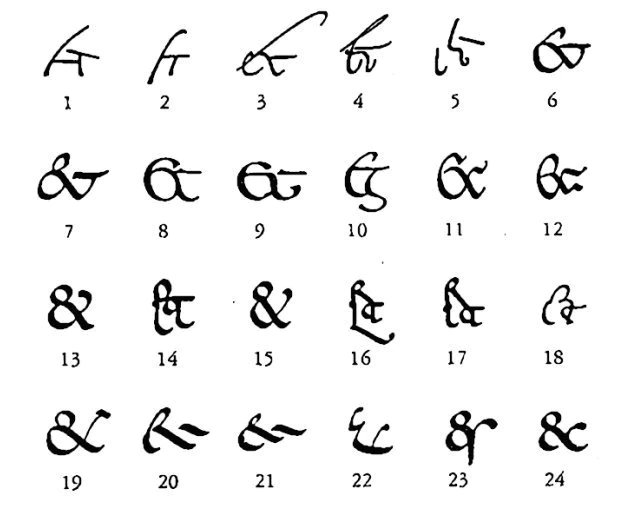
But there are three parts to this story. And the first begins over two thousand years ago in Ancient Rome with a single word: et. It's the Latin for "and". At some point Roman scribes started combining the two letters of et into a single symbol, which was the ancestor of our modern &.
The earliest example of the "et" symbol is actually from graffiti in Pompeii. In any case, it did not disappear with the fall of the Roman Empire.
Latin survived as the language of the Catholic Church and of scholarship in Medieval Europe. Scribes during the Dark Ages continued to use the & symbol. It evolved down the centuries, in places losing any semblance of the letters e and t whatsoever.
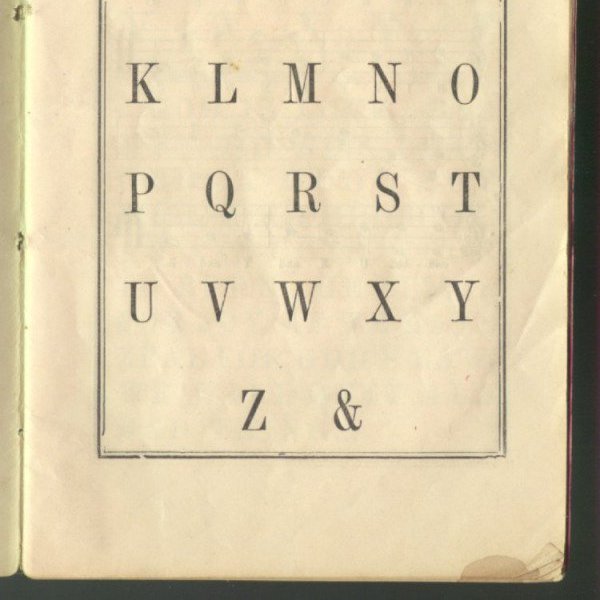
The second part of the story is that during the 18th and 19th centuries, as education and the teaching of literacy spread, & was added to the end of the alphabet as a sort of 27th letter.
On a related note, although "et cetera" is now usually just abbreviated as etc., for a long time it was instead abbreviated as "&c". The & was for et and the c for cetera.
The third and final part of the story is about how the alphabet was taught to children — and how it was read out loud.
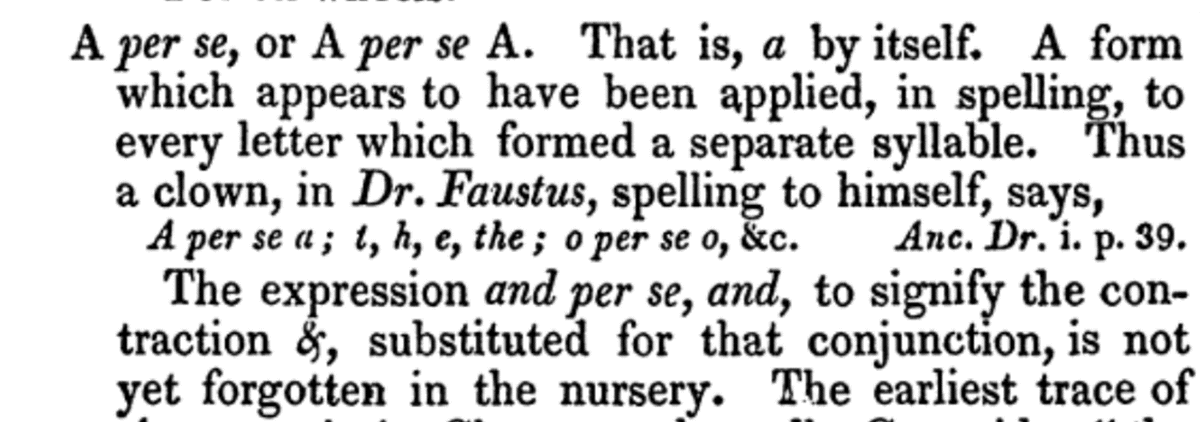
As this 1822 Glossary of Words and Phrases explains, it had been normal during the Renaissance, when speaking the alphabet, to add "per se" before any letter which could also be a word on its own — "per se" means "by itself" in Latin.
Take the letter A, which can also be a word of its own. When reading out the alphabet people would say "A, per se A, B, C, D, E, F, G, H, I, per se I..." and so on. O was also considered a word of its own.
Which means, when people got to the end of the alphabet, with & being the 27th letter, they would say: "S, T, U, V, W, X, Y, Z, and per se &."
When this old way of reading the alphabet was taught to children in the 18th century and they were reciting it aloud, they would garble "and per se " into what eventually became... ampersand.
A Dictionary of Slang and Colloquial English from 1905 relates some of the many other pronunciations school children apparently came up with:
"Ampersand. The sign &; ampersand. Variants: Ann Passy Ann; anpasty; andpassy; anparse; apersie; per-se; ampassy; am-passy-ana; ampene-and; ampus-and; ampsyand; ampazad; amsiam; ampus-end; apperse-and; empersiand; amperzed; and zumzy-zan."
Well, of all the many pronunciations that might have stuck, it was "ampersand" which came to be accepted and is now the official name for &... rather than zumzy-zan. So, from hurried Roman scribes to unruly school children, that's where "&" came from.
And many congratulations from @geddestrust whose Memorial Lecture you gave so eloquently at Oxford in 2015. Young journalists learn by your example, Lyse
Remembering last night the reporter #PhilipGeddes, killed by the IRA in 1983, at his old college @StEdmundHall. A dazzling tribute and speech by @thehuwedwards made this 40th anniv v. special - thank you Huw, Teddy Hall, @petercardwell@GeddesTrust and all friends who attended
A pleasure to hear from @thehuwedwards at the 40th anniversary Geddes lecture today.
Huw’s thoughts on the vital role of the BBC were timely and fascinating - thanks to @petercardwell & @GeddesTrust for organising.
It’s Geddes Day! Huw Edwards will give the 40th anniversary lecture at 5pm today in Oxford on the topic: ‘What’s the point of the BBC?’ and will award our three student prize winners the Philip Geddes, Ronnie Payne and Clive Taylor prizes.
Very pleased to have won the 2023 Ronnie Payne Prize for foreign reporting and very excited to get to work on my own foreign report project! Look at me! An award winning journalist !✨🥳
Congratulations to @AnnaFDowell of Wadham College, who has won the 2023 Philip Geddes Prize for the most promising undergraduate journalist at @UniofOxford. @wadhamoxford
We’re delighted that the BBC’s Chief News Anchor @thehuwedwards will give the 40th anniversary @GeddesTrust Lecture on Friday 19th May (4th Week of Trinity) at the @UniofOxford’s Museum of Natural History. You can register at this link.
https://t.co/K6UrncKVmH
This was such a brilliant opportunity to meet more of Oxford’s student journalists and put some reporting skills from Cherwell to the test! Really looking forward to the rest of the Geddes events this year too, thanks again to everyone for a fabulous time
A belated thank-you to @tomhcalver and @Tony_Diver for their masterclass--as someone who's mostly written articles about arts and culture, learning about writing breaking news and data journalism was a truly new and fascinating experience