🚨HUGE: $ICP has just smashed TWO all-time records!
According to @chainspect_app, $ICP reached 4,200 transactions per second and an astonishing 10.88 BILLION transactions in a single month!
That's over 363 MILLION transactions every day!
The scale of ICP is becoming impossible to ignore!
ICP keeps setting wild records!
According to data from Chainspect (@chainspect_app), the Internet Computer (@dfinity) registered two new all-time network highs on Sunday, November 15.
First, the blockchain hit a new all-time high for its monthly average transaction count, at 4,200.34 TPS.
Additionally, its cumulative transactions for the same period amounted to 10,886,400,000 TPS, or around 363 million transactions daily.
More on ICP: https://t.co/HrVmI8imo9
"Sovereign cloud means that you're able to control precisely what hardware is backing it. And not only that, you're able to change the hardware without interrupting the apps and services running on your cloud. That's what a Cloud Engine is."
Dominic Williams (@dominic_w) spoke with LaunchPod at @DubaiAIFest about what sovereignty means for a cloud, how Cloud Engines give you control of the hardware, why software built by AI needs tamperproof infrastructure, and OpenSaaS, free replacements for the SaaS a business pays for.
Full interview linked below.
Dfinity Founder Challenges Hyperliquid's Decentralization Claims
Dfinity (@dfinity) $ICP founder Dominic Williams (@dominic_w) says Hyperliquid (@HyperliquidX) $HYPE operates more like a centralized exchange.
"HyperLiquid is really a centralized exchange, and this is a key part of most of their business models," Williams noted.
He argues that onchain, open-source systems governed by a DAO offer a different model. His remarks came amid allegations of preferential access in Hyperliquid's priority auctions.
A community post by Tor00_1 accuses Hyperliquid's auction system of giving major trading firms an edge.
It alleges Wintermute secured most top auction slots last month. The post also claims altcoin order book depth fell 82% across 86 pairs.
More on Internet Computer: https://t.co/HrVmI8iUdH
🔥 BREAKING: Internet Computer is reportedly processing transactions at nearly 3x the speed of Solana, according to data from @chainspect_app.
@dfinity network recorded an average of approximately 5,260 transactions per second over the past week, making $ICP the fastest blockchain by real on-chain activity, while @Solana $SOL ranks second.
JUST IN: Internet Computer (@dfinity, $ICP) has pulled well clear of @solana ($SOL) on raw transaction speed 🚨
Chainspect measured the gap over the past week, and BSCN sets out what that figure captures and what it leaves out.
See the numbers ⬇️
Story: https://t.co/atHtscIiSi
Internet Computer now 3x faster than Solana?!
According to data from @chainspect_app, @dfinity's Internet Computer recorded a real weekly average of some 5,260 tx/s this past week.
This makes $ICP the fastest blockchain in terms of real activity and a staggering 3x faster than @Solana $SOL, which sits in the #2 spot.
More ICP content: https://t.co/HrVmI8imo9
HyperLiquid is really a centralized exchange, and this is a key part of most of their business models (e.g. NYSE sells cross-connects from their servers to hedge funds' servers so they can front-run). MULTI/DEX won't, because onchain, open source, and updated by a DAO.
As predicted, AI continues to accelerate the security challenges facing anything built on traditional tech.
We've predicted this for years, and it's one of the reasons for ICP cloud engines → build using tamperproof code.
Next week, I'm releasing an episode many of you have been waiting for.
I visited the headquarters of @dfinity in Zürich, and recorded an 80-minute podcast with the founder of $ICP, @dominic_w.
A thoughtful, interesting conversation where we talked about the challenges humanity currently faces as AI rises.
I've learned a lot from the episode, and I'm really keen to hear what you all think.
Releasing on Thursday!
Dominic Williams spoke to @MSBIntel in Dubai about cloud engines, and about his bet that AI agents will change how software is built.
He explains why, after 46 years of writing code, he calls himself obsolete, and what AI agents need from the infrastructure they run on.
The conversation also covers the changing cybersecurity threat, OpenSaaS, Motoko 2.0, and what a cloud engine costs to run.
ICP canister memory usage reached 12,528,256,551,052 bytes on November 11, up 14.35% in 30 days.
That compares with 10,955,813,953,913 bytes on October 12. The measure tracks software memory, rather than customer data-storage demand.
@dfinity@dominic_w
EXCLUSIVE: Dominic Williams on Cloud Engines, AI Agents & ICP’s Next Chapter
We didn’t let AOL own the internet. Why did we let three companies own the cloud?
In this interview, I sit down with DFINITY founder Dominic Williams (@dominic_w) to discuss Cloud Engines and his bet that AI agents will change how software is built, and which infrastructure wins.
After 46 years of writing code, his verdict on his own role is striking: “I’m a super expert software engineer. I’m obsolete.”
We get into sovereign cloud infrastructure, OpenSaaS, Pakistan’s early work with ICP, and the proposed model connecting Cloud Engine payments to ICP burning.
As Cloud Engines enter early access, this is the thinking behind the rollout.
Watch the full 42-minute conversation. @dfinity
Recorded in Dubai ahead of the rollout. Chapter timestamps below.
ICP connects to Ethereum with NO bridge! 🔗 @dfinity calls it Chain Fusion, and $ICP smart contracts can sign Ethereum transactions themselves.
Here's the clever cryptography behind it.
Get ahead:
https://t.co/zBXaSmS4h6
Pakistan's digital authority runs an Internet Computer cloud engine in a country with more than 241 million people.
Government teams use Caffeine to build apps whose software and data stay in Pakistan.
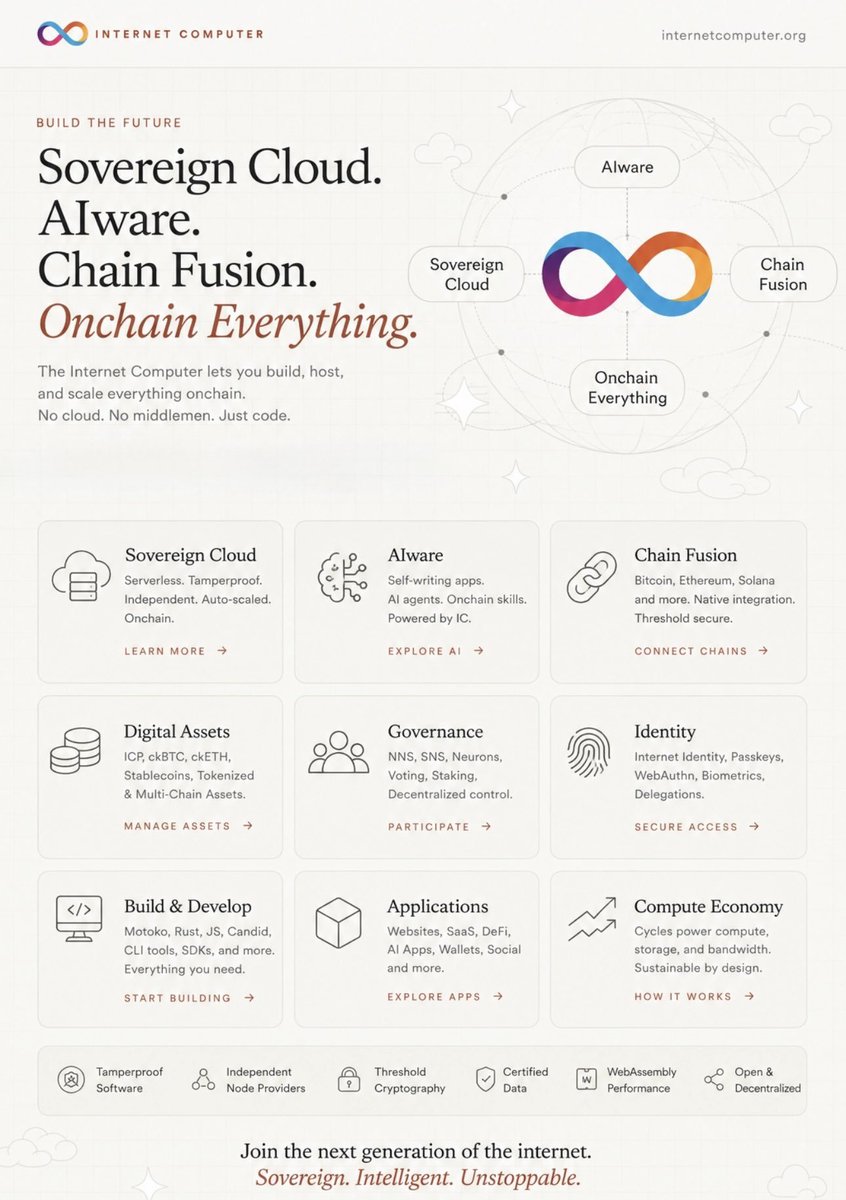
🚨 BREAKING: DFINITY Foundation, the team behind Internet Computer Protocol (@dfinity), has launched Cloud Engines, a sovereign cloud platform designed for AI applications.
The platform aims to keep applications resilient against cyberattacks and data center outages while supporting AI-powered workloads.