AI systems · Agents · RL post-training · LLM inference
Ex-RecSys / large-scale data systems
Building Veyra · Exploring world models, memory & embodied AI
13/13 — My takeaway:
Progress is shifting from better code generation to reliable closed-loop software engineering.
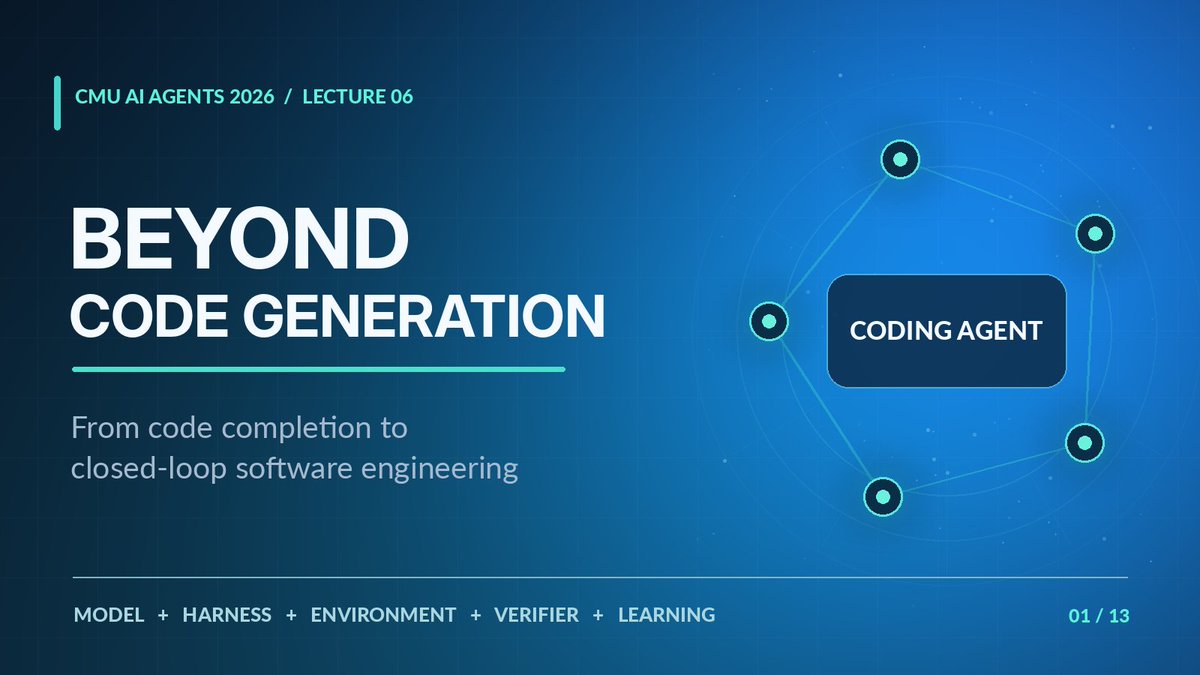
Model + harness + environment + verifier + learning pipeline.
Improving the full stack matters more than optimizing any one piece.
Just finished CMU’s lecture on Coding Agents.
My biggest takeaway:
A coding agent isn't just an LLM that writes code.
It's a closed-loop system that explores repositories, edits software, verifies outcomes, and learns from feedback.
Here are 12 key lessons. 🧵
12/13 — The next frontier may be code world models: predicting what a tool call or program execution would do before running it.
Powerful if accurate; dangerous if wrong.
The central question is when to trust a prediction—and when to execute.
@Vici_001 Thanks! Completely agree. Knowing when to stop is an important part of agent decision-making.
More reasoning or tool calls aren't always better. The key is balancing uncertainty, information gain, and execution cost.
The full thread is now up. Would love to hear your thoughts!
Reliable AI agents are not just a reasoning problem. They're a systems problem.
After studying CMU's AI Agents 2026 lecture on planning and multi-agent coordination, one question stood out:
When should an agent think, act, inspect, delegate, replan—or stop?
My takeaways 🧵 (1/15)
Reliable agents need more than better models.
Agent infrastructure should capture plans, observations, actions, task trees, replanning, constraints, and outcomes.
What we log shapes what we can evaluate—and train.
Better models + better runtimes.
Plans can enforce security boundaries.
A web page may provide prices and reviews. It must not grant the agent new authority.
Typed APIs, constrained execution, and human approval for high-impact actions help keep untrusted data from becoming instructions.