Another week, another wave of progress across the @injective ecosystem.
The biggest focus has been the upcoming Injective Summit, which is quickly becoming one of the most important gatherings for onchain finance.
With less than three weeks to go, the speaker lineup now includes leaders from BlackRock, Invesco, Grayscale, Pantera, Circle, Chainlink, a sitting U.S. federal regulator, and three members of Congress.
Institutional interest continues to build.
Kathleen Wrynn, Global Head of Digital Assets at Invesco, has officially joined the event, while Circle, the company behind USDC, and Chainlink, the oracle network supporting countless blockchain applications, have also confirmed their participation.
Beyond the Summit, Injective continued pushing the conversation around regulation. John Medel of the Injective Policy Institute appeared on CNBC to discuss how the CLARITY Act could provide a stronger framework for bringing institutions into crypto.
A new CryptoRank report also highlighted how quickly Injective has expanded its financial infrastructure, pointing to milestones such as native USDC, the first U.S. regulated injective-protocol:native futures, and three ETF filings arriving within just a few months.
Across the network:
☞ Injective now ranks among the top five blockchains by net inflows this year, with more than $250 million bridged onto the network.
☞ Choice introduced concentrated liquidity, giving liquidity providers more control over where their capital is deployed instead of spreading it across the full price range.
Again, Injective continues to strengthen its role as the blockchain built for onchain finance.
Rules matter, but so does understanding them.
For institutions, uncertainty has been one of the biggest barriers to adopting blockchain tech.
Clear regulation is only part of the solution.
The other part is helping policymakers and traditional finance understand how modern protocols like @injective work.
That's why the work of the Injective Policy Institute is important.
Watch the video below for more info 👇
People usually judge a blockchain project by its token price.
I prefer to look at what people are using.
Back in April, RWA perpetuals powered by @PythNetwork reached $173 billion, with 1/3 from the RWA perpetual market.
In May, Pyth powered $130 billion in total trading volume. Of that, $110 billion came from RWA perpetuals alone.
Gold
Oil contracts
Tokenized stocks, name it.
June is still counting.
So far, Pyth has already supported more than $100 billion in total trading volume, with roughly $80 billion coming from RWA markets.
That growth didn't happen overnight.
Even as monthly volumes fluctuate, the growth is very visible. Demand for commodities, equities, indices, and other real world markets onchain keeps growing.
And it is not slowing down, not anytime soon.
By the time Q1 2026 closed, RWA perp volume across the market had already hit $524 billion for the quarter, more than the entire $313 billion recorded for all of 2025.
Pyth alone has now powered more than $3.25 trillion in trading volume across the ecosystems that rely on its price feeds.
The oracle layer that does not make headlines is the one that determines whether a perp market can actually function.
When oil moves 3% on a Saturday morning and every futures desk is offline, the contract still needs a price. The settlement still has to happen. The margin calculations still have to run.
That requires data that does not close on weekends, and does not depend on a single source that someone could influence.
Pyth's model covers that.
Over 125 data providers, which include trading firms and exchanges that are actually active in the markets they are pricing, feed directly into the system.
No middleman deciding what the price is.
The people trading the asset are the ones reporting its price.
As more exchanges bring traditional assets onchain, the infrastructure behind those prices becomes just as important as the markets themselves.
Pyth isn't only following the growth of onchain finance, it's helping make that growth possible.
the tech is ready.
the capital is ready.
the only thing missing is understanding.
and that’s exactly what the @injective policy institute is fixing.
john medel on CNBC is not a small thing.
the conversation is moving into the right rooms now
Every major step in onchain finance depends on one thing.
Reliable data.
Without trusted oracles, tokenized assets, lending markets, RWAs, and derivatives simply don't work.
It's great to see Chainlink joining the @injective Summit because these are the conversations that shape the infrastructure behind the next generation of financial markets.
Liquidity providers have one problem.
A large part of their capital just sits doing nothing.
Traditional liquidity pools spread your funds across every possible price, even though trading usually happens within a much smaller range.
You're just providing liquidity where it may never be needed.
Choice is taking a different approach on @injective.
With its new concentrated liquidity pools, you decide where your capital should be active. Instead of covering the entire market, you can focus on the prices that matter most to your strategy.
If the market trades inside your chosen range, your liquidity is working and collecting swap fees. If the price moves outside that range, your position waits until you adjust it or the market comes back.
Choice also gives LPs different fee options depending on the asset pair, ranging from 0.01% to 1%. Right now, every swap fee generated by these pools goes directly to liquidity providers.
That said, concentrated liquidity isn't just another pool type.
It's a different way of thinking about how capital should work in DeFi.
Instead of trying to be everywhere, your liquidity can be where it'll most likely be used.
Read more about it here 👉 https://t.co/UUNXQ82KV3
Crypto has never lacked innovation.
What it lacks is clear rules.
@injective has been pushing for clearer crypto rules long before the recent momentum in Washington
Last year, the team submitted recommendations to the SEC, outlining practical steps that could help support responsible growth across the industry.
The proposal was simple:
➽ Don't treat open protocols like traditional financial intermediaries
➽ Give genuinely decentralized projects room to grow responsibly
➽ Establish clear standards for what qualifies as DeFi.
Now, those conversations are turning into real progress.
With the CLARITY Act moving through the U.S. legislative process, the industry is getting closer to the regulatory certainty builders have been asking for.
The outcome matters far beyond one blockchain.
Clear rules give builders confidence, protect users, and make it easier for innovation to happen.
Building great infrastructure is important, building in an environment with clear rules is even better.
Back to this again, everything is not about money.
You got to have principles you stand by as a human being else whatever the society throws at you as trends is what you'll absorb.
There's a reason you're grinding hard in the crypto space and not fooling around on the internet cos the society rewards foolishness.
The end doesn't justify every means.
Money moves every day,
yet for millions of people in emerging markets, sending payments, exchanging currencies, or accessing basic financial services is still slow, expensive, or simply out of reach.
@Canza_Finance is working to solve this.
Canza Finance is an open finance platform building financial infrastructure for Africa and other emerging markets.
It combines blockchain technology with local financial networks to make cross border payments, stablecoin settlement, foreign exchange, and real world assets more accessible to individuals and businesses.
Canza isn't trying to replace the financial system, it's connecting the pieces that already exist and making them work better through blockchain.
Its ecosystem includes:
➩ Baki, a marketplace for African foreign exchange and liquidity.
➩ CAPP, an AI powered payment routing protocol that helps move money across borders faster and at a lower cost.
➩ RWA infrastructure, making it easier for people to access tokenized real world assets.
➩ CXDS, a product being developed to help users manage credit risk on exchange deposits.
The bigger picture is financial inclusion.
Canza wants someone running a small business in Lagos, Nairobi, or Accra to have access to modern financial tools without the usual barriers of expensive intermediaries or fragmented payment systems.
For more info:
Twitter 👉 @Canza_Finance
Website 👉 https://t.co/BHLPtKMS9A
When you have leaders from asset managers, stablecoin issuers, policymakers, and crypto firms all in one place, the conversation moves beyond speculation.
The @injective Summit is where the interesting discussions will happen.
July 16, be there.
Gold has been one of the world's safest assets for so long.
Now it's finding it's way to the blockchain.
Investors no longer need to choose between holding a physical asset and participating in onchain finance.
Tokenized gold combines both, allowing ownership to move as easily as any digital asset while keeping its link to the underlying metal.
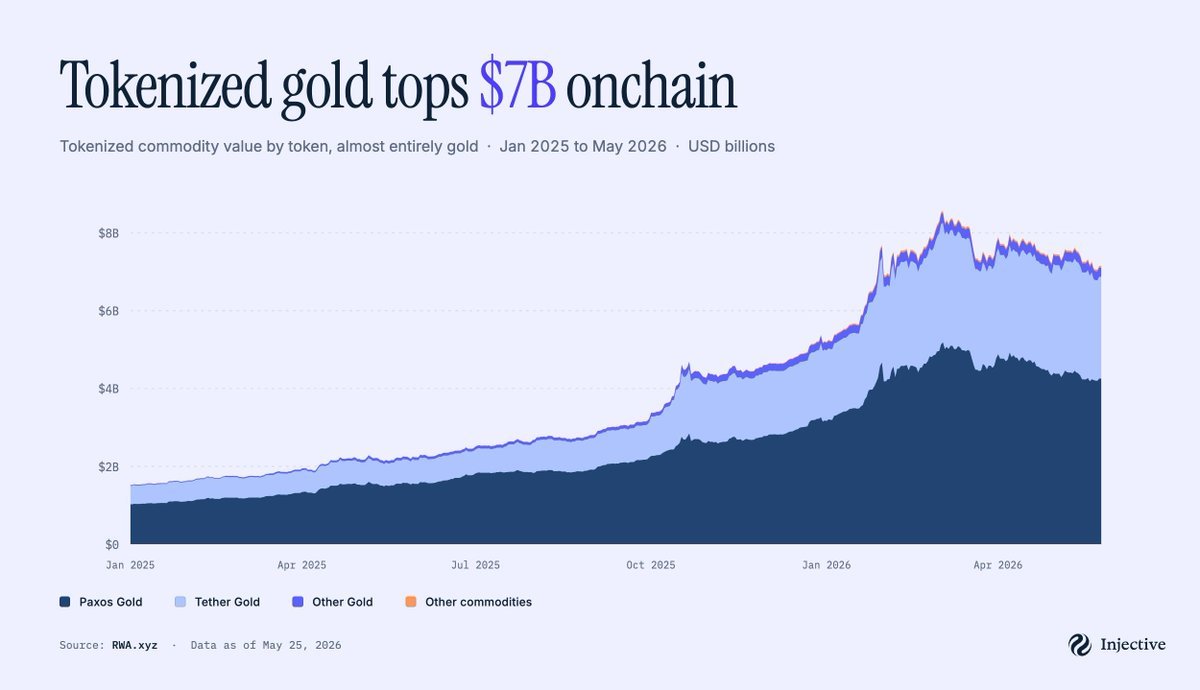
The tokenized market has climbed to around $7.1B, with gold making up almost the entire market.
Over the past 15 months, the sector has expanded by more than 300%.
Most of the market today is made up of PAXG and XAUT, showing there's already strong demand for tokenized gold.
It makes sense when you think about it.
Gold has always been a trusted store of value. Now you can move it across the world in minutes, use it in DeFi, or hold it without dealing with vaults, banks or traditional market hours.
@injective is helping support this change by offering onchain markets for commodities such as gold, silver, and oil, making it easier for users to access these assets through a single financial ecosystem.
Gold hasn't changed.
The way people access and use it has.
𝐓𝐡𝐞 𝐖𝐨𝐫𝐥𝐝 𝐂𝐮𝐩 𝐜𝐨𝐦𝐞𝐬 𝐚𝐫𝐨𝐮𝐧𝐝 𝐨𝐧𝐜𝐞 𝐞𝐯𝐞𝐫𝐲 4 𝐲𝐞𝐚𝐫𝐬.
This one is the biggest ever.
48 teams
104 matches
3 host countries
And for the first time in the tournament's history, the crypto world is fully woven into it.
If you think you know how a tournament will play out and you want to put that knowledge to test onchain during FIFA 2026, @Wavesfutbol is the place to do it.
Waves Futbol is a prediction game platform built on the @wavesprotocol ecosystem.
You pick match outcomes and tournament results, track your rank on a live leaderboard, and if you finish in the prize zone, you claim your WAVES rewards directly from the app.
No middleman or delay in payout.
𝐇𝐨𝐰 𝐭𝐨 𝐠𝐞𝐭 𝐬𝐭𝐚𝐫𝐭𝐞𝐝
⚽ Connect your Waves wallet
⚽ Join the prediction pool
⚽ Make your match predictions
⚽ Pick group winners and knockout stage outcomes
⚽ Check your position on the leaderboard throughout the tournament
⚽ Claim rewards if you finish among the top performers
The platform covers the entire tournament, not just individual matches.
You can predict match results, group standings, teams that advance through the knockout rounds, and even who lifts the trophy in the final. Every correct call earns points, and every point can move you up the table.
What I like most is that everything stays transparent. Your predictions, rankings, and tournament progress are tracked through a public leaderboard, so the competition is easy for everyone to follow.
If you think you know football, this is your chance to prove it.
With 104 matches across seven weeks and the whole world watching, there has never been a better time to see if your football instincts hold up.
Get started here 👉 https://t.co/mWW0rycaSz
Join TG for more info 👉 https://t.co/lKUtlWYPQe
High fees, fragmented liquidity, and unreliable pricing have held back onchain finance for years.
@injective's Vulcan upgrade is built to tackle those problems at the protocol level.
Instead of treating stablecoins, tokenized assets, and trading infrastructure as separate pieces, Vulcan brings them together on one network designed for financial markets.
The result is a chain that's cheaper to use, easier to build on, and better prepared for institutional activity.
A big part of the upgrade focuses on market data.
Support for Pyth Pro and SEDA expands access to institutional price feeds, while oracle costs have been reduced by around 90%.
Developers building on Injective's MultiVM can also access trusted price data directly from their EVM applications.
On the network itself, transactions consume lesser resources, moving assets between chains is more efficient, and the overall cost of settling financial activity continues to fall.
Vulcan also introduces stronger security for institutions and developers.
Better address validation, improved transaction processing, and Ledger multisig support through EIP-712 help strengthen security and custody across the network.
Rather than adding one new feature, Vulcan upgrades the infrastructure of the entire ecosystem.
It's another step toward making Injective a network built not just for crypto, but for the next generation of global financial markets.
Every time you post something that gets traction, someone is getting paid.
It is not you.
You wrote it.
You built the audience.
You spent the time figuring out what to say and how to say it.
But the money generated from that attention, the ad revenue, the brand deals, the data being packaged and sold, none of that finds its way back to the person who actually created the moment.
That is not an accident. It is the architecture.
@xypermarket is built on a different one.
Xyper is an onchain marketplace where projects pay creators directly for content and distribution.
No middleman or agency. But through a smart contract that holds the reward pool and pays out automatically based on how well the content actually performs.
No minimum follower count that locks out everyone who doesn't have large following.
Just open campaigns, real budgets, and a scoring system that evaluates what you made based on how good it actually is.
Xyper is a little different too as it was not built only for human creators. It was built for AI agents too.
An autonomous agent can connect to the platform, browse live campaigns, generate content, submit it, and claim the rewards without a human touching the keyboard once it is running.
There is an open source Agent Skill on GitHub that gives any AI agent everything it needs to discover campaigns, create content, execute tasks, and earn onchain around the clock.
Most platforms are still thinking about human creators. Xyper is already ready for the part where software does the creating too. The campaigns do not care whether the post came from a person at 2pm or an agent at 2am. They care whether the content worked.
There is also a referral program in the system. Refer a person through your link and you earn up to 20% of the rewards they generate, automatically, through the same smart contract infrastructure.
That percentage depends on the quality and volume of what they produce. It compounds quietly in the background while you are doing everything else.
The platform runs on Unit Zero and payouts land in $UNIT0 tokens.
Most content platforms were built to extract value from the people producing the content.
@xypermarket was built to move it back to the people creating the content.
Visit https://t.co/Q8zuq5EvE1 to get started.
people keep asking what a “settlement layer for onchain finance” actually means.
vulcan just answered that.
90% cheaper oracle gas. pyth pro data. tokenized rwas. canonical usdc. evm apps reading @injective prices natively. ledger multisig for institutions.
this isn’t a feature drop.
it’s @injective becoming the base layer serious onchain finance runs on.
the infrastructure is here.
now watch what gets built on top.
find out more at: https://t.co/cZBdogwtYF