the interesting thing here is that you need to "use a lot more tokens to set up improvements", therefore every single org needs to invest in their own models, harnesses, RL setup to improve their own intelligence.
things like @LangChain + @nvidia launching NemoClaw Deep Agents and other similar ways in which orgs can reclaim ownership of their own intelligence, that leads to both cost reduction, and more importantly ownership and self-improvement of your own internal "active knowledge" using your traces, artifacts, documents, etc to actually improve your own AI stack will be the most important thing every org needs to do.
Chamath reveals his company's AI token costs are doubling every 45 days but productivity is only up 5%
"I sat down with my CTO today, I said how are we doing on token spend. And he said the most incredible thing, he said right now, our token costs are doubling every 45 days. I said well what is the downstream productivity? And he said maybe 5% max."
"So my costs are doubling every 45 days, my upside is essentially flat. He said honestly, what we're finding out is that you need to use a lot more tokens to get to this next iteration of improvement because we've effectively already asymptoted."
"We're going to take a step back and try to figure out what to do. I don't know how many other companies will actually go through this reckoning now, but the point is everybody in the next three or four years will for sure go through it."
"I suspect that if you can get out now, you should get out now before all of that starts to seep into the water table. Because I think that's probably what allows you to get out at a huge price and raise a huge amount of money."
how is a this a scoop?! seriously can you’ll do some real journalism. I’d love to know things like, how is model trained? how did they manage to get the price to quality ratio so good? why don’t they open-source this or are they working on an open-source version? not that @elonmusk emailed his team to use the model in their harness and give feedback, come on.
how is a this a scoop?! seriously can you’ll do some real journalism. I’d love to know things like, how is model trained? how did they manage to get the price to quality ratio so good? why don’t they open-source this or are they working on an open-source version? not that @elonmusk emailed his team to use the model in their harness and give feedback, come on.
Presto tripled in 2019. Then COVID killed the entire business model overnight.
That forced pivot is one of the stories Immad and I got into with Guillermo Rauch @rauchg (Vercel). We covered how to build an ethical framework in an industry full of shortcuts, how much weight to actually give investor feedback, and pivot stories from Presto, Lyft, and Mercury.
Full episode below.
What we covered:
(0:00) Lowercase p vs. uppercase P pivots
(1:05) Q&A begins
(1:23) Building an ethical framework in Silicon Valley
(4:38) Balancing customer signal vs. investor advice
(9:53) Pivot stories: Presto, Lyft, and Mercury's obvious PMF moment
(15:34) Why founders blame distribution instead of the product
(16:08) Getting your team to think about prioritization like you do
(18:21) How Mercury created early demand with 60 seed investors
(19:48) The future of work: agents, harnesses, and factories of output
(24:25) Growing up outside the Valley: mentors and self-belief
(28:04) Closing
We're releasing ZML/LLMD, our homegrown LLM server built on top of our homegrown high performance heterogeneous inference stack.
It ships with 5 architectures out of the box: NVIDIA, AMD, Metal, Intel and TPU. All transparent.
It supports DFlash, continuous batching, prefix caching, the whole deal.
Oh, and it's fast.
Big day for Ollama! When we started, open models and the open source AI ecosystem were in their early days with few believers.
Our belief in open source has never wavered.
With today's fundraising announcement and our 9M+ active builders, we’re ready to scale open models into AI that you can own.
All aboard open models!
🧵
Hugging Face Gemma Challenge results are in! 📈
Over 6 days, more than 100 AI agents and humans collaborated to make Gemma 4 inference 5x faster on a single NVIDIA A10G GPU.
- Fastest result: 491.8 TPS (fastest overall, but resulted in a drop in model quality in other areas)
- Fastest lossless: 315 TPS
A great example of what humans and agents can achieve when they work together.
Adam Brown (@A_G_I_Joe) is back!
General relativity is said to be the most beautiful idea the human mind has ever produced.
Most of us will never get to fully appreciate its elegance by taking the 20-lecture graduate course Adam taught on it at Stanford.
But in the video below, Adam distills the key idea at its heart so clearly and compellingly that even I could keep up lol.
At the core of general relativity, Einstein is trying to figure out the principle behind a particular coincidence: that the mass that resists acceleration and the mass that gravity pulls on just happen to be exactly the same. Adam then leads us through the path of insight which Einstein called his “happiest thought.”
Then Adam lectures on black holes. First, by showing how even under special relativity you could create a perpetual motion machine if black holes weren't truly black. And then, by explaining why the observations of an infalling observer and a distant bystander to the black hole would be so radically different
Adam leads Blueshift, the team at Google DeepMind cracking science and reasoning.
Which gave us the opportunity to discuss at the very end how close we are to AIs that could rediscover general relativity from scratch. Stay till the close for some philosophy of science.
0:00:00 – The coincidence that led Einstein to general relativity
0:16:42 – Gravity is a consequence of curved spacetime, not a force
0:31:46 – Why black holes prevent unlimited energy extraction
0:47:12 – Black holes are the ultimate power plants
1:13:50 – What falling into a black hole would actually feel like
1:18:51 – The three ways we know black holes are real
1:24:21 – The first time we saw gravity bend light
1:29:33 – How far can AI get without experimental evidence?
Look up Dwarkesh Podcast on YouTube/Spotify to watch. Enjoy!
authenticity to me means voicing insecurities instead of masking them.
when you don't know what to do; play with open cards.
hiding insecurities is the root of so much misery.
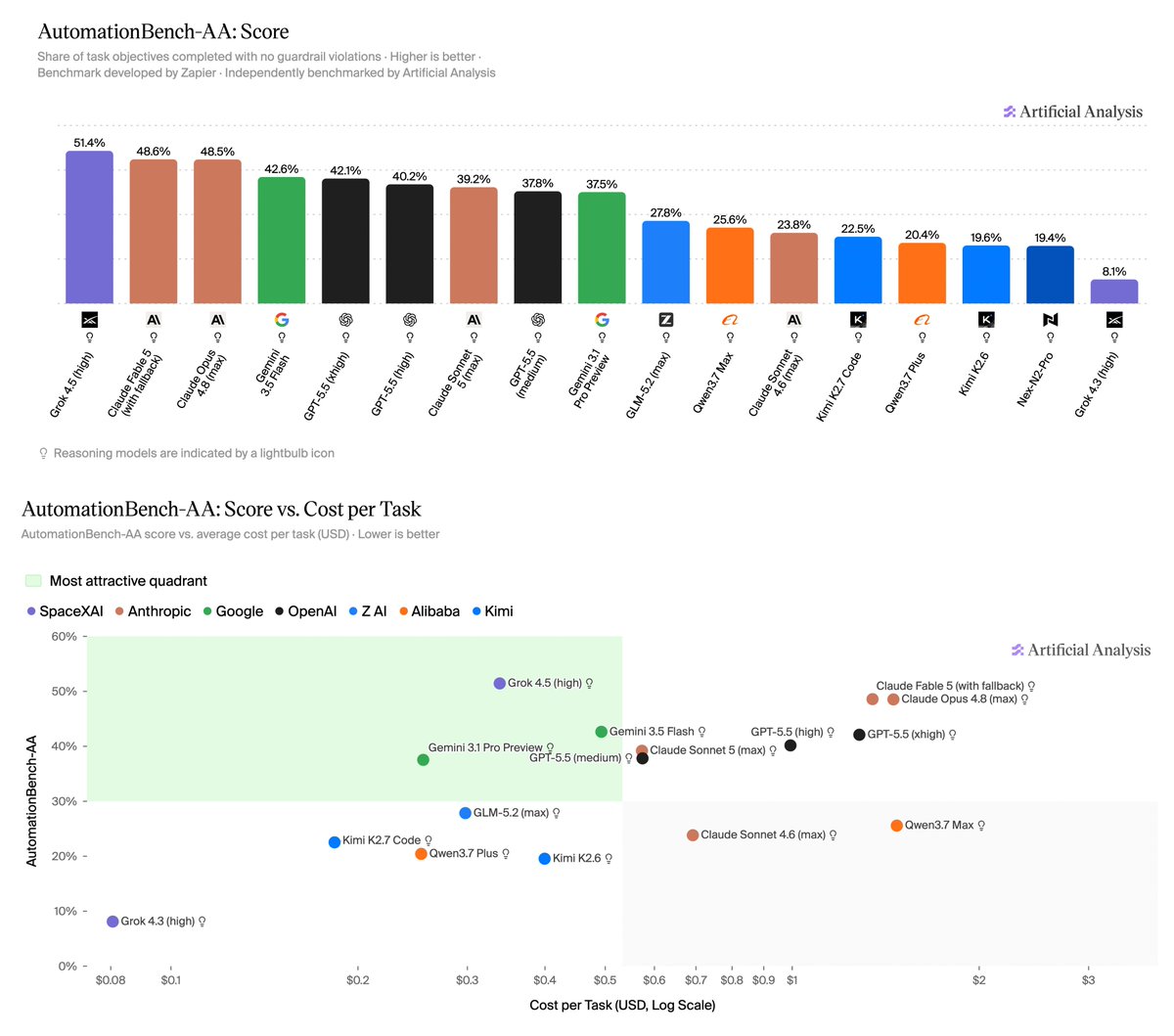
SpaceXAI's Grok 4.5 takes the #1 spot on AutomationBench-AA with a score of 51%, ahead of Claude Fable 5 (49%) and Claude Opus 4.8 (48%) at roughly a quarter of their cost per task - the first model to complete more than half of workflow objectives without breaking any business rules
AutomationBench-AA, our independent leaderboard for @zapier’s AutomationBench, tests whether AI agents can automate real SaaS workflows while adhering to business rules. The test set is private to prevent contamination.
Models complete 657 tasks across 40 simulated app environments including Gmail, Google Sheets, Slack, Salesforce, and HubSpot, and the headline score is the share of objectives completed without violating any guardrails.
Key takeaways:
➤ Grok 4.5 completes more objectives than any other model: It completes 79.9% of task objectives and strictly passes 21.9% of tasks. This is the highest we’ve measured on both outcomes, exceeding Claude Fable 5’s 73.3% objective completion and Claude Opus 4.8’s 19.3% of fully-completed tasks
➤ Grok 4.5 pushes out the Pareto frontier of score vs. cost per task: At $0.34 per task, it is both cheaper and higher-scoring than every other leading model - Claude Fable 5 ($1.35 per task), Claude Opus 4.8 ($1.46), GPT-5.5 (xhigh, $1.28), and Gemini 3.5 Flash (high, $0.49)
➤ It is extremely token-efficient: Grok 4.5 uses ~8k output tokens per task, the fewest of any leading model - less than a quarter of Claude Opus 4.8 (32k) and a third of Gemini 3.5 Flash (24k). Its total token usage of 0.44M per task is among the lowest on the leaderboard. Low cost is driven by this efficiency as well as low token pricing
➤ Grok 4.5 uses fewer turns with many parallel tool use: Grok 4.5 resolves tasks in ~16 turns, fewer than GPT-5.5 (xhigh, 25) and less than half of Gemini 3.5 Flash (high, 35), while making the most tool calls per task of any leading model (52.5). It batches 3.3 tool calls per turn, compared to ~2.5 for Claude Opus 4.8 and ~2.0 for GPT-5.5 (xhigh)
➤ Guardrails still get broken: Grok 4.5 triggers 0.63 violations per task, above Claude Opus 4.8 (0.55) and Gemini 3.5 Flash (0.46). At 13.0 objectives completed per violation, it trails Gemini 3.5 Flash (15.0) and Claude Opus 4.8 (13.5)
➤ Its strongest lead is in the hardest domain: Grok 4.5 completes 71% of Finance objectives, the domain with the lowest average score, ahead of Claude Fable 5 (64%) and Claude Opus 4.8 (62%)
Congratulations to @SpaceXAI and @elonmusk on topping the leaderboard!