For real.
I know so many people have fallen down the Bangtan rabbit hole over the last few comebacks, and even during the solo eras, when the guys were basically tag teaming us from the military 😂, and there is SO MUCH of their content available out there in full.
You just have to ask around.
I have my own repository, actually. I don't advertise it very often because I don't particularly want BigHit knocking on my door, and I sure as fuck don't have the physical or mental capacity to spend my days playing cat and mouse with their legal team. 😂
But the content is out there.
And please, for the love of God, watch it in full.
Bangtan's content isn't 30 second snippets. It isn't a compilation of someone's favourite moments. It isn't a TikTok edit. It isn't a fucking shipper's narrative.
These guys have given us hours upon hours upon HOURS of content. Episodes, seasons, documentaries, interviews, lives, behind the scenes footage, logs, Bon Voyage, In the SOOP, concerts, Festa content, the whole fucking lot.
If you're only consuming the snippets, you're only getting part of the sentence.
And sometimes you're not even getting their sentence. You're getting someone else's carefully curated interpretation of it.
Go watch the original.
Let Bangtan tell you their own story.
And honestly, I will never understand someone saying they want to call themselves ARMY while simultaneously saying, “I don't have time to watch the full content.”
I'm sorry, but… that's casual fan behaviour.
Because ARMY invests the time.
Not just emotionally. Time.
You don't get to know seven people, seven very different people, through 30 second clips. You get to know them by watching them over years. You watch the way they speak. The things they care about. The way they interact with each other. The way they respond to ARMY. The things they consistently say.
And most importantly, you watch the consistency.
Because yes, obviously, we don't know these men privately. We don't know what they're like when the cameras are off and they're sitting at home scratching their ass. 😂
We're not supposed to.
But people are remarkably consistent when they're being genuine.
Their messaging doesn't suddenly change depending on which camera is pointed at them. The way they treat each other doesn't suddenly change. The way they talk about their brothers doesn't change. The way they talk about and defend ARMY doesn't change.
And I'm not talking about some fucking “OMG they called ARMY cute once” shit.
I'm talking about years and years and years of the same fundamental behaviour.
They've pushed back when people have talked shit about ARMY. They've defended each other. They've corrected narratives about themselves. They've repeatedly told us what matters to them, what they believe, what they struggle with and what they want for themselves.
That's consistency.
And consistency is how trust is built.
I didn't wake up one morning and decide I trusted Bangtan because I liked a few songs.
I invested the time to get to know them.
I watched the content. I listened to what they actually said. I watched them grow up. I watched their relationships with each other evolve. I watched their words line up with their actions over and over again.
And somewhere along the way, I realised: Oh. I feel safe here.
Not because I think they're perfect. Not because I think I know them personally. And certainly not because I agree with everything they do.
But because I've seen enough of them, over enough years, to recognise the consistency.
That's why I trust them.
And that's why I will always tell new ARMY: don't let somebody else's 30 second clip tell you who Bangtan are.
Go watch the whole fucking story.
Let them introduce themselves to you. 💜
My Letter to the Korean Music Critic Who Downplayed BTS's AMA Triumph
Two days ago, when I wrote my post about BTS's victory at the American Music Awards, I had no idea that a Korean music critic, someone prominent enough to serve on the selection committee for the Korean Music Awards (KMA), had publicly disparaged BTS's Artist of the Year win.
He argued that the AMA is no longer one of the three major music awards ceremonies in the United States. And that it has lost much of its prestige and influence. He also claimed that because the winners are determined by fan voting, the AMA should not be taken seriously.
He even suggested that BTS was the only major artist who attended the ceremony while other big names stayed away. The critic's view: because they don't give a hoot about the AMA.
He never explicitly said that BTS's victory meant nothing. But by dismissing the AMA itself so thoroughly, the implication was difficult to miss.
This was not the first time I had encountered this sort of reaction. Back in the late 2010s, when some Korean journalists and online writers downplayed BTS's achievements, I often reached out to them through email or social media messages to offer a different perspective. In one case, we ended up exchanging many thoughtful replies back and forth, and over time, I felt that some of his views on BTS began to change.
As many of you know, even when I strongly disagree with someone, I try to remain polite, reasonable, and emotionally grounded. That was the approach I took then, and it was the approach I took again this time.
After obtaining the critic's email address, I wrote to him and respectfully explained why I disagreed with his assessment.
I want to share that letter with you because some of the points I raised may be of interest, particularly the history and original purpose of the American Music Awards, which many younger fans outside the United States may not be familiar with.
I wrote to him in Korean, and below is my own translation of the letter:
Dear Mr. Jung Min-jae,
Hello. I am an educator living and working in Seoul. I am well aware that you have received your share of criticism from ARMYs. However, I am writing not out of hostility, but out of a genuine desire to have an open and constructive conversation.
I would simply like to offer a different perspective on some of the points you raised regarding the American Music Awards.
First, you argued that the AMA is no longer one of America's three major music awards shows and that it has lost much of its former prestige and influence. As someone who spent his youth and college years in the United States, I see things differently. For people like me, the AMA and the Grammys were, and still are, the two pillars of American music awards. The Billboard Music Awards did not enter the public consciousness in a major way until much later.
At least before the 2010s, the Grammys carried a reputation for being overly conservative and establishment-minded. To be frank, many people considered it somewhat dull. The AMA, by contrast, was always the fun one. It was energetic, accessible, and unapologetically fan-oriented. Personally, I have rarely watched the Grammys except in years when BTS received nominations. Yet from my youth until I moved back to Korea, I watched the AMA every single year without fail.
When Dick Clark created the AMA in the early 1970s, he did so as an alternative to the Grammys. The Grammys still operate through a system in which nominees are selected by committees and winners are chosen by voting members. Many of those committee members and voters are older industry insiders, and historically they have been disproportionately white and male. That has long been the nature of the institution. The AMA, on the other hand, was built from the beginning around the idea that music fans and the general public should have a meaningful voice.
In fact, I spoke with my friends in the United States about this issue yesterday. Every one of them still considers the AMA and the Grammys to be the two most iconic music awards shows in America.
For those reasons, I hope you will not take the opinions of some Americans who dismiss the AMA because BTS, a foreign group, won the award (you even reposted one such tweet) as evidence that the AMA has somehow become irrelevant.
You also argued that because AMA winners are ultimately determined through fan voting, the awards should not be taken too seriously. I would respectfully disagree.
The AMA nomination process is not a simple popularity contest. Nominees are selected based on a wide range of objective metrics, including album sales, radio airplay, streaming figures, and other measurable indicators of public engagement. Fans then vote among those nominees to determine the winners.
Music, perhaps more than any other art form, is powered by fans. Fans buy albums. They call radio stations to request songs. They organize streaming parties. They purchase concert tickets and fill arenas. Given that reality, it seems entirely reasonable for a music awards show to reflect the voices of the people who sustain the industry.
The same principle applies even in classical music. No matter how extraordinary a musician may be, their work ultimately depends on audiences. The reason pianist Yunchan Lim sells out concert halls around the world is because he has earned the admiration of countless music lovers. After becoming the youngest winner in the history of the Van Cliburn International Piano Competition at just eighteen years old, he captivated audiences globally and built a devoted following.
For that reason, I believe the AMA is one of the awards shows most closely aligned with how popular music actually functions today. In many ways, the Grammys represent an older model. The AMA does not. That is why I do not believe its influence will fade anytime soon.
Finally, you pointed out that BTS attended the ceremony while many other major artists did not. But the same has always been true of the Grammys. Every year, numerous high-profile artists skip the event, even when invited. That is hardly unusual.
More importantly, who is the most popular and influential music act in the world right now?
In my view, the answer is BTS.
And BTS showed up.
It is comparable to the Beatles attending an awards show in the 1960s or Michael Jackson attending one in the 1980s. The presence of the Beatles alone was enough to give an event significance and prestige. The same logic applies here. The fact that BTS chose to attend demonstrates that the AMA remains a meaningful and influential platform.
As a music critic, I am sure you understand better than most what it means for an artist from a non-English-speaking country to win an American music award of this magnitude.
You know how extraordinarily difficult it is.
You know the barriers that must be overcome.
And you understand what such an achievement symbolizes, not only for the artist but also for the broader cultural landscape.
That is why I cannot help but wish that more attention had been given to that larger cultural significance and value, instead of focusing on whether the AMA has lost prestige or influence.
Thank you for taking the time to read my thoughts. If the opportunity ever arises, I would be more than happy to hear your perspective and any rebuttal you may have. My feeling is that you and I probably have far more in common than we do in disagreement. Above all, we both care deeply about music.
I wish you good health and all the best.
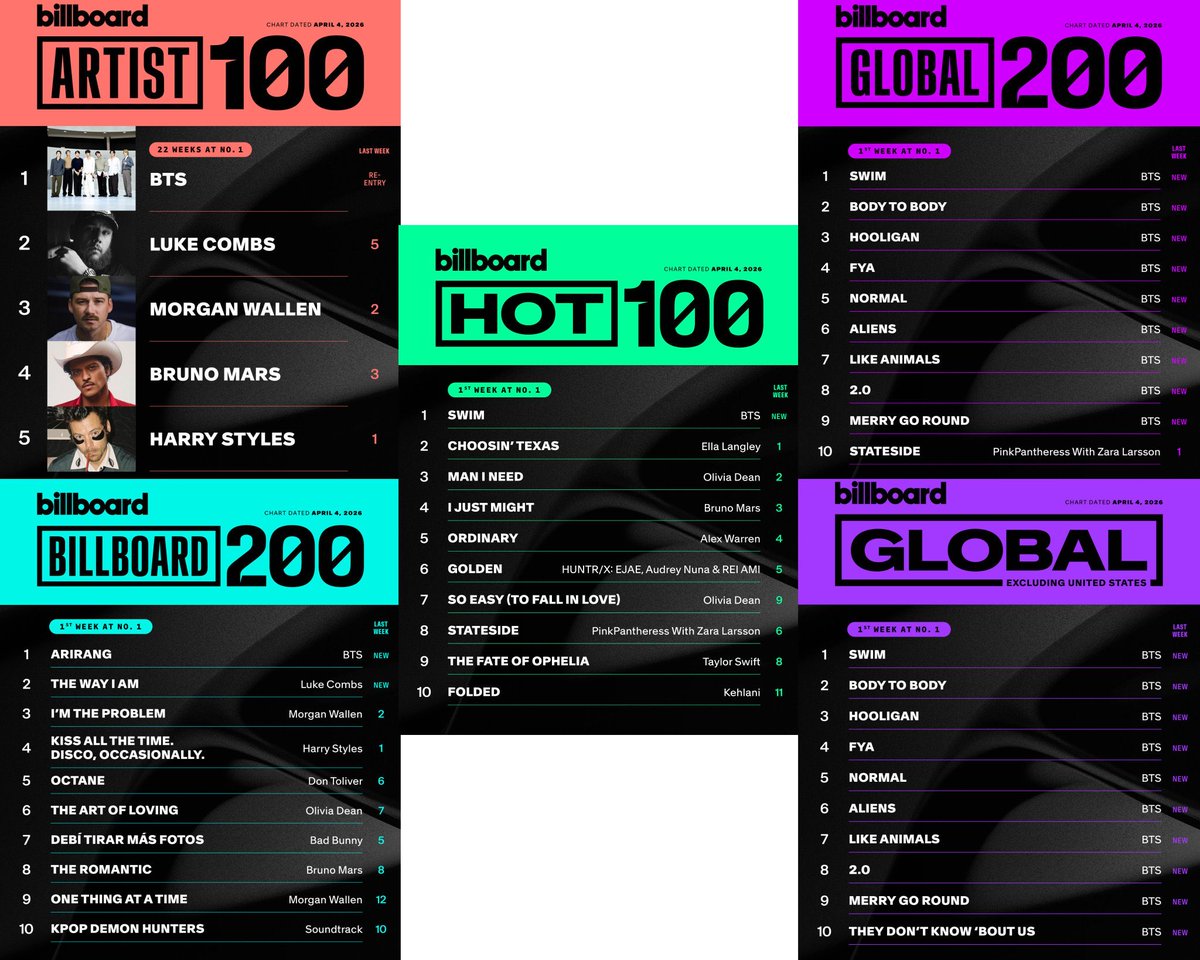
BTS’ “ARIRANG” surpasses Taylor Swift’s “The Life of a Showgirl” to become the ONLY album in history to chart all of its tracks on the Billboard Global 200 for 7 consecutive weeks.
There seems to be a surge of backlash toward BTS lately from people clearly rattled by how massive and successful their concert tour has been so far. The usual insults are back again. Questions about their masculinity. Mockery of ARMY. The same tired assumptions.
It reminded me of something that happened a few years ago. One of my male students, after finding out I was a huge ARMY, asked me if I was gay.
Now, in Korea, the relationship between teacher and student is traditionally built on a fairly rigid hierarchy. Students usually do not speak casually to teachers, challenge them, or ask personal questions. But I have always been a different kind of teacher. I treat my students warmly and as equals, and tell them to ask me anything. They do not even call me seonsaengnim. They call me saam, a more casual and affectionate way of addressing a teacher.
So when he asked me that question, I did not see it as hostility. He was curious, not malicious.
I told him that I support gay rights and equal marriage, but loving BTS does not make me gay. I told him that I love BTS because of their extraordinary writing, rapping, singing, and dancing talents. That I love the sincerity and meaning in their lyrics, and the way they consistently treat people with kindness, warmth, and positivity.
And of course, because I am me, the poor student then had to sit through a very long lecture from me about masculinity and how narrow definitions of it can limit people.
To this day, I still find it strange that some people think appreciating artistry, emotional honesty, beauty, or kindness somehow threatens masculinity. If anything, BTS helped expand the idea of what masculinity can look like for millions of people around the world.
And then there is the mockery of ARMY itself. Some people keep repeating this stereotype that ARMYs are lonely women with no lives who pour all their money into BTS. The assumption is not only lazy, but honestly disconnected from reality.
First, there are many male ARMYs, like me. On Korea’s music streaming platform Melon, around 35% of BTS listeners are male. I even checked the listener statistics for “Swim” today (May 12, 2026), and men made up 37% of the listeners.
Futhermore, the ARMYs I have met are some of the most socially active, accomplished, and creative people I know. They have vibrant family lives, meaningful careers, and talents of their own in writing, art, music, design, education, and countless other fields. One ARMY friend from America who visits Korea often holds a major executive position while also involved with multiple organizations.
No, people do not love BTS because they are lonely. We love BTS because they represent the kind of humanity we want to see more of in the world. Empathy. Hard work. Vulnerability. Kindness. Emotional honesty. Growth.
Being ARMY has enormously enriched my life. Without BTS and ARMY, how would I have ended up with close online and offline friends across the United States, Americas, Africa, Europe, Oceania, and Asia? The fandom opened doors to human connections I otherwise never would have experienced.
And it is funny to watch some men mock women for passionately following BTS when those same people spend enormous amounts of time, money, and emotional energy on football in America or soccer in Europe. Nobody calls them lonely for flying across countries to watch matches, memorizing statistics, wearing jerseys, or centering weekends around sports. Human beings naturally gather around the things they love. Music is no different. BTS is no different.
As for Jimin’s hair, which is somehow also causing backlash, I love it. It immediately reminded me of Brad Pitt’s hair in Troy, where he played Achilles. Achilles was supposed to be a Mediterranean Greek warrior, yet nobody complained that Pitt had flowing Swedish blonde hair down to his shoulders. People accepted it because he looked charismatic and amazing on screen.
That is exactly how Jimin looks with his long blonde hair. I hope he keeps it throughout the entire concert tour.
Presenting Rolling Stone's biggest cover ever: @bts_bighit for May 2026 💜
How did the world’s biggest band reclaim their crown? By overcoming doubt & returning to their roots on an adventurous album. #방탄소년단 #BTS
Cover story: https://t.co/bc0v3QCNYF
Video interview:
https://t.co/Mf1kyq2bgD
To our i-lovelies: we send our deepest gratitude and respect for your hard work and support. BTS and K-diamonds know everything you do. We're so happy to be in this together. THANK YOU 😭😭😭
#BTS1onHot100#SWIMNumber1Hit#외랑둥이수고는우리가알아#반랑둥이수고도우리가알아
BTS becomes the first artist in history to simultaneously occupy the entire top 10 on the Billboard Global Excl. U.S. singles chart.
They hold the entire top 13.
Hi,I’m here because of BTS. Heard like animal by BTS and ever since I have been hooked I had to listen to the full album and then I watch swim mv and fell in love with one of the rapper (I don’t know his name yet) and boom now I’m here on twitter I have to know everything 😭😭
I think we can all say that we don’t need to understand Portuguese to get emotional witnessing a Korean father living in Brazil cry as soon as he recognized the most beloved song of Korea🥺😭
🔗 https://t.co/8s6IVmasSA