Q: More chains will start claiming post-quantum signatures. What's the one question that separates them?
A: One word. Where.
Q: Where what?
A: Where the post-quantum signature actually gets verified. There are only three places it can happen, and they are not equal.
Off-chain, by a wallet or a custody server, which then submits an ordinary classical transaction. The chain never sees the post-quantum signature at all. You're trusting whoever runs that software.
In a smart contract, via account abstraction. The chain executes it, but as bytecode: expensive, gas-heavy, and without any guarantee it runs in constant time. It's an application feature, not a property of the chain.
In the protocol itself, as a native operation every node runs as part of consensus. That's the only one where "post-quantum" describes the chain rather than something sitting on top of it.
Q: And NaoX?
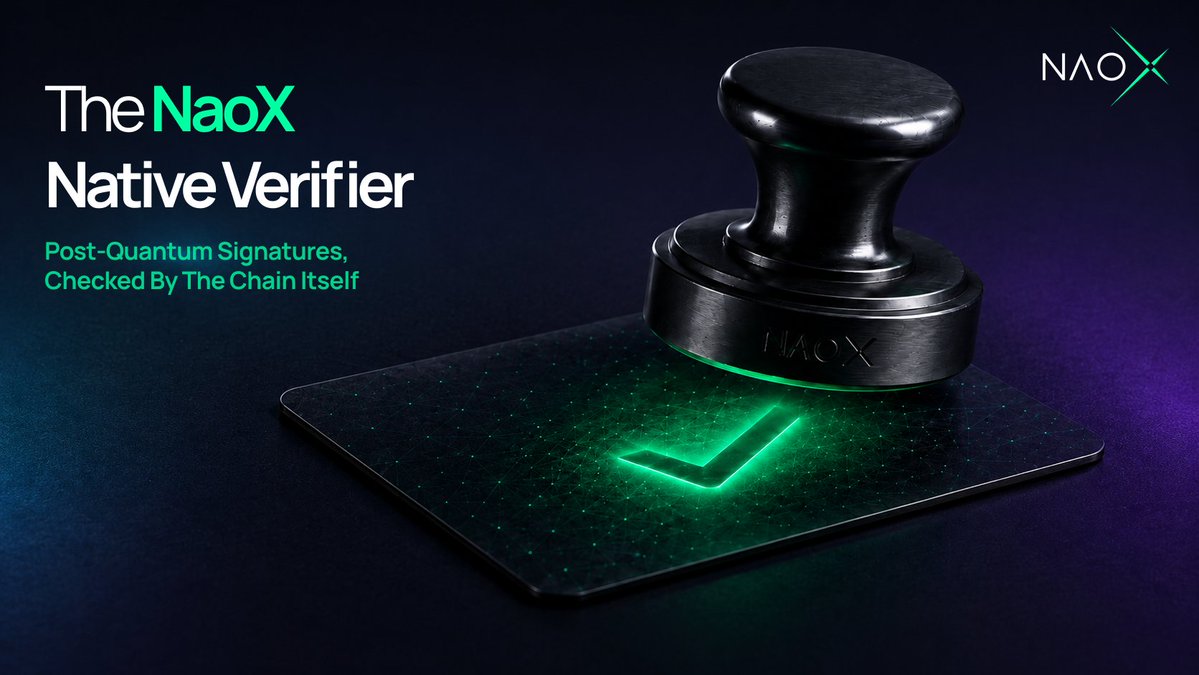
A: The third one. Post-quantum verification is built into the protocol, the same way Ethereum verifies classical signatures with ecrecover. Every node runs the same check on the same ML-DSA-87 signature and reaches the same answer, and that answer is part of consensus.
Q: Numbers?
A: About 38.5 microseconds per verification. Roughly 26,000 per second on a single CPU core. Native, constant-time code, so timing leaks nothing. Callable by any contract on the chain.
Q: Why does it matter?
A: The verdict on a post-quantum signature comes from the chain, not from an intermediary whose software you can't audit.
And because any contract can call the verifier, post-quantum authorisation becomes a building block. Vaults, registries, bridges, all without an oracle or a trusted server.
If the chain doesn't verify it, the chain doesn't know it happened.
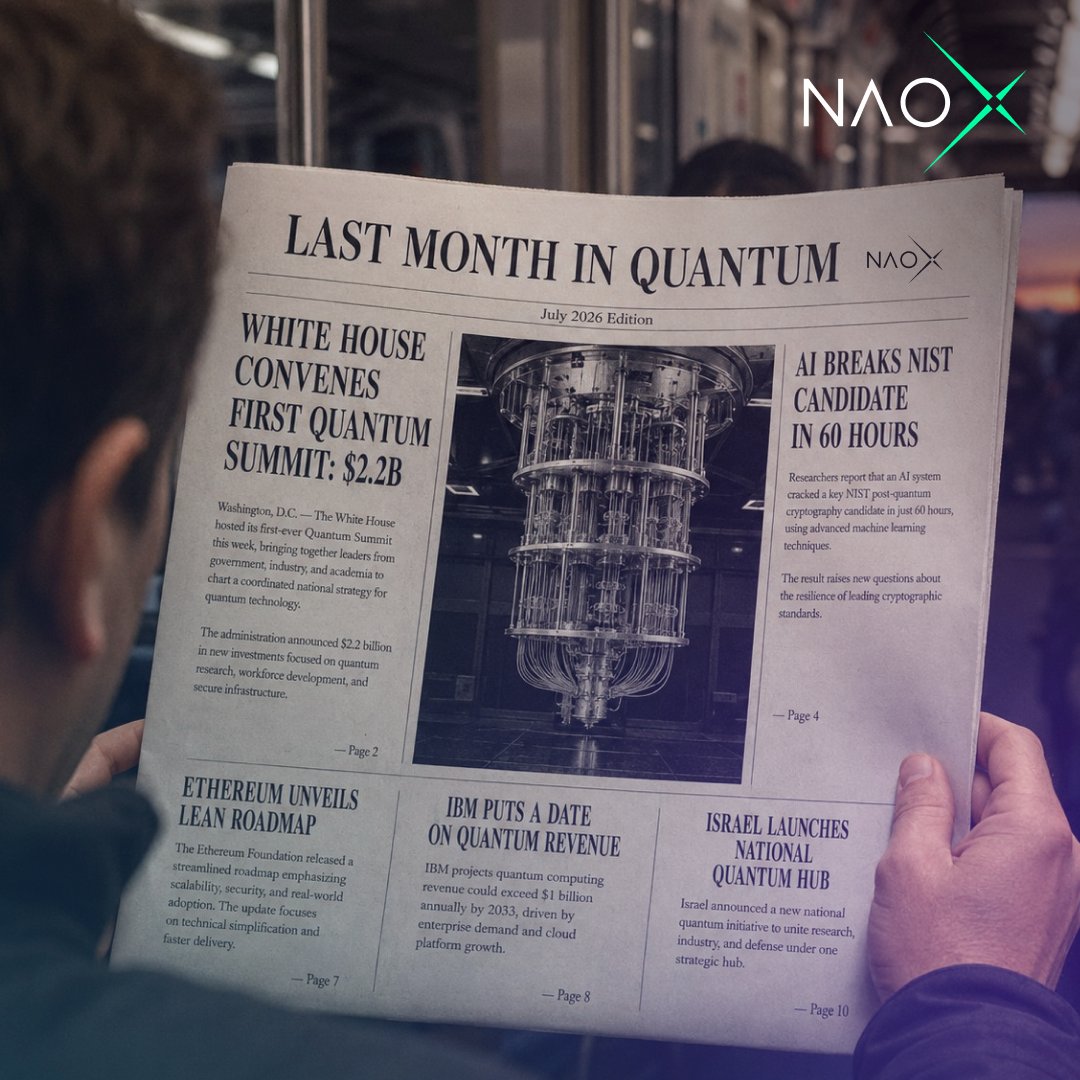
Last Month in Quantum 🗓️
As we enter a new month, let's recap all the moving quantum parts that went down in July:
🏛️ @WhiteHouse held its first quantum industry summit: over $2.2B in support, industry aligned on fault-tolerant computing by 2028.
🇮🇱 Israel launched a national quantum computing infrastructure program, NIS 100M to build a country-level R&D hub.
🇪🇺 The EU's Cloud and AI Development Act arrived, with building up Europe's quantum sector written into it.
⟠ @VitalikButerin unveiled Lean @ethereum: the biggest overhaul since the Merge, ~7 forks over 3 to 4 years, quantum resistance at the core. His own odds on a cryptographically relevant quantum computer before 2030: one in five.
🤖 @AnthropicAI's Claude Mythos broke HAWK, a NIST post-quantum candidate, in ~60 hours. Withdrawn. ML-DSA and ML-KEM: untouched.
💰 @IBM's CEO put dates on quantum revenue: 2028 or 2029, "a trillion dollars of value" by the late 2030s, a $2B chip foundry behind it.
🌐 @Cloudflare: over two-thirds of browser traffic to its network is already post-quantum encrypted, full post-quantum security targeted for 2029. NIST's own message the same week: the migration takes a decade, start now.
⚛️ The science moved too:
→ @QuantinuumQC and the University of Chicago entangled 54 qubits via non-Abelian anyons, published in Nature
→ @PsiQuantum signed a $125M agreement with DARPA to advance utility-scale quantum computing
→ According to Quantum Zeitgeist, new qLDPC error-correction codes from USTC and Origin Quantum cut physical qubits per logical qubit by ~8x
The whole world is setting the stage for the post-quantum future. Bullish.
And the signature at the centre of it, ML-DSA, is the standard NaoX transactions can be signed with, at the strongest level NIST defines.
Humanity's greatest engineering challenges:
🧑🚀 Going to the Moon: complete
⚛️ Splitting the atom: complete
🌁 Building the Golden Gate Bridge across a mile of open ocean: complete
💥 Building the Large Hadron Collider, a 27 km ring that smashes particles at near light speed: complete
🧬 Sequencing the human genome: complete
🛰️ Building a navigation system that covers the planet: complete
🌌 Detecting gravitational waves from a billion light years away: complete
🚀 Landing rockets that fly themselves home: complete
⏳ Quantum computers breaking classical encryption: loading...
That last one is not a feat to celebrate. It's a deadline.
We must understand that becoming quantum safe is not an ordinary task.
It is one of the greatest security migrations the digital world has ever faced. And the major players are all racing to understand how to play it.
@NaoXprotocol is already there. A post-quantum chain built quantum safe from the beginning:
→ Transactions can be signed with ML-DSA-87: NIST-standardized, FIPS 204, security Level 5, verified natively by the chain in ~38.5 microseconds
→ Keys enrol over ML-KEM-768, and validator entry has required post-quantum keys since the first block
→ Hybrid transactions carry classical and post-quantum signatures together: no flag day, no migration event, ever
Industry post-quantum migration: ▰▱▱▱▱▱▱▱▱▱ 5%
NaoX, post-quantum native: ▰▰▰▰▰▰▰▰▰▰ 100%
gNaoX!
The recent @AnthropicAI news is huge for NaoX. Here's why 👇
Claude Mythos, Anthropic's model, just broke HAWK, a NIST post-quantum signature candidate, in 60 hours. Two years of human review missed the flaw. Days later, HAWK's authors withdrew it.
The signature it could not touch? ML-DSA-87. The signature our quantum-resistant Layer 1 is built around.
What it is:
The Module-Lattice Digital Signature Algorithm, NIST's FIPS 204, standardized after a six-year, 82-candidate competition. NaoX runs the strongest parameter set: security Level 5, the highest NIST defines.
How it works:
ECDSA rests on elliptic curves, which Shor's algorithm breaks on a large quantum computer. ML-DSA rests on lattice problems: mathematics with no known quantum shortcut after decades of attack.
How NaoX runs it:
→ Verified natively by the L1 itself: ~38.5 microseconds per signature, ~26,000 per second per core, every node computing the same answer
→ Implemented through liboqs, the audited open-source library the industry trusts. The standard, not a homebrew variant
→ 4,627 bytes vs ECDSA's 64. The graphic shows the full field. Those bytes are the security margin, and the chain was engineered to carry them
HAWK fell in sixty hours. ML-DSA-87 came through untouched, with Anthropic's confirmation that the finalized standards stand. That's the signature NaoX transactions can be signed with, at the strongest level NIST defines.
Five architecture decisions separate NaoX from almost every other Layer 1.
Here's each one, and why it matters 👇
1️⃣ Post-quantum transaction signing
Almost every chain authorises transactions with ECDSA, elliptic-curve signatures a large quantum computer running Shor's algorithm will eventually forge. On NaoX, transactions can be signed with ML-DSA-87 instead: the NIST standard, FIPS 204, security Level 5, built on lattice problems with no known quantum attack.
2️⃣ Verification inside the protocol
A signature is only as trustworthy as whoever checks it. On NaoX, the chain checks it: a native verifier built into the protocol itself, the post-quantum equivalent of Ethereum's ecrecover. One verify takes ~38.5 microseconds, and every node computes the same answer. No wallet or server ever holds the trust.
3️⃣ Hybrid transactions
A NaoX transaction can carry two signatures over the same payload: one classical, one post-quantum. Both must pass, so forging one still fails the other, and existing tooling sees a normal EVM transaction. Protection is added underneath, nothing breaks on top. And the path only moves forward: classical → hybrid → post-quantum only, no hard fork required.
4️⃣ Post-quantum validator entry
The validator registry accepts exactly one kind of key: 2,592 bytes, the exact size of an ML-DSA-87 public key. Classical keys aren't discouraged, they're structurally refused, and that check has been enforced in the chain's code since genesis.
5️⃣ Fully EVM compatible
Built on standard Ethereum client software. Same Solidity, same Hardhat, Foundry, ethers, MetaMask. Existing contracts deploy as-is, and inherit a quantum-resistant foundation the moment they do.
NaoX Growth Engines: Activated 🔋
Coming up on the roadmap:
→ More validators onboarding
→ Node software, so the community can run the network directly
→ Developer access opening next
Each stage announced as it's ready. The network opens up from here.
Inside NaoX: The Road Ahead 🎙 X Spaces RECAP ⏪
Thank you to everyone who joined us yesterday for our most in-depth Space to date!
The rebrand, the year quantum got real, the tech under the hood, how NaoX compares, the security mesh, and what's coming for builders and the community.
For those who missed it, let's recap 👇
The rebrand 🔄
- Naoris Protocol is now NaoX. Same chain, same technology, same team, same $NAORIS token.
- No migration, no swap, no action needed. Anyone DMing you otherwise is a scammer.
- The old name described where we came from. NaoX describes what the chain is built for: the post-quantum era.
The team 🤝
We welcomed @onchainantonio to the stage, our new Chief Architect Officer. He brings years of experience building in crypto, and he'll play a pivotal role in shaping the NaoX roadmap from here.
Quantum in 2026 ⚛️
The year the conversation stopped being theoretical and became a deadline:
→ January: the G7 adopted a roadmap to move the entire financial sector to post-quantum cryptography
→ Google, Microsoft and Cloudflare all committed to quantum-safe by 2029
→ Two US executive orders, signed the same day: a quantum computer by 2028, every federal system post-quantum by 2030-31
→ The US government moved from grants to equity: ~$2B across nine quantum companies
→ BlackRock, Fidelity, Coinbase and six others launched a Bitcoin Security Consortium with PQ migration as a priority
The whole world landed on the same narrow window: the end of this decade.
The Chain, decoded 🔗
We went deeper on the tech than ever before:
→ Transactions can be signed with ML-DSA-87, the NIST post-quantum standard (FIPS 204, Level 5), built on lattice maths no known quantum algorithm can break
→ Post-quantum verification brought on-chain, natively: the chain checks signatures itself, no wallet or server to trust
→ Hybrid transactions carry two signatures at once, classical and post-quantum, so nothing breaks and nobody migrates
→ Your post-quantum keys recover from a standard 12-word phrase, on any device, no custodian
→ And the honest line, said openly: finality still runs on classical cryptography today, because no mature post-quantum aggregation exists yet, for anyone. We name our edges on purpose.
How NaoX differs from Ethereum 🆚
Full respect first: Ethereum built the EVM the whole industry runs on, and their post-quantum roadmap is the most honest in the space. They say openly it runs years, with no completion date.
That's the difference. Migrating a live chain means coordinating thousands of validators, every wallet, every exchange and millions of users, without breaking anything mid-flight.
NaoX never has to run that migration. We started on the post-quantum side, with the same EVM developer experience on top.
Same rails. Different starting point. And the starting point is everything.
The Security Mesh 🏘️
The second layer most chains simply don't have: a trust and security mesh, a neighbourhood watch for machines.
The oldest flaw in computer security is that machines report on their own health, and a compromised machine lies. On the NaoX mesh, no machine vouches for itself:
→ Devices watch and attest to their neighbours
→ Attestations are cross-signed with the same post-quantum cryptography the chain uses
→ A finding only counts once independent peers corroborate it
→ Every record carries its own evidence: what was checked, what was found, who signed
Trust becomes something the network agrees on, not something one box claims.
And here's the part that matters most: a mesh is only as strong as the people running it. As node software rolls out, this stops being our network and becomes yours: community-run nodes, community validators, the community itself becoming part of the security fabric. That's the whole point of decentralising it.
For Builders 🛠️
If you can build on Ethereum, you can build on NaoX:
→ Same Solidity, same Hardhat, Foundry, ethers, MetaMask, contracts deploy as-is
→ Go development supported too
→ DeFi, tokenized RWAs, stablecoins, payments, identity, gaming: anything the EVM runs
→ SDKs and documentation on the way
→ Your app inherits a post-quantum foundation with no migration hanging over it three years from now
What's ahead 🗺️
Mainnet is operating in its initial phase. From here the network opens in stages:
→ more validators onboarding
→ node software coming, so the community can run the network directly
→ developer access opening next
Each stage announced when it's genuinely ready, not before.
Your questions 💬
The big ones from the room: the token is unchanged (same, same contract, no action needed), and on chains "working on quantum": most are planning a migration, NaoX began where they're trying to arrive. We'd rather under-claim and be trusted than over-claim and get caught out.
Recording is still live too if you want to listen! 🎧
Next episode soon, turn on notifications.
The world spent 2026 getting ready for quantum. NaoX was built ready.
Onwards.
Another one bites the dust.
HAWK, a leading candidate in NIST's search for the next post-quantum signature standard, has officially withdrawn from the process.
The recent Anthropic research is the reason: their AI found a flaw in HAWK's lattice in 60 hours that two years of expert review missed.
It's not the first. Rainbow fell in 2022. SIKE fell in 2022. Candidates fall so standards don't. That's the gauntlet working, now at machine speed.
This is exactly why NaoX chose ML-DSA-87: the strongest parameter set of FIPS 204, the signature standard that already survived NIST's full multi-year gauntlet. NIST security Level 5, the highest category in the standard, built on lattice problems no known quantum algorithm can break.
Transactions on NaoX can be signed with it today, verified natively by the chain itself.
And if the cryptography ever needs to evolve, the chain moves with it: classical → hybrid → post-quantum only, no hard fork required.
HAWK spent two years in review. ML-DSA survived six, against the best cryptanalysts in the world. That's the signature securing NaoX.