Built https://t.co/RqiLUapptv @GenAI_Now Open Agent Hack
Bothy answers complex supply-chain exposure q's by connecting data that normally lives in separate systems
One about gallium export restrictions, answered by federating an ops file, SEC filings + an EU registry
@Zetaris
Roughly a week ago, I submitted my hackathon project. I participated in the track of the agent that explains things. The biggest thing I've enjoyed is the realization, after every feature implementation, of what AI can do nowadays, the feeling of empowerment and how easily you can do things with AI in today's world. The tool that made the biggest difference during my building process is Nightshift. It gave me access to a free Nvidia powerhouse of excellent models and certainly Claude Code. One of the biggest things I've learned is that I can do big stuff in a short amount of time, something I've struggled with throughout my life, but this hackathon showed me I can do great things easily if discipline is implemented. @GenAI_Now
Impact 24.0 / 30
Technical 15.5 / 20
Innovation 6.5 / 15
Demo 11.0 / 15
Product & UX 6.5 / 10
Sponsor tech 7.0 / 10
We didn't win this one, thank you @GenAI_Now for the feedback, more hackathons should adapt this feedback methods.
Now we know where to improve on
I placed 3rd in Track 1 at the #OpenAgentHackathon by @GenAI_Now .
Thank you to the judges and the team behind it.
What I built
Fieldwork: You ask a question about a neighborhood in plain English, like "which parts of Montgomery have high asthma rates and a lot of housing code violations?"
No single website has that answer. The health numbers are on the CDC site, the violations are on the city's site, and the neighborhood map is somewhere else. Fieldwork goes and finds those sources by itself, connects them through @Zetaris, checks that they really line up, and answers on a map. Every number links back to the real records it came from. If the data doesn't exist, it says so instead of guessing.
Try it: https://t.co/dCYJGcXMG3
Now that the leaderboard scores are out, here is what I learnt:
I finished 1 point behind 1st place in my track. My Product & UX score was the best in the track. My build quality and video scored as high as the winners'.
The whole gap was in one place:
Impact. Judges asked who exactly this helps, and what that person does differently tomorrow because of it.
I aimed too wide. Fieldwork was built for city staff, health analysts, reporters and residents, and a tool for everyone is hard to judge as vital to anyone.
Finding the truth in scattered data is half the job. The other half is turning it into the next move for one specific person.
What I will do next time:
Keep everything that scored well, and add what was missing:
- One person I am building for, with a real cost when the problem goes unsolved
- An answer they can act on, not just read
- Something they come back to every day.
Thank you again to the judges and team for publishing these scores because It helps me know where to improve and what to keep doing.
Lets build more!!
Grateful to have been part of the @GenAI_Now Open Agent Hackathon as an ambassador.
It was a great experience contributing to the community, and I'm glad to have this recognition.
Looking forward to more opportunities to learn, contribute, and grow. 💚
The @GenAI_Now Open Agent Hackathon with Zetaris, @spacexai and @nvidia kicks off today & we can't wait to see what you all come up with!
144 Hours. What will you build?
#hackathon#AIAgents
Built something at the Open Agent Hackathon? Show us Zetaris working live.
Zetaris Demo Challenge: $10,000, 3 winners ($5K/$3K/$2K). Entries close 5 Nov, 23:45 UTC.
Rules: https://t.co/HDsSRzPjoN
Made with Grok Bot, Grok Imagine, Kokoro voice
I sat down with @JensenHuang , CEO of @nvidia, to discuss one of the biggest concerns surrounding AI: safety and security, and what NVIDIA is doing to address them.
Jensen has been vocal about his opposition to pausing AI development. His argument is that AI safety is fundamentally an engineering problem, and we need to build the technology to solve it.
But here's where things get interesting.
At @NVIDIAGTC Berlin yesterday, NVIDIA introduced its new OpenShell Reference Architecture, designed to make autonomous AI agents safer to deploy.
The idea is surprisingly straightforward:
→ Give AI agents only the permissions they actually need.
→ Isolate them from sensitive systems and data.
→ Continuously monitor their behaviour.
→ Enforce security boundaries independently of the agents themselves.
→ Use hardware-level controls to stop agents that violate those boundaries, potentially within milliseconds.
NVIDIA is essentially building a security layer for a world where billions of AI agents could be working autonomously.
And I think this represents an important shift in how we approach AI safety.
For years, much of the conversation has focused on making AI models safer through training, alignment and guardrails.
But as AI moves from answering questions to executing actions, model-level safety alone won't be enough.
We also need to secure the environments in which AI operates.
Of course, this doesn't solve every AI safety challenge. Questions around misuse, alignment and long-term risks remain.
But it is a concrete example of turning safety research into engineering.
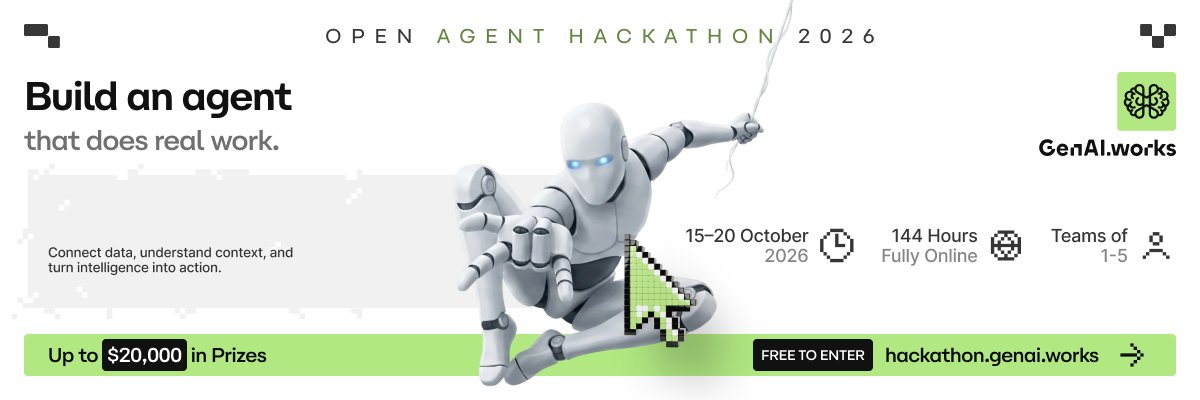
In case you missed it: the Open Agent Hackathon is live.
6 days. Fully online. $20K up for grabs.
Build with @nvidia , @spacexai , @cursor_ai , Bright Data, @Zetaris and Meterless.
Registration closes 22 Oct 👇
https://t.co/zFJAdoeYEt
Pleased to share I'll be a Regional Ambassador for the Open Agent Hackathon 2026!
🗓️ October 15–20 |💰 Up to $20,000 in prizes.
Build AI agents that do real work, with support from Zetaris, NVIDIA, Meterless and SpaceX AI.
Register: https://t.co/B3QdBFZniX
Still thinking about joining the Open Agent Hackathon? There's still time. ⏳
📅 Oct 15–20 · fully online
🛠 4 tracks + a bonus Tinkerer Track
⏳ Registration closes Oct 13
Secure your spot 👇
https://t.co/DMcXeUjejr
In 12 months, there will be two types of people:
Those who watched the AI revolution unfold.
And those who built during it.
🏆 Up to $20,000 in prizes
🌍 Global competition
🤖 Build AI agents that solve real problems
The next breakout founder, engineer, or AI operator could be reading this tweet right now.
Register:
https://t.co/n7PBIC6Mhc
Build something that makes people say, "How the hell did they make that?"
Join @GenAI_Now Global Hackathon.
I’ve partnered with @nvidia to give AI builders a shot at a Golden Ticket to NVIDIA GTC Berlin. 🎫
If you’re building with open models, show us what you’re working on, you could be joining us in Berlin.
Your Golden Ticket includes:
→ Free conference pass
→ VIP seating for Jensen Huang’s keynote
→ Exclusive NVIDIA merch
→ Access to special events
How to enter:
Share your project below.
Only one day left (11 Sep)
🏆 Winner announced by September 14
👉 Contest details: https://t.co/bOZi4b3a2j
Building something worth seeing? "Comment" your project below.👇
Or tag an AI builder who should be in Berlin.
🚨 New dates. Same energy. Bigger build.
The Open Agent Hackathon 2026 is now happening 15–20 October.
Get ready. We’re building! 🚀🔥
🔗 https://t.co/x9SPF4sD0U
Builders from around the world are already signing up for the Open Agent Hackathon 2026
📅Date: Oct 7–9
🪧Place: fully online
🏆Grand Price: $20,000 in prizes.
You don't need a team. You don't need to be an expert. You need a weekend and an idea.
Registration link below 👇
Builders from around the world are already signing up for the Open Agent Hackathon 2026
📅Date: Oct 7–9
🪧Place: fully online
🏆Grand Price: $20,000 in prizes.
You don't need a team. You don't need to be an expert. You need a weekend and an idea.
Registration link below 👇
Builders from around the world are already signing up for the Open Agent Hackathon 2026
📅Date: Oct 7–9
🪧Place: fully online
🏆Grand Price: $20,000 in prizes.
You don't need a team. You don't need to be an expert. You need a weekend and an idea.
Registration link below 👇