1000+ GPUs. 10+ data centers. 50+ STOA models, Nvidia, Qwen, GLM, MiniMax, Kimi and more. 1 click global scale inference.
Multi-cloud access to GPUs at up to 70% less than hyperscalers, built-in security, audit logs, RBAC, and pay-as-you-go pricing with zero vendor lock-in, H100s, B200s, or whatever your workload needs.
Stop managing infrastructure. Start shipping AI.
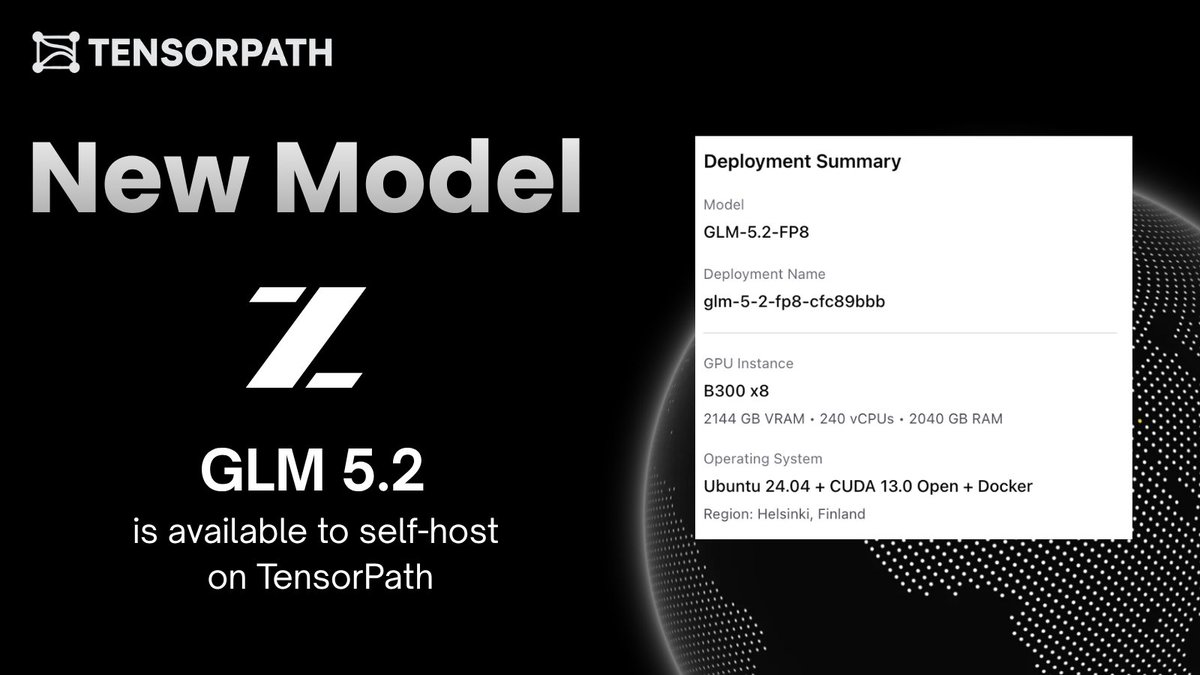
New Open Source Model Available on TensorPath! GLM 5.2 is live on the TensorPath AI Factory ⚡ The MOST POWERFUL open source model by far, scoring 51 on Artificial Analysis Intelligence Index just slightly behind Opus 4.8, GPT 5.5 and Fable 5.
1000+ GPUs. 10+ data centers. 50+ STOA models, Nvidia, Qwen, GLM, MiniMax, Kimi and more. 1 click global scale inference.
Multi-cloud access to GPUs at up to 70% less than hyperscalers, built-in security, audit logs, RBAC, and pay-as-you-go pricing with zero vendor lock-in, H100s, B200s, or whatever your workload needs.
Stop managing infrastructure. Start shipping AI.
Google’s TurboQuant paper is getting a lot of attention right now. But most of the takes we’re seeing misunderstand what it actually does.
Here’s what TurboQuant is — and what it isn’t:
xAI just expanded its Colossus supercluster again, pushing toward multi-gigawatt AI training capacity. At this scale, compute becomes scarce, slow to deploy, and tightly controlled.
Our POV: The real opportunity is in infrastructure that delivers usable AI compute faster — through smarter orchestration and distributed capacity, not just bigger clusters.
@Tensorpath 5/5 And x21 sits on top of that compute layer — turning human workflows into AI counterparts that actually run in production.
AI only becomes utility when infrastructure disappears. That’s the future we’re building.
1/5 Everyone is talking about GPUs, TPUs, and new AI chips this week.
But the real bottleneck in AI infrastructure isn’t silicon — it’s how unusable and inefficient compute still is for most businesses.
4/5 @tensorpath exists to turn raw compute (GPUs, TPUs, pipelines, schedulers) into a single usable system — optimized, observable, and deployable without needing an army of infra engineers.
OpenAI is in talks with Amazon on a potential $10B+ investment — tightening the link between frontier models and hyperscale compute.
AI is becoming vertically integrated, and access to compute will matter as much as the models themselves. @genintelx is built for this shift — providing flexible, independent AI infrastructure so businesses aren’t locked into a single hyperscaler.
NVIDIA just dropped Nemotron-3 — open models built for enterprise reasoning and agent workflows, not demos.
Why it matters: Open weights aren’t the bottleneck. Running, tuning, and scaling them is.
The real value in AI is moving downstream — into infrastructure that makes models actually usable in production.
NEWS: NVIDIA announces the NVIDIA Nemotron 3 family of open models, data, and libraries, offering a transparent and efficient foundation for building specialized agentic AI across industries.
Nemotron 3 features a hybrid mixture-of-experts (MoE) architecture and new open Nemotron pretraining and post-training datasets, paired with NeMo Gym, an open-source reinforcement learning library that enables scalable, verifiable agent training.
Read more: https://t.co/ldf247t3Zz
Google just tapped Amin Vahdat as Head of AI Infrastructure Buildout — signaling an all-in push to scale global compute (with $90B+ capex through 2025). https://t.co/7GocBU4UgU
@genintelx sees this shift: the winners in AI will be the ones who can build and operate infrastructure efficiently and at scale — not just the ones with the newest chips.
The U.S. just cleared Nvidia’s H200 sales to China — but Beijing is already tightening who can actually access them. https://t.co/AlZgHGABm1
High-end AI compute is becoming a regulated asset class. Scarcity + compliance will shape who can build real AI capabilities.
Our POV: GI Tech is built for this era — where stable, compliant, scalable infrastructure matters more than headline chips.
🌍Brookfield + Qai (Qatar’s new sovereign-AI backer) are dropping a $20 B JV to build a regional “Integrated Compute” hub — the Middle East is doubling down on high-performance AI infra. https://t.co/LwouGzDpEJ
What this signals: AI compute is no longer just a U.S./China game. Global hubs are rising. GI Tech exists to ride — and shape — that wave.
⚒️ “AI infrastructure” in 2025 isn’t just GPUs.
It’s the whole chain: compute → data flows → orchestration → monitoring → security.
Miss one layer and the system breaks.
That’s why we build and operate end-to-end infrastructure that delivers utility, not just demos — so businesses get AI that works every day, not just on launch day.
5. This is why we build, operate, and acquire systems that treat AI like utility infrastructure — delivering reliability, efficiency, and future-proofing that businesses can actually depend on.
📸 Your weekly snapshot of what actually matters in AI infra — not the hype, the systems.
1. CyrusOne is dropping $430M on a new Texas data-center.
Why it matters: AI demand isn’t measured in GPUs anymore — it’s measured in megawatts, land, and cooling capacity.
4. Regions racing to become AI hubs are discovering the hard truth:
A room of GPUs ≠ an AI facility. Real infra requires planning, resiliency, monitoring, and orchestration.