‼️Call or email your Denver City Council representative TODAY. Tell them to reject Bill 26-0328, the “update” to municipal criminal offenses and to put forward a new, clean bill that strictly complies only with the Camp decision.
On Monday, a bill that vastly exceeds the Camp decision will be introduced.
In particular, it significantly lowers max penalties for Municipal criminal offenses, removing an essential legal means to persuade offenders to clean up their act or spend time in jail.
The bill authors think max sentences for these crimes should be reduced so the offenders don’t lose their public benefits or risk immigration trouble. They do not care about Denver’s citizens and crime victims.
Not only does the Bill lower max sentences beyond Camp, it creates a Working Group to review the criminal code (Chapter 38) that is fraught with problems that should concern every citizen:
‼️Per the ordinance, the Working Group must consider “disparate impact” in its deliberations. This collectivist framing rejects individual responsibility for behavior and instead advances the notion that something shouldn’t be a crime if the % of people arrested for it exceeds a group identity’s population proportion.
For example, if 75% of people arrested or convicted for the crime of petty theft have an income less that $15,000, but are only 15% of Denver’s population, then the Working Group must “Identify and attempt to prevent disparate impacts of Denver’s criminal prosecutions and penalties based on race, ethnicity, nationality, gender identity, sexual orientation, disability, religion, income, and other protected status;”
How can the Working Group “prevent” this disparate impact? Since the methodology requires group analysis rather than addressing prosecution for individual behavior, either petty theft can no longer be a crime, or exceptions for a crime must be made for members of certain groups but not others until the proportions represent the population.
This is nuts. It washes away individual responsibility for our choices and behavior. It builds into our criminal code notions of “systemic” oppression that are not real. We will no longer be equal under the law.
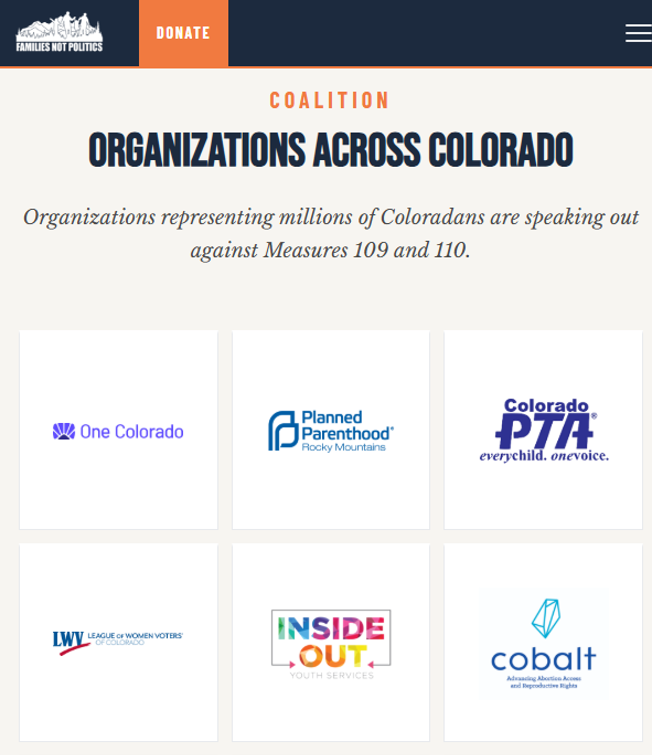
‼️The Working Group must include specific types of nonprofit activist organizations (full list pictured).
Missing from the list? Any organizations representing the regular citizen who wants safe and clean streets. Who wants legal mechanisms in place to hold people accountable for behavior that disrupts and erodes our neighborhoods and public spaces. Who want crimes to be prosecuted regardless of the identity of the criminal!
‼️The bill does not specify how Council and the Mayor will select the community organizations who will serve on the Working Group. There are no provisions for nominations or applications. The absence of such provisions is a strong indicator that the bill proponents already know who they want serving on the working group.
There are also no provisions requiring the Working Group to seek input from the people of Denver nor our business community.
Links to Council Contact info and the Bill 👇
I stopped by Target today and was shocked by how much of the store is now locked up.
Tumblers. Shoes. Flip flops. Wallets. Silverware. Nail polish. Lunch boxes. Toothpaste. Deodorant. Laundry detergent. Even shoe laces.
This isn’t a criticism of Target. They’re responding to a problem.
I remember when stores mainly locked up electronics and other high-dollar items. Now it’s everyday necessities and basic household goods.
At some point we have to ask ourselves whether this is the kind of city we want to accept as normal.
There will always be theft, and there will always be people who steal for different reasons. But it’s impossible to ignore the impact that addiction, organized retail theft, and a lack of consequences have had on our communities.
Because a city where half the store is locked behind glass shouldn’t be considered normal.
Take away their money. Their ideology is their religion and they have no logic left to realize what danger they are putting our district in by digging in their heels.
For the second time this year, my husband is coming out of anesthesia for a joint replacement and I just can’t stop laughing.
He is funny af right now.
First words: “Where am I? Am I playing hockey?” 🤣
(All went well with his surgery.)
There's something exciting happening in American poetry right now.
There are two streams of "dissident" poetry occurring simultaneously outside of the Creative Writing Program assembly line of identity drivel: One is Christian and Catholic, and leans heavily into more formal poetry, and the other is—what seems to me—a more aesthetically sophisticated, and interesting, extension of the "Alt Lit" scene I was familiar with back in the mid-2000s.
For the first time in close to a decade, there is a new wave—two waves in alignment—shoving institutionalized po-mo pronoun poetry further into irrelevancy.
Maybe we are witnessing the beginnings of a renaissance in American poetry!
Real compassion versus the performance of compassion.
Annemarie’s essay has so many insights, I had a hard time narrowing down to one that captured the spirit of this brilliant piece.
Highly recommend the read.
🔗👇
1/2
💔 We built an entire culture around therapy language, wellness slogans and performative compassion and somehow ended up lonelier, angrier and more emotionally exhausted than ever.
Real compassion is not posting infographics or “holding space”.
It's answering the phone at 3am.
Sitting in oncology wards.
Telling difficult truths gently.
Staying when things get ugly.
Loving people properly when there’s absolutely nothing glamorous in it.
I wrote something about that.
Aurora Police have been helpful and quick to answer my questions on X.
Meanwhile, Denver Police completely stopped responding to me back in March 2025. The police spokesman said the decision came “with guidance from the mayor’s office”.
Chief Ron Thomas said on @CityCastDenver that answering DoBetterDNVR is “onerous” because my questions aren’t “solution-oriented.”
Is the Chief seriously saying it’s too much work to keep the public informed?!?
He did admit that DPD watches what I post and responds when they think they need to.
It’s not my job to come up with solutions. That’s what NGO execs and city officials making hundreds of thousands a year are supposed to do.
But here are some of the solutions I’ve been advocating for:
✅ Fully fund Denver Police
✅ Defund HOST, Housing First, and addiction enablement (taxpayer funded meth pipes & drug use supplies)
✅ Prioritize transitional housing that requires accountability and sobriety
✅ Refelonize hard drugs like meth and fentanyl
✅ Harsher sentences for repeat and violent offenders
✅ End PR bonds for felonies and repeat offenders
✅ Zero tolerance for open drug use and camping
Some of these need state law changes, but a lot are things Mayor @MikeJohnstonCO could do right now through policy.
Instead, he keeps defunding public safety and dumping money into programs that are attracting more drug-addicted vagrants to Denver.
@AuroraPD actually gets it.
@denverpolice leadership answers to Meth Camp Mike.
Denver deserves better.
#DoBetterDenver
Great, now my cancer has its own theme song. Somewhere between Jardiance, and “plop plop fizz fizz” 😂. Check the latest episode right here —-> https://t.co/1FmtabM3Ob
In his first talk at the Mere Simulacrity conference in Phoenix, Arizona, in December 2022, @ConceptualJames presents the idea and mechanism of negating the real to replace it with a hyperreal simulation in which totalitarianism can be accomplished.
https://t.co/Q3boykWtFF
Elaine is spot on.
“Unhoused” points to a single solution and a single outcome to measure: Housed.
It erases everything else that really matters, that truly brings a person “home”.
Reject this political term.
It’s political framing.
Homeless is a descriptor that describes the consequences for people who have unresolved issues: mental health, drug addiction, or in a small number of cases financial.
Unhoused is a descriptor that designates the government and taxpayers as responsible for providing all these people housing without solving the underlying causes.
It is designed specifically to cloud the issue and pave the way for more money to flow through the system without requiring accountability.
Never underestimate the power of nomenclature changes to control our political beliefs.
Colorado taxpayers are funding the opposition of the Colorado citizen-led ballot initiatives to protect girls sports and protect kids from irreversible sex-change surgeries.
Nearly $2,000,000 in state funds have been paid to One Colorado Education Fund through grants approved by One Colorado-endorsed @RepLorenaGarcia.
And One Colorado is facilitating the PAC opposing both ballot measures.🧵
SCOTUS said no to Colorado on this, in Chiles v. Salazar.
So Colorado enacted the same law again, moving the penalty from licensing to lawsuits.
The point is to chill speech and prevent parents from getting help. So parents and counselors will both be scared, without help.
@mlottmanier@dobetterdnvr Once again: the existence of a statistical disparity is not evidence of animus. A disparity sheds no light on causality.
My reply to you below includes my reasoning.
https://t.co/Yt5WI9HfLF
I laid out my reasoning in the original post, but I’ll expand here a bit.
This is the specific language of the bill that I recommend Council remove: “Identify and attempt to prevent disparate impacts of Denver’s criminal prosecutions and penalties based on race, ethnicity, nationality, gender identity, sexual orientation, disability, religion, income, and other protected status.”
Disparate impact analysis is a simple descriptive statistic comparing proportional outcomes by group identity to a group’s population proportion.
As applied in many domains, beginning with Griggs in employment law, disaster relief in ICP v. HUD, or the City of Denver’s Equity Index the theory suggests that disparities on their own are evidence of discrimination or some form of injustice. That, absent some structural outside influence (e.g., discrimination, oppression), outcomes would be proportional to the group’s population proportion.
It’s an oversimplification built on a faulty foundation. Further, there is no evidence of either selective prosecution based on group identity animus nor selective sentencing based on group animus in Denver County in 2026.
Were we in San Francisco, where most street dealing is done by Hondurans, a disparate impact analysis would show overrepresentation of Hondurans in prosecutions and sentencing because that is who controls that particular criminal market in SF. Denver’s Working Group would be tasked with reducing that disparity per the ordinance.
It’s a statistical artifact not evidence of actual animus. Once identified, how can that disparity “be prevented” as the Ordinance directs?
In some cases, the Working Group might say XYZ should no longer be a crime. In others the Working Group might recommend that people with a certain characteristic not be prosecuted, or diverted, or given lighter sentences, effectively replacing equal justice under the law with group conditional treatment in order to prevent a disparity.