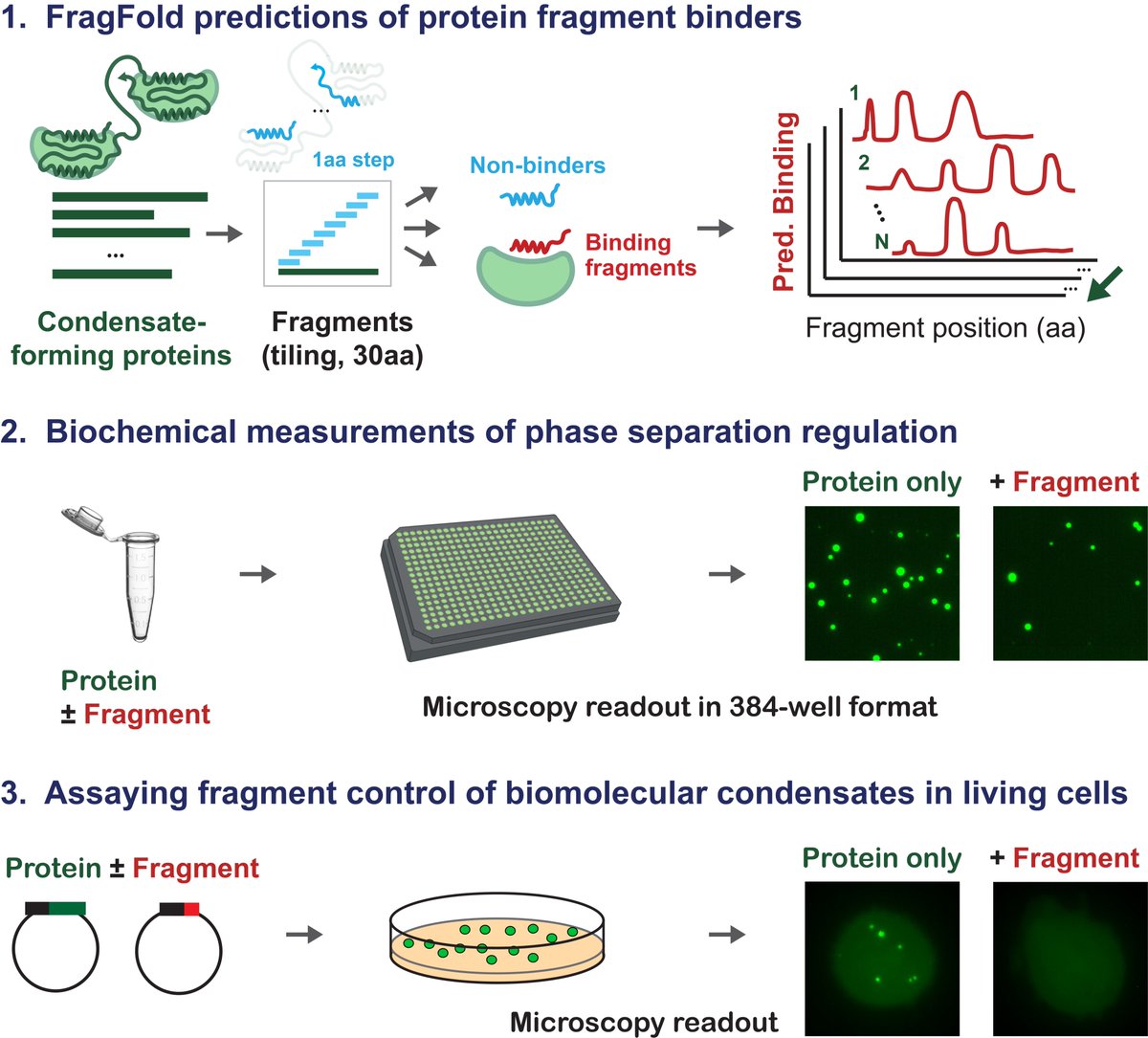
Thrilled to share the latest from @bioSavinov, K99 fellow in the lab & corresponding on this work together w/ @LinsdayCase19. Andrew & @jibin_sadasivan show that protein fragments discovered with our FragFold AI method act as generalizable regulators of biomolecular condensates!
Interested in genetically encodable inhibitors of your favorite biomolecular condensate? Excited to announce our latest work, w/ @jibin_sadasivan, @GeneWeiLiLab, & @LindsayCase19, on protein fragments as generalizable regulators of phase separation. (1/n)
https://t.co/6IMkrTP3ZQ
Thrilled to contribute to this exciting work on protein binder design together w/ @HannesStaerk, @felix_faltings, @BarzilayRegina, Tommi Jaakkola, and co. We applied BoltzGen to design novel antimicrobial peptides targeting DNA gyrase based on inhibitory protein fragments. (1/n)
Agreed, Yunha. Fantastic to discuss the interplay of AI & biology with you, Teja, & great attendees @BostonBacteria. Many thanks to David for moderating.
Opportunities for new discoveries are vast, esp. if we keep pushing systematic experimental measurements alongside AI models!
What are cells doing?? Here we showed that proteomic composition encodes information about cellular reaction rates. This is a step forward to reconstructing these important activities using protein-based observations.
https://t.co/b15qbte8Hz
Hot on the heels of excellent work from @SvenssonLab, more evidence of large-scale generation of functional protein fragments by proteolysis https://t.co/fDnONai5Cr
Very exciting to see this convergence with our work showing pervasive function of protein fragments in vivo! (1/2)
Fantastic to see these physiologically functional protein fragments, congrats all!
This aligns with our work demonstrating pervasive functionality of protein fragments in living cells (& ability to predict their binding partners): https://t.co/jecm5NNjgy https://t.co/2SSeVkAj2m
A new method developed in @MITBiology builds on existing artificial intelligence models to computationally predict protein fragments that can bind to and inhibit full-length proteins in E. coli https://t.co/BX0aNvtCxQ
Great to see this piece from @MITBiology highlighting our work on discovering protein fragments to inhibit protein interactions in cells! Thanks @LillianWEden for the write-up.
Thrilled to announce the final version of our paper on computational discovery of protein fragments that can inhibit cellular protein interactions, led by Andrew Savinov (@bioSavinov), now published in @PNASNews.
@MITBiology@ScienceMIT @HHMINews
Happy to announce that our paper on systematically discovering peptides to inhibit protein-protein interactions in living cells is out now @PNASNews: https://t.co/jecm5NMLr0.
@MITBiology@ScienceMIT @HHMINews
See quoted thread on the updated preprint for details:
for the folks who missed @bioSavinov's fantastic seminar this week, you can check out the recording 👇
https://t.co/xEk9LOGsUL
and thanks again to @pillar_vc for hosting!
Check out Li lab postdoc Andrew Savinov's (@bioSavinov) updated manuscript on our computational approach to predict inhibitory protein fragments at scale -- now complemented by extensive new deep mutational scanning experiments. @MITBiology@ScienceMIT @HHMINews
Excited to share our updated manuscript on FragFold, the massively parallel AlphaFold-based approach we’ve developed to discover protein fragment inhibitors at scale -- w/ @SassSeabass, @keating_lab, and @GeneWeiLiLab. https://t.co/hava9PHmEa (1/n)
Excited to share some work from my postdoc! In our recent preprint (w/ @gregorybritten@GeneWeiLiLab Sean Hackett and Mick Follows), we ask how to use proteomic data to estimate in vivo reaction rates? (1/n)
Massive congratulations to my postdoc mentor Gene Wei-Li @GeneWeiLiLab for being named an HHMI Investigator! Deeply deserved, and I am incredibly excited for the transformative science that lies ahead.
Congrats as well to the rest of this amazing cohort.
@MITBiology@ScienceMIT
Was great to have the opportunity to highlight my research program on the power of protein fragments to rewire protein interactions in living cells! @MITBiology
Congratulations to Li lab graduate student Manraj Gill on being awarded the William Asbjornsen Albert Memorial Fellowship for his academic accomplishments and his commitment to the MIT community! @MITGradStudents@ScienceMIT
Congratulations to Li lab postdoc Andrew Savinov (@bioSavinov) for receiving an Infinite Expansion Award, recognizing his outstanding service to the MIT community!
https://t.co/BtaQP4yT54