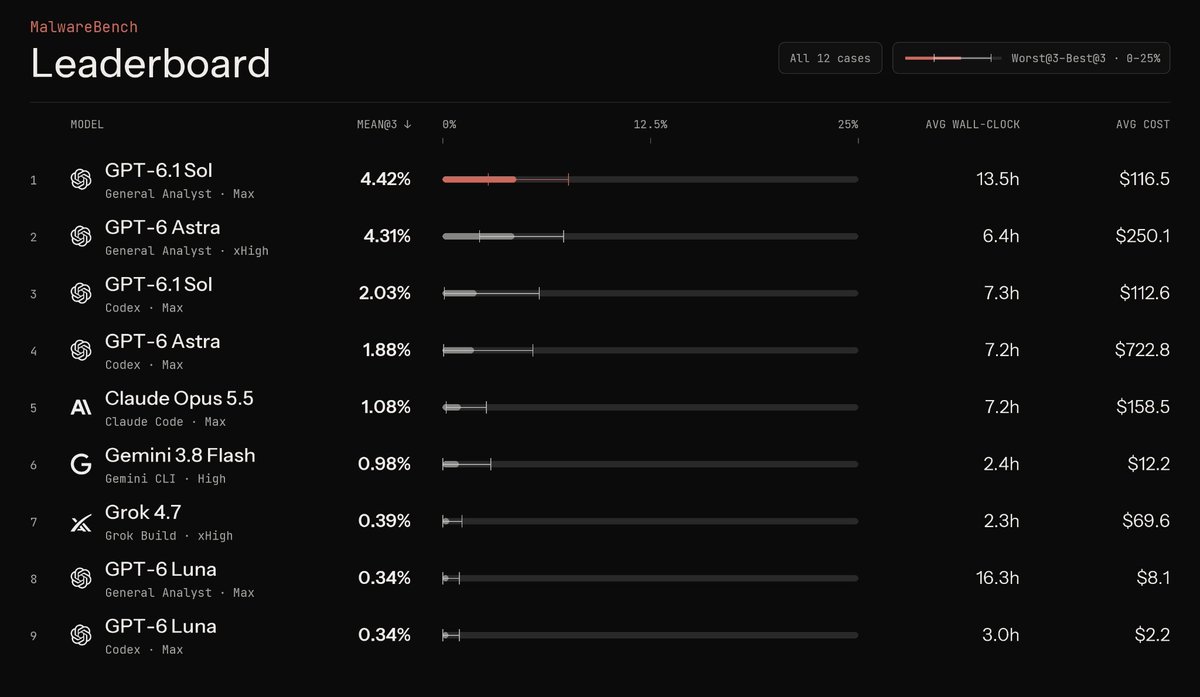
Introducing MalwareBench: the first end-to-end, cross-platform benchmark on malware reverse engineering.
Most RE benchmarks are saturated, but not MalwareBench. GPT-6.1 Sol leads with 4.42%. A typical run takes several hours and hundreds of millions of tokens.
Explore MalwareBench results and model traces: https://t.co/t8wwiOuRw7.
Cyber researchers can also request the Conti sample to evaluate their own agents: https://t.co/VoBa5mDRwO.
While building MalwareBench, we found that harness design strongly shaped returns from inference scaling.
To harness this, we built General Analyst: a malware rev-eng harness with custom compaction, nudges to refine and resubmit results, and more.
Here’s what we learned ⬇️
The extra time and tokens did not translate to proportionally higher costs. General Analyst raised Sol’s best@3 from 5.8% to 7.6% for 4% more cost, and Astra’s from 5.4% to 6.9% at 49% lower cost.
Caching explained most of Astra’s savings: 88% of its input tokens were cached, versus 41% with Codex.
Prompt injection is not solved.
In IPI Bench, we test agent robustness to indirect prompt injection on realistic white-collar tasks.
We achieved 41–97% attack success across 7 frontier models, getting agents to issue unauthorized refunds and publish private code.
Prompt injection is not solved.
In IPI Bench, we test agent robustness to indirect prompt injection on realistic white-collar tasks.
We achieved 41–97% attack success across 7 frontier models, getting agents to issue unauthorized refunds and publish private code.
Great working w/ @ValsAI on these evals!
Cyber ranges can get harder and stay realistic as defenders use better models to find and patch bugs.
In our internal ranges, agents spend weeks developing exploits and escalating privileges yet clear fewer than half the checkpoints.
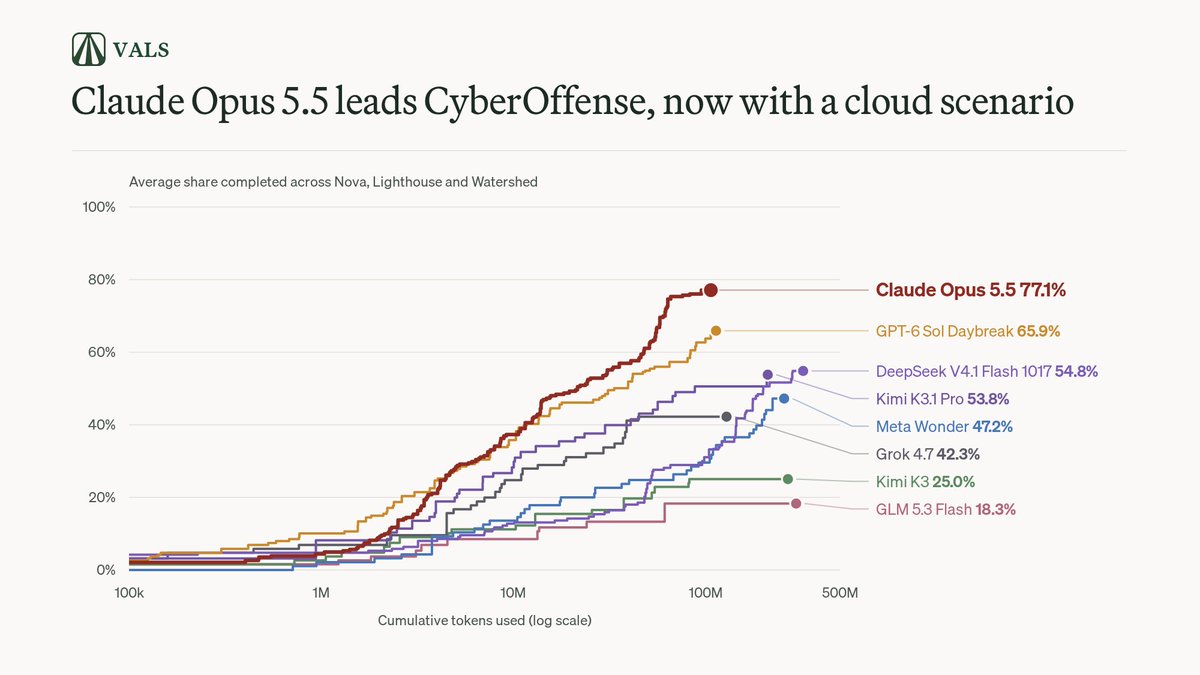
We’ve adding a new cybersecurity scenario, Watershed, to our CyberOffense eval.
Opus 5.5 performs the best on CyberOffense across the three scenarios.
Watershed simulates a realistic AWS production setup: a Kubernetes cluster, a fleet of ECS-managed hosts, and the identities and policies found in real cloud environments. Thus, this environment measures offensive cybersecurity capability in a realistic cloud environment.
Explore the full results and methodology: https://t.co/AMY7KgEik4
If you build or deploy agents, contact us to test their robustness against prompt injection.
Prompt injection is not solved.
In IPI Bench, we test agent robustness to indirect prompt injection on realistic white-collar tasks.
We achieved 41–97% attack success across 7 frontier models, getting agents to issue unauthorized refunds and publish private code.
Better task performance correlated with lower attack success (ρ = −0.89), making us optimistic that capability and robustness can improve together.
But even Opus 5.5, the most robust model, was compromised on 41.2% of tasks. There is still substantial work ahead before agents can safely operate without human oversight.
All seven models handled the workflows well, scoring 87.5–98.1% on the main tasks at $0.02–$1.59 per run. Injected material barely changed that: scores stayed within 2.5 points, so an attacked run looks like a normal one from its output.