We see a lot of customers at General Medicine. This account is where we share what the care actually looks like. The referrals placed, the clinical calls made, the follow-through, and the customer satisfaction. Real cases, anonymized.
Ten years. Three visits. One customer's comparison between her previous doctor and General Medicine says more than we could.
We think good care isn't measured in how long you've been going somewhere. It's in whether anyone's actually listening. That's what we build every visit around.
It's not about years. It's about being heard.
"Can I just treat this with a prescription cream?"
A recent customer came in having already researched options for a skin lesion. They’d looked up options and submitted photos. We reviewed the images carefully. The lesion had features that photos alone couldn't rule out, and prescribing a treatment that could mask a potentially cancerous lesion wasn't the right call.
We told him why, and scheduled him for an in-person dermatology visit locally. In the meantime, we offered sun-protection guidance and specific symptoms to watch for before that appointment. He came in wanting a quick fix. He left confident with the fix his concern warranted.
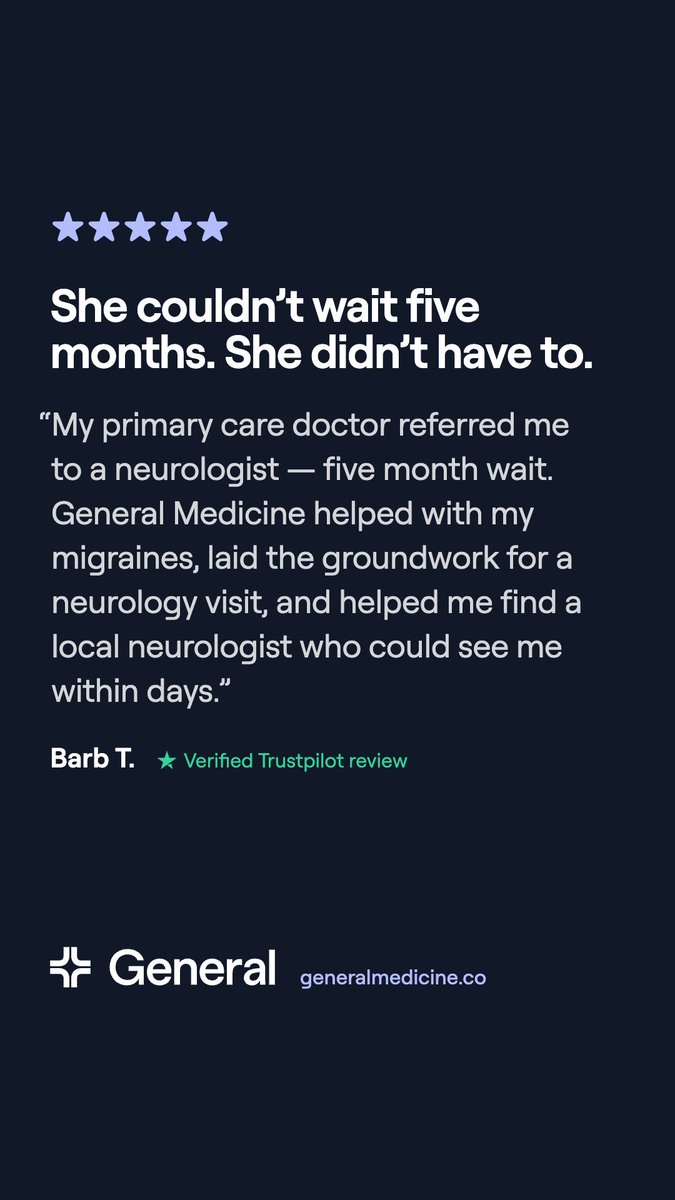
Referral sent. Five-month wait. Migraines, still happening.
That's where Barb's care could've stalled.
General Medicine stepped in — treating the migraines directly, laying the groundwork for the neurology visit ahead, and connecting her with a local neurologist who saw her within days.
If a specialist wait has you stuck in the meantime, tell us what's going on. We'll help you use the time, not lose it.
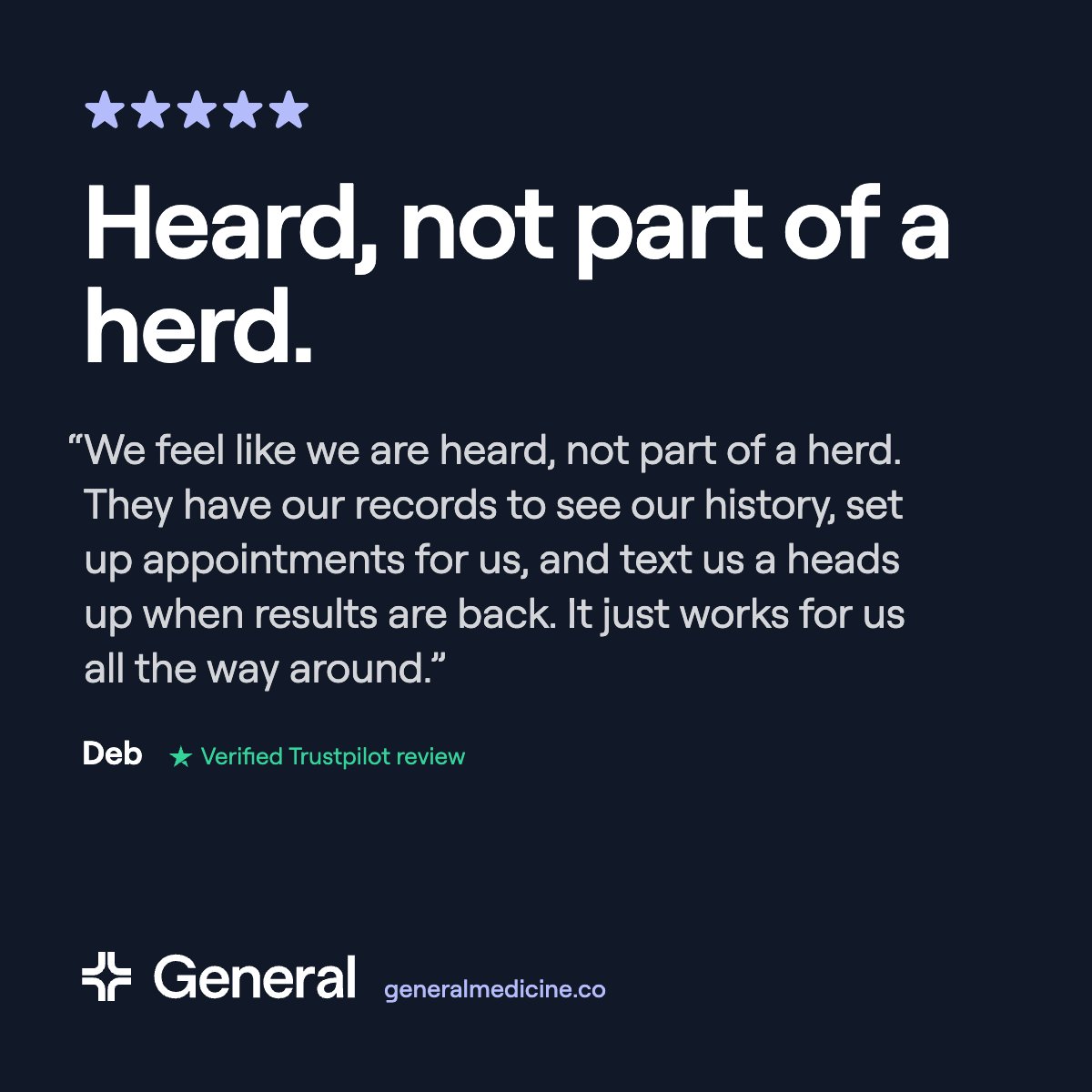
That's Deb's take on General Medicine care, her team has her full history, books her appointments, and texts her the second results are back. Personal, not assembly-line.
Getting seen shouldn't take three tries.
One customer came to us after three failed attempts elsewhere. She had an appointment the next day. Her prior authorization was handled within three days. And when she needs something now, a text gets a response in under an hour.
That's not luck. That's what happens when someone actually holds the thread for you.
We've got that. We've got this. And we've got you.
"Will these medications be too expensive?"
A recent customer came in with an acute migraine and nausea (but no red flag features). Her daughter was interpreting on a video visit and she had no insurance coverage. She was nervous to even seek treatment in case the medications would be far too expensive.
In the visit, we checked prices against pharmacy discount programs and got to a clear answer for each medication — what it was for, what to expect at pickup, what it would actually cost. She came in not sure she could afford to treat her conditions. She left knowing exactly what she'd pay before she ever reached the counter.
Nothing tests a healthcare system like “I leave in three days and I’m out of my medication.”
Jaden moved, lost access to his endocrinologist, and needed an emergency prescription before an international trip. General Medicine got him an appointment and handled both prescriptions - in time for him to go.
We’ve got that. We’ve got this. And we’ve got you.
"Do I still have time?"
That’s what a customer wanted to know when they reached out after a potential HIV exposure. We confirmed they did. They started Truvada and dolutegravir the same day. The 28-day regimen was on its way to the pharmacy and an appointment for labs was confirmed before the visit ended. The care plan spelled out exactly when we’d follow up with test results, and the customer felt confident knowing what would happen next.
"Can I manage my psoriasis and my joint pain in the same visit?"
This customer was already on low-dose naltrexone and wanted to get her skin under control next.
We reviewed her full history, prescribed clobetasol with a clear 2-week use limit, and titrated her naltrexone to 4.5 mg nightly. Her SI joint pain was stable enough that we decided together to hold off on MRI for now — her preference, supported by the clinical picture. Opioid interaction counseling was completed before the visit ended, and both prescriptions were confirmed at her pharmacy. She came in with two separate concerns and left with both addressed.
"Why isn't clindamycin the first-line treatment for acne?"
That's what a recent customer wanted to know. She'd done her research and came in with a specific ask.
We reviewed her photos, completed pregnancy screening, and walked through why tretinoin 0.025% and benzoyl peroxide are often recommended as a starting point; and what the path to clindamycin would look like. She asked questions and chose what she wanted. Both prescriptions were confirmed at a local CVS before the visit ended, and she left with a follow-up plan for 8–12 weeks out.
"Can I get both of these handled in one visit?"
A recent customer came in with two things on her list: she wanted her vitamin D checked, and she'd been dealing with anxiety and wanted to explore new treatment options.
Her clinician reviewed her history, ordered the lab, and created an anxiety plan together. Her lab appointment at Quest Diagnostics was confirmed before the visit ended, and her prescription was already at her pharmacy. She came in not knowing if two things in one visit was even possible. She left with both handled.
"Do I actually have sleep apnea, or am I just tired?"
A customer came in with that exact question. His wearable health tracker had flagged disrupted sleep but he wasn’t sure it was worth taking seriously. We went through his history, the wearable data, and his symptoms – talking through the reasoning together before ordering anything. He decided to go ahead with a sleep study and the referral was placed and confirmed before the visit ended.
Because he was paying out of pocket, we pulled together a list of in-lab facilities that worked for his situation and sent it through his care plan. He came in unsure if he was overreacting. He left with a referral already placed and a facility list already in hand.
"What does my MRI actually mean?"
A customer came in with MRI results from she didn't know how to interpret, and no way to talk to the ordering provider quickly. She had enough anxiety to make the not-knowing worse than any specific fear.
We reviewed the images alongside her history and walked through exactly what the scan did and didn't show: no tumors, no strokes, no blood clots, no acute findings. There was one incidental finding, a hippocampal variation, that we explained with full context.
She left knowing what to watch for, what would warrant a call back, and what she could stop worrying about.
"Is it safe to take an antibiotic while I'm still breastfeeding?"
A customer urgently needed to treat the mastitis she'd woken up with. She sent photos of the affected area through chat, confirmed her temperature, and had a diagnosis within minutes. She asked questions and got answers about safety, and the prescription was already on its way to her pharmacy before she put her phone down.
She left knowing what to expect in 2–3 days, what side effects to watch for, and what to do if things didn’t improve quickly.