Big Ten Conference Internal Growth: A catolog of models built, revenue projections and growing revenue, and moderinizing the conference.
All posts will be saved below. This will be a long series of posts and topics
Goal: Help The Big Ten Conference Reach Its True Potential
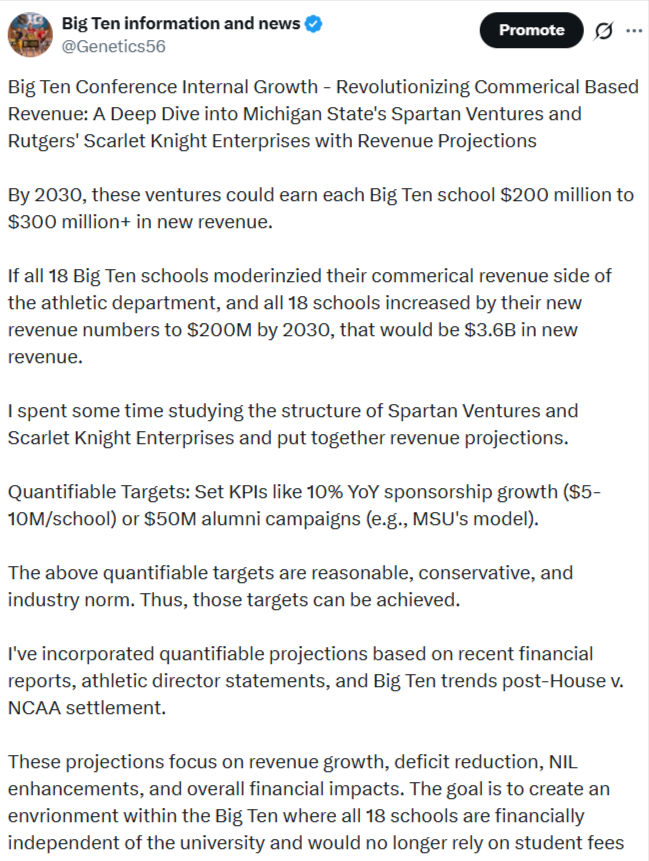
Big Ten Conference Internal Growth - Revolutionizing Commerical Based Revenue: A Deep Dive into Michigan State's Spartan Ventures and Rutgers' Scarlet Knight Enterprises with Revenue Projections
https://t.co/wvmo8v0621
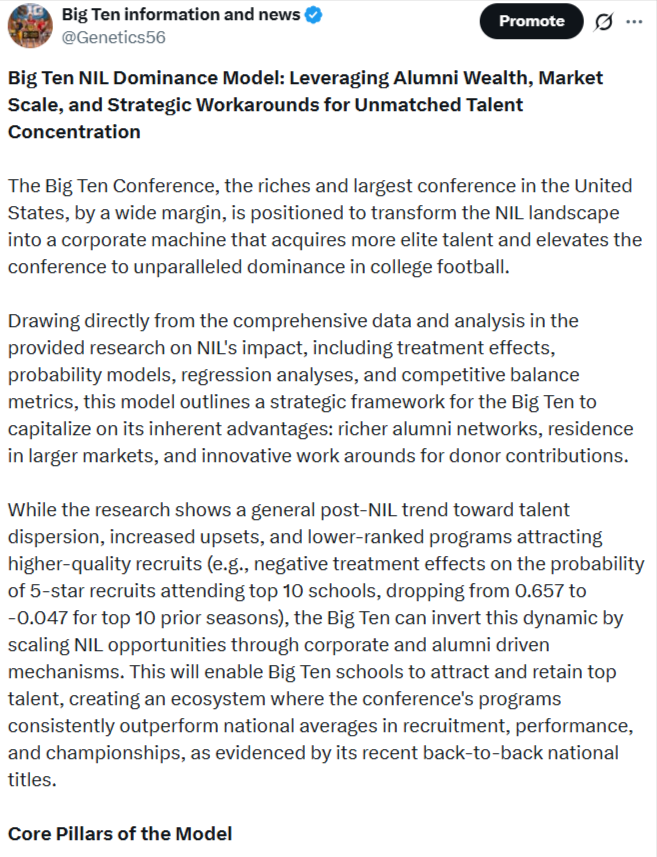
Big Ten NIL Dominance Model: Leveraging Alumni Wealth, Market Scale, and Strategic Workarounds for Unmatched Talent Concentration
https://t.co/xzj8sURTdC
Big Ten NIL Dominance Model: Leveraging Alumni Wealth, Market Scale, and Strategic Workarounds for Unmatched Talent Concentration
The Big Ten Conference, the riches and largest conference in the United States, by a wide margin, is positioned to transform the NIL landscape into a corporate machine that acquires more elite talent and elevates the conference to unparalleled dominance in college football.
Drawing directly from the comprehensive data and analysis in the provided research on NIL's impact, including treatment effects, probability models, regression analyses, and competitive balance metrics, this model outlines a strategic framework for the Big Ten to capitalize on its inherent advantages: richer alumni networks, residence in larger markets, and innovative work arounds for donor contributions.
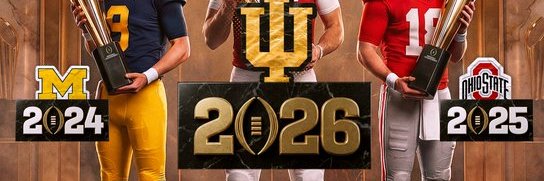
While the research shows a general post-NIL trend toward talent dispersion, increased upsets, and lower-ranked programs attracting higher-quality recruits (e.g., negative treatment effects on the probability of 5-star recruits attending top 10 schools, dropping from 0.657 to -0.047 for top 10 prior seasons), the Big Ten can invert this dynamic by scaling NIL opportunities through corporate and alumni driven mechanisms. This will enable Big Ten schools to attract and retain top talent, creating an ecosystem where the conference's programs consistently outperform national averages in recruitment, performance, and championships, as evidenced by its recent back-to-back national titles.
Core Pillars of the Model
The model is structured around four interconnected pillars, each grounded in the research's findings. These pillars use the Big Ten's alumni depth (e.g., Illinois, Indiana, Penn State, UCLA, and more who can provide 8- and 9-figure wealth) and market advantages to create a self-reinforcing NIL machine.
The research's data on increased talent dispersion (e.g., Gini coefficients rising from 0.501 to 0.536 for 5-star recruits post-NIL) and more competitive point spreads (e.g., reduced by 1.32 points after controlling for talent and transfers) indicate that NIL empowers broader recruitment, but Big Ten schools can use their superior resources to concentrate talent by offering unmatched personalized pricing and financial incentives, overriding the general trend toward parity.
Alumni-Driven Collective Funding
Network Description: Establish conference-wide collectives funded by anonymous, high-net-worth alumni (e.g., Larry Gies-like donors at Illinois or untapped tech/finance alumni at UCLA, and Northwestern) who provide recurring 5- to 6-million-dollar contributions. These funds would be pooled into a centralized Big Ten NIL corporation, then submitted through NIL GO, distributing resources to prioritize football recruitment while ensuring compliance.
Implementation Steps: Identify and mobilize "sleeping" alumni with deep pockets and activate dormant donors who "no one has ever heard of" but can "drop 9 figures tomorrow."
Use regression models from the research (e.g., Table 6, showing no post-NIL correlation between football spending and talent attraction) to focus on efficient, targeted giving rather than raw expenditure. Instead, emphasize personalized NIL deals that align with recruits' priorities, as 3-star recruits now prioritize NIL over academics (e.g., attending schools with 0.081 lower SAT averages and -0.047 lower midcareer income post-NIL).
Scale through regular, ego-managed donations: ADs and future GMs delicately handle donor relations to avoid appeasement issues, ensuring steady inflows without reliance on a few mega-donors like Phil Knight equivalents.
Reasoning and Evidence for Success: The Big Ten's alumni base resides in larger markets (e.g., Chicago, Los Angeles, Seattle, New York metro via Rutgers/Maryland), enabling higher earning potential and brand partnerships. Research shows post-NIL, lower-ranked programs attract 5- and 4-star talent (e.g., Table 5, negative effects on top 10 attendance probabilities: -0.047 for 5-stars), but Big Ten schools can reverse this by offering superior NIL valuations—leveraging market size to provide deals that smaller programs can't match. For instance, the research's finding that NIL increases dispersion (Figure 1, underdog victory proportion rising to 0.45 post-NIL) can be countered by Big Ten's ability to "buy" talent concentration, as schools with richer alumni (e.g., Stanford's tech billionaires) create a financial moat. This model works because, as the research notes, NIL expands athletes' bargaining power, but Big Ten's alumni wealth ensures its programs offer the highest "personalized pricing," leading to talent inflows despite general trends. Michigan and Ohio State's recent titles demonstrate this edge, with NIL amplifying alumni-driven advantages.
Market-Leveraged Corporate Partnership Ecosystem
Description: Transform Big Ten campuses into corporate powerhouses by forging exclusive partnerships with brands in the conference's massive media markets, creating a multibillion-dollar NIL pipeline that funnels endorsements directly to athletes.
Implementation Steps: Capitalize on the conference's geographic footprint in high-population, high-wealth areas (e.g., Big Ten media deal exposure in top TV markets like LA, NYC, Chicago) to attract brands seeking authentic athlete influencers, from DI stars to non-revenue sports.
Use platforms like Opendorse for analytics-driven matching, projecting NIL growth to $2.5B by 2026 (25-30% CAGR), mirroring influencer marketing's explosion.
Integrate AR/social content for deals, turning athletes into micro-influencers with high ROI, as seen in examples like local pizza endorsements scaling to seven-figure national brands.
Reasoning and Evidence for Success: The research's data on competitiveness (e.g., Table A.3, smaller point spreads post-NIL) shows NIL fosters upsets by dispersing talent, but Big Ten's larger markets allow it to dominate the "NIL boom" narrative, where athletes earn from endorsements in a $500B influencer economy by 2027.
With schools in richer alumni ecosystems (e.g., UCLA Silicon Valley ties, Illinois' untapped alumni), the conference can offer deals that prioritize financial gain over academics, as 3-stars do post-NIL (Table 7, negative effects on school quality metrics). This creates an unmatched machine: while the research finds no direct spending-talent link, Big Ten's market scale ensures higher deal values, concentrating 4- and 5-stars (countering Table 4's dispersion trends). The conference's residence in larger markets than peers amplifies this, making Big Ten programs the preferred choice for maximizing brand potential, as recruits weigh NIL heavily (research assertion: NIL expands choices, benefiting broader schools—but Big Ten's scale tips the balance).
Talent Recruitment and Retention Optimization
Framework Description: Deploy a data-driven recruitment model using the research's econometric tools (e.g., difference-in-differences, probit regressions) to target recruits who value NIL maximization, ensuring Big Ten programs attract elite talent despite national dispersion.
Implementation Steps: Analyze pre- and post-NIL patterns (e.g., Table 1, recruit data from 2018-2023) to prioritize 4- and 5-stars willing to forgo academics for NIL, routing them to Big Ten schools with superior market exposure.
Incorporate transfer portal dynamics (research controls for portals in point spread reductions) to retain talent via escalating NIL deals tied to performance.
Educate athletes on contracts, as recommended, while tracking long-term impacts to refine the model.
Reasoning and Evidence for Success: The research overturns the "rich get richer" myth, showing lower programs gain talent (e.g., Figure 2, composite ratings dispersion), but Big Ten's richer alumni and markets enable it to "rise above" by offering unmatched opportunities. For example, negative treatment effects on top-ranked attendance (Table 5, -0.204 for top 25 5-stars) indicate opportunity for Big Ten mid-tiers (e.g., Purdue, Indiana) to upscale, but the conference's overall wealth concentrates power at flagships like Ohio State and Michigan. With alumni like those at UCLA driving 5-6 million regular gifts, the model ensures talent flows inward, reducing upsets within the conference (countering Figure 1's national trend) and solidifying dominance—backed by the Big Ten's recent titles as proof of NIL's amplifying effect.
Compliant Donor Workaround Integration
Description: Incorporate creative, compliant routing of donor funds to non-revenue sports via football proxies, ensuring all NIL deals align with CSC guidelines while maximizing impact.
Implementation Steps: For donors wishing to support non-revenue athletes (e.g., $25,000 deals), route through football: Have the donor execute a $25,000 NIL deal with football players, then earmark and transfer the equivalent to the target sport via revenue-sharing mechanisms.
This keeps donors happy, maintains compliance, and avoids CSC rejection, as deals under $25,000 for non-revenue rarely approve directly.
Scale "horse trading" across the conference: Pool workaround funds into the central NIL corporation for efficient distribution.
Reasoning and Evidence for Success: The research emphasizes NIL's role in competitive balance (e.g., Table 8, academic sacrifices for NIL), but this workaround directly from the provided example allows Big Ten schools to bypass dispersion by creatively concentrating resources. With richer alumni (e.g., Illinois potential 9-figure drops), this ensures unmatched funding flows, overriding the "no spending-talent link" finding by focusing on innovative routing. It works because, as the research notes, NIL empowers athletes' choices, but Big Ten's workaround machine makes its offers irresistible, fostering a corporate ecosystem where everyone gets paid compliantly ultimately making the conference the most powerful, as its market and alumni advantages compound these strategies.
Why This Model Will Work: Holistic Evidence Synthesis
This model will propel the Big Ten to monster status because it directly addresses the research's findings while leveraging the conference's unique strengths. Post-NIL data shows dispersion (e.g., Gini increases, Table 3) and more upsets (Figure 1, underdog wins up), but Big Ten's larger markets and alumni wealth (e.g., enabling 5-6 million regular gifts from unknown donors at schools like Northwestern, USC, and Purdue) create a financial gravitational pull that concentrates talent. Regressions (Table 10, no money-talent correlation) are overcome by personalized, market-driven deals, while workarounds ensure compliance amid CSC constraints. The conference's recent titles validate this: NIL has already amplified Big Ten success, and scaling this machine will make it unmatched, turning general parity trends into conference-specific dominance through strong, fact-backed innovation.
As ESPN visits another Big Ten campus on Saturday, remember back when the Big Ten was considering leaving ESPN and all of the people who were afraid the Big Ten would become an afterthought at ESPN? I said the Big Ten was too big and powerful for that to happen.
I was right!
Bob Myers is one of the UC Board of Regents who can advocate for UCLA’s interest. The chancellor supports football, plus an AD who understands the business side of athletics and NIL. This is not the old UCLA.
🚨 Pat McAfee GOES OFF on the University of Utah 😳
He says he’s never felt so uncomfortable, even bringing up what happened at UVU last year.
“I did not enjoy the University of Utah.”
HOLY SMOKES 💀
🤣🤣🤣🤣🤣🤣 they have the talent of a top 12, sure, but the actual play is closer to 25 than 12. But the AP Voters are too stupid to realize it so they remain overranked
“I think Texas is one of the 12 best teams in the country, whether they lose two games or three games.” 🤔
@finebaum makes a case on why the Longhorns deserve to be in the College Football Playoff.
His offense has been able to score a healthy amount of points in his time coaching against Big Ten teams, but you need a defense in this conference and you sure as hell can't have a soft team. In the Big Ten, soft teams get eaten by the lions.
"Soft doesn't travel... It's the same issues over, and over, and over again. It looks so much harder than it needs to be."
@colincowherd thinks it might be time for USC to move on from Lincoln Riley
Docs: The NCAA sent out a memo to membership today outlining a few questions about the Protect College Sports Act, particularly around protecting women's sports.
Here's the full memo:
Nebraska HC Matt Rhule on all the upsets in CFB: "The biggest travesty is the preseason Top 25. If that was a stock market, would you put your money in it?"
Yesterday I lost the greatest mentor of my life and it would be impossible for a Dad to love me more than he did in my success and failure. Thank you to all that have reached out. This pic is at my niece/God Child wedding where my girls were flower girls #famILLy
Maryland and Rutgers were not winning at a high level when they joined the Big Ten. For those two schools it is about building them up from the soil so they can compete.
NEW: Michigan head coach Kyle Whittingham on a potential coordinator change:
"Right now it's not the time to panic. We're a play away from 6-1 or 7-0."
(via @TheWolverineOn3)
https://t.co/PMwIVYAsEr
Michigan is using search firm ZRG Turnkey to assist with the search for a new athletic director. President-elect C. Cybele Raver will lead the search along with current president Domenico Grasso.
The timeline will be interesting. Warde Manuel departs at the end of the year.
Coming back to this - the data is clear that the conference is too big, but the goal shouldn't be to automatically want to shrink the conference size. Instead work at making this work first. I'll talk more about this later today.
Post 10: What is the takeaway?
The Big Ten has over expanded, gotten too big, diluting the conference's SRS and increasing the pool of tier below the elite level and second level
This can be corrected, however. That for another day. I will let people dissect this info first
Post 10: What is the takeaway?
The Big Ten has over expanded, gotten too big, diluting the conference's SRS and increasing the pool of tier below the elite level and second level
This can be corrected, however. That for another day. I will let people dissect this info first
Post 9: Thus, growing from the 2005 membership to the 2026 membership of 18 schools has made the conference larger and richer but not uniformly better, and in several measurable ways weaker.
While the elite level has gotten deeper and stronger, the tiers below are stratified
Post 8: The share of very weak teams (conference win % ≤0.25) stayed in the 21–28% range, but with more teams overall there are simply more laggards diluting the product. Expansion added more variance rather than parity. SRS recovered somewhat in 2025 (8.51)
Dilution trap
Post 7: Conference win % always average 0.5 by construct, but the standard deviation of those percentages rose from approximately 0.272 in 2005 to 0.287 in 2019 to 0.299 in 2025. The share of teams with a winning conference record fell from ~64% (2005) to 50% (2019 and 2025).
Post 6: 2025, 18 teams, 9-0, 9-0, 8-1, and solid mid-upper (7-2, 6-3), but a larger bottom half; 0-9, 2 schools at 1-8, 2 schools at 2-7, and 3-6. Half the teams had winning conference records.
Post 5: 2019, East Div 9-0, 7-2, 6-3, and West (Wisconsin/Minnesota 7-2, Iowa 6-3), but more bottom out teams Rutgers 0-9, Maryland 1-8, Northwestern 1-8.
About half the teams had winning conference records.
SRS dropped (7.20).
Post 4: 2005, Co-champs at 7-1; cluster of 5-3 and 4-4 teams. Then at the bottom 0-8 and 1-7. Roughly 64% of teams had a .500 or better conference record.
Conference SRS was very high (9.67, 1st of 12).