AI is making mathematical modelling faster than ever. But who is checking the results?
Engineers and quantitative analysts are increasingly using AI to develop mathematical models, algorithms and software in a fraction of the time previously required.
But in engineering and finance, subtle mathematical errors or work that fails to appreciate business context can have serious consequences.
That's where independent expert validation becomes valuable.
At Genius Mathematics Consultants, we offer PhD-level mathematical and quantitative expertise to independently review and validate AI-generated mathematical and modelling work.
This allows your business to combine the development speed of AI with the mathematical rigour of human experts.
Rather than spending months developing a model from scratch, organisations can increasingly use AI to accelerate development, then engage independent specialists to verify that the results are mathematically sound and fit for purpose.
Build faster with AI. Then deploy with confidence.
Partner with us today.
https://t.co/LyZFfHluLD
#ArtificialIntelligence #ModelValidation #QuantitativeFinance #Engineering #MathematicalModelling #AI
Could you benefit from occasionally augmenting your headcount with part-time or project based quantitative analysis consulting, including derivative pricing, risk modelling and trading algorithms? Follow our page:
Genius Mathematics Consultants
https://t.co/hVPqNcCqEd
Can machine learning replace an expensive physical sensor? We see whether the information you need can be inferred from the data you already collect - creating a so-called "virtual sensor" which can estimate:
-product quality or composition between laboratory measurements
-equipment wear or condition
-temperature or pressure at an inaccessible location
-emissions or concentrations that are expensive to measure continuously
-a failed or drifting sensor from other correlated measurements
Drop us a message if you'd like us to design virtual sensors for your business.
https://t.co/RbrjSdY0qt
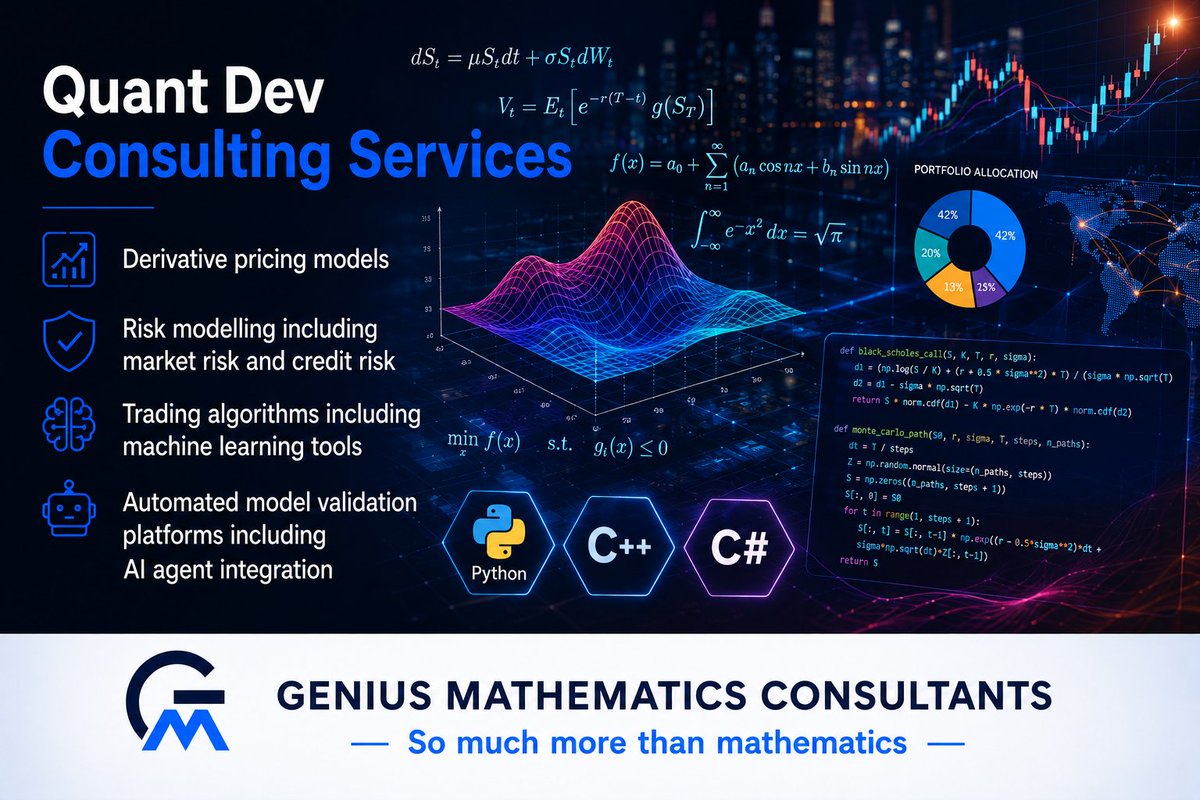
In need of quantitative development services? AI-accelerated development has dramatically increased what a small expert team can achieve, and means the classic build vs buy conundrum has shifted in favour of build for many businesses.
We offer parttime or project based engagements to allow businesses to access PhD quant expertise less expensively, in languages such as python, C++ and C#. We assist with all quant dev projects including:
- Derivative pricing models
- Risk modelling including market risk and credit risk
- Trading algorithms including machine learning tools
- Automated model validation platforms including AI agent integration
- All other coding and development projects
Are you paying an arm and a leg for vendor modelling solutions? We can help you bring modelling software in-house, eliminating high vendor fees and customizing the software for your business at the same time. For all quant dev consulting services, contact us at
Genius Mathematics Consultants
https://t.co/R5l75KAXGD
How do you validate a neural network model? Neural networks are increasingly being fitted to slow derivative pricing, market risk and XVA models to create surrogate models with lightning fast execution times, among many other applications. So how would model validation work for a neural network model?
Two key components of model validation are 1) methodology review and 2) model testing on a discrete but hopefully fairly comprehensive set of test cases.
The methodology review of a surrogate neural network would have to be a review of the methodology of the original model it is intended to replicate. For NNs which are not surrogates, it should involve a review of the fitting data, the fitting algorithm and how the NN interpolates and extrapolates the data.
Regarding model testing, many point out that a neural network is an opaque "black box", has potentially millions of parameters, and you could never test it on every possible set of input parameters. Even if it tests successfully on a set of test cases, it may still fail in between those cases. However, it's worth noting that even conventional code is often proprietary and opaque to the model validator, and could also fail due to numerical convergence issues or code faults that surface only in rare cases. Admittedly, the large number of internal parameters and numerical fitting procedures of neural networks may make them particularly susceptible to this problem.
Even when validating a model expressed as an analytic formula, you are implicitly assuming that you are validating a smooth function which doesn't "turn" too sharply, so that if the model is correct on a grid of test cases, it should also be within some tolerance for the "in between" cases.
A promising strategy for validating a neural network is to test it on a grid of input parameters, and then attempt to show that the in-between prices must be "near" the prices you have checked in some sense in order to obtain an upper bound on their errors as well. Something like a Lipschitz condition |p(x) - p(y)| < L |x-y| with global constant L would suffice. You might also impose structural constraints on the NN such as monotonicity, convexity, or bounded second derivatives etc during the fitting process. These techniques give you control over how the NN behaves in between test cases, giving you confidence that the model will behave reasonably on all inputs. The extrapolation beyond the dataset also needs to be handled carefully during both the fitting and the testing procedures. For example, an NN which replicates an option pricing model needs to behave satisfactorily on a far in the money or out of the money option.
For independent model validation consulting services, follow our page:
Genius Mathematics Consultants
https://t.co/RxtZ56LWaM
To mitigate credit risk in trading, one or both parties may be required to post both initial and variation margin. That's why we provide PhD quant consulting services for Margin Modelling and the Standard Initial Margin Model (SIMM).
While margining is often a regulatory requirement, financial services firms including proprietary trading firms and brokers/exchanges, may wish to conduct their own margin or collateral modelling to ensure they are protected against default by counterparties due to sudden changes in valuation of their trades.
To avoid disputes over margining amounts, it’s important to have a single, transparent and standardized approach that all parties must adhere to. The International Swaps and Derivatives Association prescribes an approach known as the standard initial margin model (SIMM).
At Genius Mathematics Consultants, we both build and validate margin modelling methodologies. Our parttime or project-based consulting services allow you to upgrade your margin modelling infrastructure without the expense of a fulltime hire.
Partner with our PhD quant consulting service to take your risk modelling infrastructure into the AI era. Learn more about our margin modelling consulting services at our article below:
https://t.co/MIklbINu33
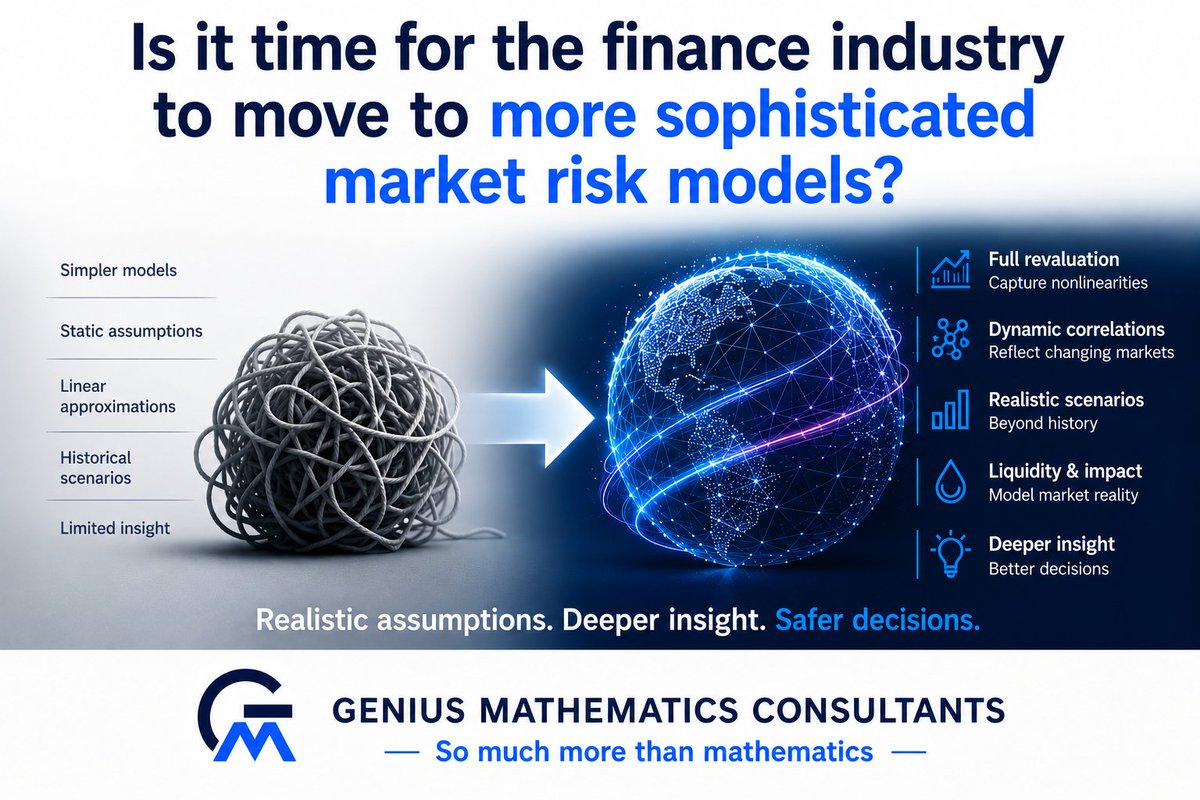
Is it time for the finance industry to move to more sophisticated market risk models? For decades, banks, exchanges and trading firms have used simplified risk models because the cost of developing more realistic models was high. With AI dramatically reducing development and validation time, this has changed.
- VaR models can be enhanced to liquidity-aware LVaR models, which recognise that periods of market stress often coincide with widening bid–ask spreads, declining market depth and reduced trading volumes.
- Market risk scenarios are often taken to be the last 250 market moves. This ignores many plausible scenarios that haven't occurred historically. Instead, scenario generation tools can be developed to realistically model risk factors and dependencies, including AI suggested scenarios.
- Simplified derivative pricing models can be upgraded to accurate ones
- Constant correlation matrices can be replaced by time varying copulas and tail dependence models
- Conventional models are slow as each scenario requires every trade to be repriced. Instead, computationally slow models can be replaced with near instantaneous neural network surrogates to allow the rapid evaluation of large numbers of scenarios.
- Instead of only validating market risk models annually, automated validation systems can be developed which can run daily or weekly, and incorporate AI into their testing.
Partner with our PhD quant consulting service to take your risk modelling infrastructure into the AI era.
Genius Mathematics Consultants - for market risk modelling and model validation consulting services
https://t.co/R5l75KAXGD
Many firms focus on certain core products, because the cost of building the infrastructure to compete in other markets is prohibitive. Or it was - AI accelerated development means expanding your operation is now cost effective.
- Are you a finance firm trading derivatives, who would like to trade new asset classes and price more sophisticated products? Or develop your risk models to get regulatory approval for new trading opportunities?
- Are you an engineering or technology firm who would like to replicate the sophisticated machine learning, signal processing and optimization models of larger competitors?
That's where Genius Mathematics Consultants comes in. We're a quantitative research and development consulting firm serving all industries from finance to technology. We use AI accelerated development combined with validation and oversight by PhD experts to achieve high quality results cost effectively.
https://t.co/3b82vzoWCs
Your team is surely using AI to accelerate mathematical work and model development, but AI can make mistakes. That's where our expert model validation consulting services come in.
Model validation has long been a regulatory requirement for industries like finance, engineering and medical. With AI flooding industries with inexpensive modelling work, it's set to become more important than ever.
Your AI accelerated development combined with independent, external review by our PhD model validation experts, means you get the efficiency gains of AI with the confidence that your models won't fail when it matters.
Genius Mathematics Consultants
https://t.co/LyZFfHluLD
Think R&D is too costly or time consuming? You're wrong! Your existing staff are busy with BAU, but without R&D you won't be competitive in the future - and that's where we come in!
Our PhD quantitative consultants augment your in-house team with part time or project-based research and development. We build quantitative tools and software for all industries from financial services to engineering.
AI-accelerated development has greatly increased what a small team of experts can achieve. So those sophisticated tools larger competitors are using? They can be yours much more affordably than you thought.
Drop us a message to start a discussion about your business, your industry, your competitors, and how we can work together to supercharge the sophistication of your business.
Genius Mathematics Consultants
https://t.co/R5l75KAXGD
Are you paying an arm and a leg for vendor modelling solutions? We can help you bring modelling software in-house, eliminating high vendor fees and customizing the software for your business at the same time.
AI-accelerated development has dramatically increased what a small expert team can achieve, and means the classic build vs buy conundrum has shifted in favour of build for many businesses.
We build modelling suites for finance, engineering and other industries, including:
- Derivative pricing models
- Risk models including credit, market and operational risk
- Trading algorithms and backtesting
- Industrial optimization
- Sensor fusion algorithms
- Machine learning applications
Drop us a message to tell us how we can help you avoid expensive vendor solutions.
Genius Mathematics Consultants
https://t.co/RxtZ56LWaM
What's fractional hiring? It's what you do when you could use specialized quantitative modelling and coding expertise, but can't justify the expense of a fulltime hire.
Fractional hiring allows smaller or less specialized firms and teams to tap into specialized expertise in an affordable and flexible way.
And with the efficiency gains of AI, a lot more can be achieved by fractional staff than was possible previously.
To learn more about how our fractional quantitative consulting service could work for your team, drop us a message today.
https://t.co/R5l75KAXGD
Why replace derivative pricing models with neural networks? Once a neural network has been fitted to the outputs of a conventional derivative pricing model, it prices virtually instantaneously. This enables:
- Real-time pricing of computationally expensive derivatives
- Option trading strategies execute faster
- Real-time calculation of Greeks
- Massive scenario analysis with millions of scenarios
- Rapid market risk calculation including intraday VaR
- Impossibly slow XVA calculations become viable
- Dramatically faster volatility model calibration
- Superior portfolio optimization
Interested in partnering with PhD quant consultants to develop neural network pricing models for your business? Talk to Genius Mathematics Consultants today.
https://t.co/R5l75KAXGD
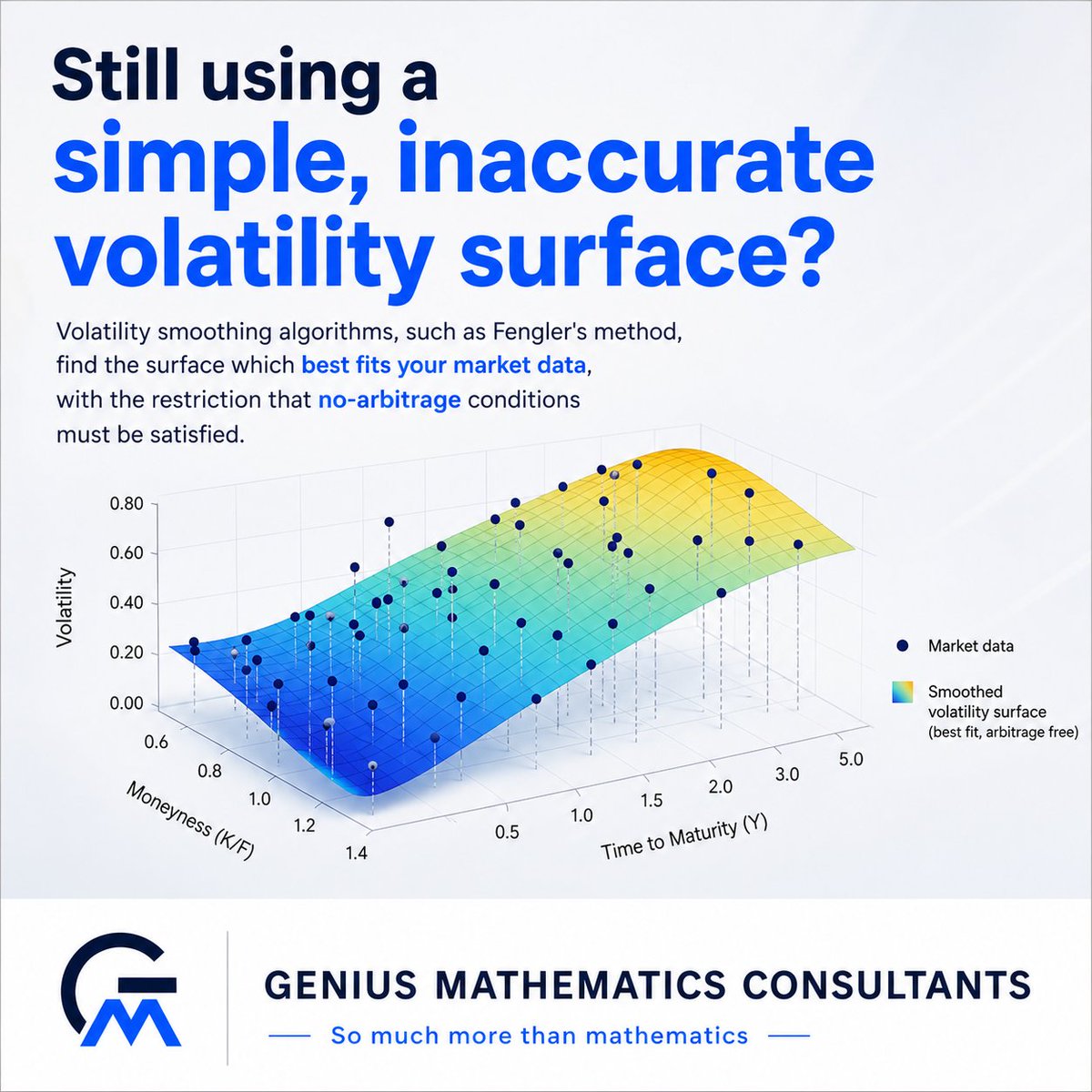
Still using a simple, inaccurate volatility surface? Volatility smoothing algorithms, such as Fengler's method, ensure that your volatility surface is arbitrage free. They find the surface which best fits your data, with the restriction that no-arbitrage conditions must be satisfied.
Unsmoothed volatility surfaces can cause:
- Option mispricings
- Arbitrage opportunities for your competitors
- Unstable Greeks
- Poor interpolation and sensitivity to slight data changes
- Numerical instability
Interested in leveling up your volatility modelling infrastructure? Learn more about our quant consulting services at
https://t.co/Frj7Ss4pMO
Do you have a model or calculation which takes a long time to run?
At Genius Mathematics Consultants we can help you replace inefficient code with more efficient models and algorithms.
This means you'll no longer be sitting around waiting for the model to finish running. And you'll be able to run the model more frequently or more comprehensively.
We can optimize models from any industry, including financial models such as market risk, derivative pricing or XVA, industrial/engineering optimization tools, or sensor processing algorithms.
Follow our LinkedIn page, and reach out anytime to discuss how we can work together to optimize your models.
https://t.co/hRyHEIgTku
As Ken Griffin from Citadel noted at the Stanford Leadership Forum in May, AI-accelerated development has decreased the time and cost of model development, and is now making sophisticated financial models attainable even for smaller or less specialized firms, or for small teams within larger firms. This includes risk models, investment models, derivative pricing models, algorithmic trading and machine learning systems.
Now is the time to be uplifting your firm's modelling, to avoid being left behind by the AI wave.
With AI rapidly becoming better at producing financial models, the focus is quickly shifting to how to validate AI generated work.
At Genius Mathematics Consultants, we combine AI accelerated development with oversight and validation by PhD human experts. This means you get the AI-powered cost savings and increased sophistication, while still having the confidence that you're building the right things and that the final product is working correctly.
What's more, we offer fractional or project-based work, so we can augment your capabilities for a fraction of the cost of a fulltime hire.
Follow our LinkedIn page, and reach out anytime to discuss how we can work together to build out your firm's modelling infrastructure.
https://t.co/hRyHEIgluW
With AI rapidly becoming better at producing financial models like option pricing models, the focus is quickly shifting to how to validate AI generated pricers.
Besides review by a model validation expert, a great way to validate option pricing models is to build a Monte Carlo pricer to use as an independent comparison. Monte Carlo is great as a validation tool, because it can price all types of derivatives, and its main drawback (slower runtime) doesn't matter so much in a validation context.
In this article, we look at how Monte Carlo pricers can be enhanced to price early exercise options using the Longstaff-Schwarz method. In particular, we look at how machine learning and optimization methods could be used to fit the decision surface.
https://t.co/d6oUtfZDjw