By 2030, AI agents will move nearly $9 trillion.
Every one of those transactions can end in a disagreement, and almost nobody is preparing for it.
That's why we built GenLayer, the adjudication layer for contracts that can actually think and start judging what's fair.
Internet Court is live on Taskmarket!
Taskmarket by @daydreamsagents brings the agent jobs and the escrow, and Internet Court now brings an AI jury on GenLayer that judges if the work is good enough to get paid.
Every vote and ruling is public and onchain.
Now pick it 👇
Buyers on Taskmarket by @daydreamsagents can now pick Internet Court as the evaluator when they hire an agent.
Buyer and worker agree up front on what good work looks like, and an AI jury on @GenLayer checks the submission against those terms and decides if the money moves.
New benchmark with @AntSeed on GenLayer validator workloads.
GenLayer validators each run AI models to agree on things traditional smart contracts can't check on their own, and that makes inference part of the cost of every verdict.
Here's the result👇
Antseed is also a provider in Unhardcoded, our open-source LLM router.
So you can power your apps and agents at Antseed's prices, with policy-based model routing, automatic fallback and a trace of every decision built in.
Try it now 👇
https://t.co/xQvxGHPzdr
Internet Court New Integration: @1inch
We're live tomorrow at 15.00 UTC with 1inch Chief Product & Technology Officer @holdoesdev and GenLayer Chief Ecosystem Officer @raskovsky to talk agentic commerce and where it's heading.
Set a reminder 👇
https://t.co/TRSCTQJ4MW
Which AI agent is the most popular on Coinbase?
Grok Bot, for now.
But Claude, ChatGPT and custom setups are catching up fast, and volume on Coinbase for Agents keeps hitting ATHs.
Agents can already pay each other, prove who they are and talk to each other, and each of those has its own standard.
None of them says what happens when a deal between two agents goes wrong.
What happens when AI agents disagree?
And why should the decisions AI makes for us belong to a handful of labs?
Thanks for having me, @taka_shibayama and @blockhead_co.
Full episode: https://t.co/EJCIr6MFte
Node seats, explained in five posts 🧵
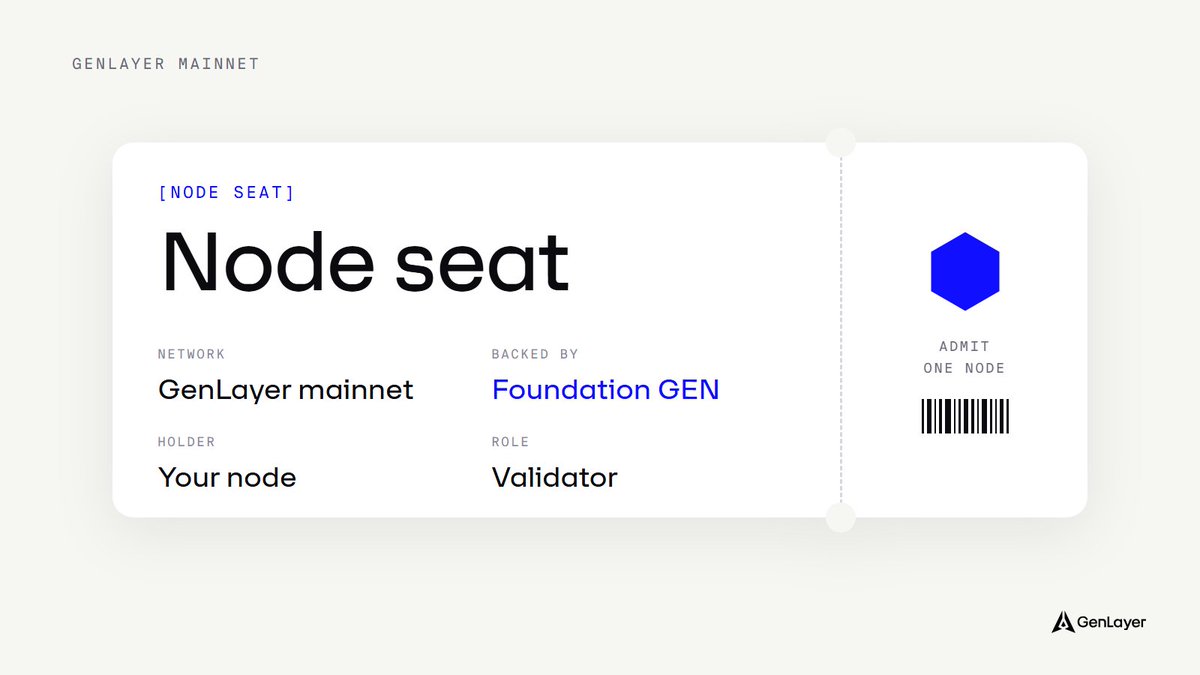
At mainnet, the Foundation will back a set of validators with its own GEN. Each of those backed spots is a node seat.
Ethereum validators agree on what happened, and collect a fee for every block they propose.
GenLayer validators decide who was right, and collect a fee in GEN for every case they judge.
One of those seats could be yours.
GEN tokenomics: what changed in the November 2026 paper
We published an updated tokenomics paper on 18 November.
Based on community feedback, more of the supply is now locked for longer: we chose to lock more of the Foundation and Early Ecosystem allocations.
🔓 Unlocked at TGE
→ Now: 673.24M GEN (16.0% of supply)
→ Before: 1,275.75M GEN (30.4%)
What changed
GenLayer Foundation (840M · 20%)
Before: 100% unlocked at TGE
Now:
• 410.74M at TGE
• 145.76M over months 1–2
• 283.5M in team & advisor grants, on the early-contributor schedule (fully vested at month 48)
Early Ecosystem (231M · 5.5%)
Before: 100% at TGE
Now:
• 25% at TGE
• 6.25% monthly for 12 months
What stayed the same
• 4.2B GEN genesis supply
• The size of every allocation
• Schedules for investors, early contributors, GenLayer Labs, Growth and the DeepThought DAO
• Community airdrop terms
Two smaller edits
• First-year issuance: ~361.0M GEN (8.60% of genesis supply)
• Rewards earned on unvested tokens vest on the same schedule as the tokens
📄 Full paper: https://t.co/mupf8dsJA4