ML PICK OF THE DAY
- Dodgers ML (-125) 1 Unit
Easy cash for us today. The Cubbies and Boyd have nothing thats able to stop what Shohei will do to them.
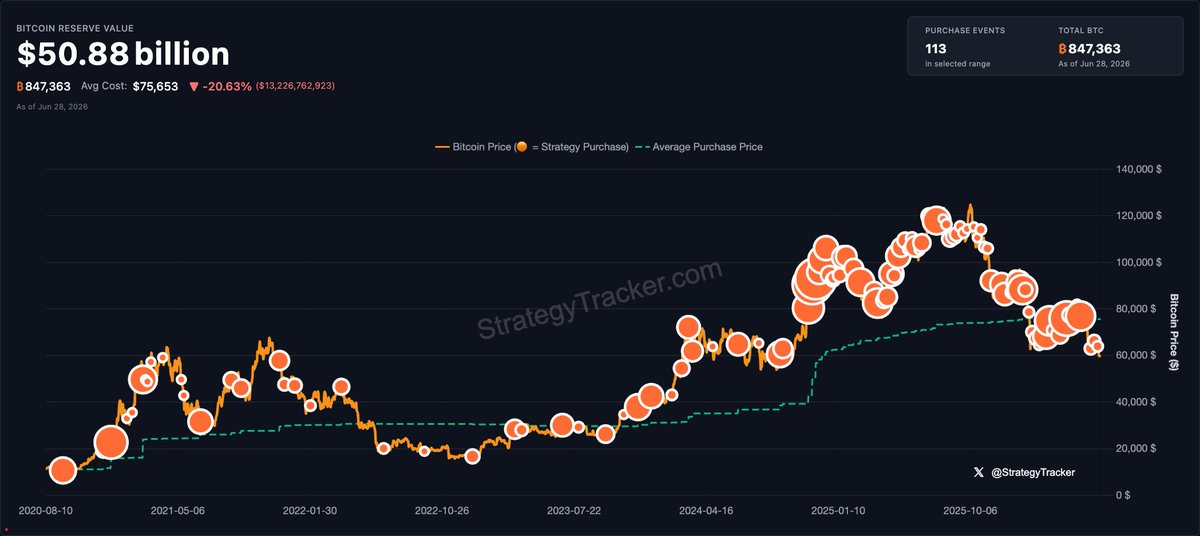
MSTR is probably the most hated asset on my timeline right now.
That’s exactly why I’m going gigalong around $84.
Everyone has the same objections:
Dilution.
“Saylor is printing shares.”
STRC below par.
80%+ drawdown from the highs.
Shorts making money on SMST.
“Just buy spot BTC.”
“Just buy IBIT.”
I get it. None of that is fake. The bear case has real pieces.
But the part people keep missing is that MSTR is not just a cleaner or messier way to own Bitcoin. The common equity has a very weird payoff profile because of the capital structure.
Start with the simple relationship.
Since Saylor started buying BTC, the historical log regression has looked roughly like this:
log(MSTR) ≈ a + 1.53 × log(BTC)
R² ≈ 0.91.
So historically, BTC +100% mapped to MSTR around +189%.
BTC -50% mapped to MSTR around -65%.
Obviously that is not a guarantee. It is just the relationship the market has actually priced over the cycle.
The uncomfortable part is the path.
You do not get the upside without eating the drawdowns, the dilution headlines, the preferred drama, the premium compression, and the endless “Saylor top ticked it” jokes.
Most people cannot hold that.
Now look at the current stack.
Debt + preferred is roughly $22.2B of senior claims, fixed in dollars.
Gross exposure today is about 218k sats per share.
After subtracting that senior stack in BTC terms, common equity is getting about 123k sats per share.
So roughly 95k sats per share are being eaten by the senior claims today.
That sounds bad until BTC moves higher.
If BTC goes to $150k, those fixed-dollar claims shrink hard in BTC terms.
Common equity NAV rises to roughly 180k sats per share.
So the common goes from about 56% of gross BTC exposure today to roughly 82% of the gross ceiling.
Same BTC stack. Same debt stack. Higher BTC price.
That’s the convexity.
With no additional BTC purchases and no mNAV expansion:
BTC from roughly $60k to $150k is about +150%.
Common equity exposure goes from about 478k BTC-equivalent to about 699k BTC-equivalent.
At the same multiple, common NAV is up roughly 260%.
That extra performance is not magic. It is the fixed-dollar senior stack shrinking in BTC terms and the delta flowing to the common.
Current sensitivity is roughly 1.75% common NAV move for every 1% BTC move.
That is why I think people calling this “just levered BTC” are missing the point.
The leverage is embedded in the structure, but it does not behave like a normal margin trade where a BTC drawdown automatically liquidates the position.
There are still risks. Real ones.
Dividend obligations matter.
STRC trading below par matters.
Dilution matters.
mNAV sitting around 1x matters.
Capital markets access matters.
If the market stops paying a premium for the strategy, the flywheel slows down fast.
But when MSTR can issue common above NAV, the math can actually help existing holders because the company raises more BTC-equivalent capital than the shares dilute.
That is the BTC-per-share accretion story.
The new ATM programs, $21B STRC and $21B common, give Strategy a lot more room to keep playing that game.
Issue capital.
Buy BTC.
Manage leverage.
Rebalance.
Repeat.
It is messy. It will never look clean in real time. There will always be a reason to hate it.
That’s why the setup is interesting.
You have a hated equity, a stressed preferred, a compressed multiple, a market obsessed with dilution, and a structure that gets much cleaner if BTC simply grinds higher over the next few years.
That is the bet.
Not that every headline is bullish.
Not that dilution is fake.
Not that STRC does not matter.
The bet is that BTC goes higher, the fixed-dollar claims shrink in coin terms, the common captures more of the stack, and the market eventually prices that convexity again.
The strategy survived 2022, raised tens of billions, added hundreds of thousands of BTC, and now sits with reserves massively above debt.
Volatility breaks most balance sheets.
This one was designed for it.
That’s the whole bet.
I’m not buying comfort.
I’m buying convexity.
$MSTR bitcoin:native
@CaponeCovers Buddy talked about our number one rule is transparency yet he deleted his picks from yesterday which lost and update his tracker to only show the winner lol what a joke
June might be the most important month in $ASTS history. Here's what's about to happen.
Every catalyst this company has been building toward is converging into one 4-week window.
Mid-June -- BB8, BB9, BB10 launch on Falcon 9.
Three BlueBird satellites in one shot. Constellation goes from 6 to 9. This is the first multi-satellite launch since the company proved 98.9 Mbps from orbit. Every successful launch makes the bear case harder to hold. Hardware in space doesn't care about your price target.
May 22 -- Russell preliminary additions list.
$ASTS at $27B+ market cap easily qualifies for Russell 1000. Once the list publishes, every index fund tracking the Russell knows they MUST buy. The buying hasn't started yet. It's coming.
June 26 -- Russell reconstitution.
This is the day index funds are forced to buy $ASTS shares. Not "choose to." Forced. Passive money doesn't read earnings reports or care about revenue misses. It buys because the index says buy. Billions in passive capital rebalances on this date.
June 12th (tentative) — SpaceX IPO at ~$1.75/ $2 trillion.
This reprices the entire space sector. If the market values SpaceX's D2D business at $100B+ inside a $1.75T company, the only public pure-play D2D stock on earth gets repriced. Money that can't buy private SpaceX looks for public alternatives. There's one. It's $ASTS .
Every shorted share is a future buy order.
End of May or June -- Carrier JV details emerge.
AT&T, T-Mobile, Verizon just announced their D2D joint venture. The JV needs a technology partner. Two of the three carriers are already ASTS equity investors. The details of who gets selected, what spectrum gets pooled, and what the timeline looks like will start leaking this month.
Ongoing -- 33 satellites in production, shipping to Cape Canaveral.
BB11 through BB33 are in advanced stages of assembly. Phased arrays done through BB28.
The factory is producing 10 satellites worth of microns per month. The next launch after mid-June won't be far behind.
Stack all of this:
Three satellites launching ✅
Russell forced buying ✅
SpaceX IPO repricing the sector ✅
Short interest at historic highs ✅
Carrier JV details incoming ✅
33 more satellites in the factory ✅
All in June. All confirmed. None of this is speculation.
The last time $ASTS had a single major catalyst, the stock moved 30-50% in a week. This month has six of them stacked on top of each other.
And the stock is sitting at $84 after a revenue miss that management said was planned.
I'm not telling you what to do. I'm telling you what's about to happen. Enjoy the ride!
$ASTS 🛰️
Strategy has acquired 24,869 BTC for ~$2.01 billion at ~$80,985 per bitcoin and has achieved BTC Yield of 12.6% YTD 2026. As of 5/17/2026, we hodl 843,738 $BTC acquired for ~$63.87 billion at ~$75,700 per bitcoin. $MSTR $STRC
https://t.co/edM1l29DZG
People are sleeping on what $ASTS actually is as a business. Let me show you why this could become one of the greatest cash flow machines ever built.
First understand the comparison.
Netflix has 325 million subscribers paying $15 a month. $45 billion in annual revenue. $380 billion market cap.
They spent 15 years and tens of billions in content spend acquiring every single one of those subscribers one at a time.
Spotify has 290 million premium subscribers paying $11 a month. $17 billion in annual revenue. $120 billion market cap.
Same story. Years of losses. Billions in marketing. Fighting for every user.
$ASTS does not work like that.
$ASTS charges carriers a wholesale fee per subscriber. AT&T does the acquisition. Verizon handles the billing. T-Mobile manages the churn.
$ASTS provides the network layer and collects on every user that opts in. No customer acquisition cost. No marketing spend. No churn risk. Pure recurring infrastructure revenue.
Now here is the simple math.
3.3 billion subscribers sitting inside partner carrier networks today. Management is guiding 2027 revenue approaching $1 billion with half the commercial pipeline already booked.
Analysts project $1.6 billion in 2028 with profitability expected that same year.
At $5 per user per month on 1 billion subscribers that is $60 billion in annual revenue.
Netflix generates $45 billion serving 325 million subscribers they had to fight for one at a time.
$ASTS has access to 10x that subscriber base through partners who already own the customer relationship.
FCC authorized up to 248 satellites. They are targeting 45 to 60 by end of 2026. The revenue curve has barely started.
This is not just a satellite company.
It is one of the most scalable subscription infrastructure businesses ever built.
$NBIS has two revenue contracts:
$17.4B with Microsoft (through 2031)
$27B with Meta (over 5 years)
Total contracted revenue: $44.4B
Market cap today: ~$28B.
You are paying $28B for a company with $44.4B already contracted.
The math is broken. In your favor.
🚨 JUST IN: $NBIS "Data Centers activation as the key to accelerated growth in 2026-2027 & beyond".
To reach $7B-9B ARR I have compiled a list of the current & tentative projects. I have calculated an average $9.74M x 1MW ARR activated. There are a few projects that we have not heard publicly yet only rumours and details from city councils & real state but hoping this info is useful enough to understand that growth is coming & it will be massive if properly executed. 🎯
I have no doubts that hyperscaler contracts like $META should increase substantially the moment we start selling the new capacity coming aboard in the new projects that will be announced in 2026. CEO Volozh mentioned that if Nebius had larger capacity available that amount in the contract revenue could have been more.
The compounding numbers that $NBIS could reach after 2027 are unheard of in a Tech player that came into action recently but as I always say the best is yet to come... we are only scratching the surface at this point.
EU & other global markets (Sovereign) are not even accounted for. The pace at which they are executing as more AI opportunities are coming aboard (LifeSciences, NVDA Partnerships, Physical AI & Robotics) make me very optimistic about the future. ROI is coming 🫰
$NBIS
AI is real.
$17B deal over 7 years.
That's $2.4B a year from Microsoft $MSFT.
Nebius is projecting $625M of revenue by the end of 2025. Microsoft's revenue alone would increase their revenue growth by 3x YoY.
Congrats to everyone in this name, retail found another gem & that gem was in the AI/Datacenter space in the face of people screaming that the entire thesis on capex was a bubble.
Incredible.
JUST IN: $NBIS announces multi-billion dollar agreement with Microsoft for AI infrastructure. 🔥
Under this multi-year agreement, $NBIS will deliver dedicated capacity to Microsoft from its new data center in Vineland, New Jersey starting later this year.
Arkady Volozh, Founder and CEO of Nebius, said:
“Nebius’ core AI cloud business, serving customers from AI startups to enterprises, is performing exceptionally well. We have also said that, in addition to our core business, we expect to secure significant long-term committed contracts with leading AI labs and big tech companies. I’m happy to announce the first of these contracts, and I believe there are more to come. The economics of the deal are attractive in their own right, but, significantly, the deal will also help us to accelerate the growth of our AI cloud business even further in 2026 and beyond.”
$NBIS expects to finance the capital expenditure associated with the contract through a combination of cash flow coming from the deal and the issuance of debt secured against the contract in the near term, at terms enhanced by the credit quality of the counterparty. The company is also evaluating a number of additional financing options to enable significantly faster growth than originally planned and will update the market on its financing strategy in due course.
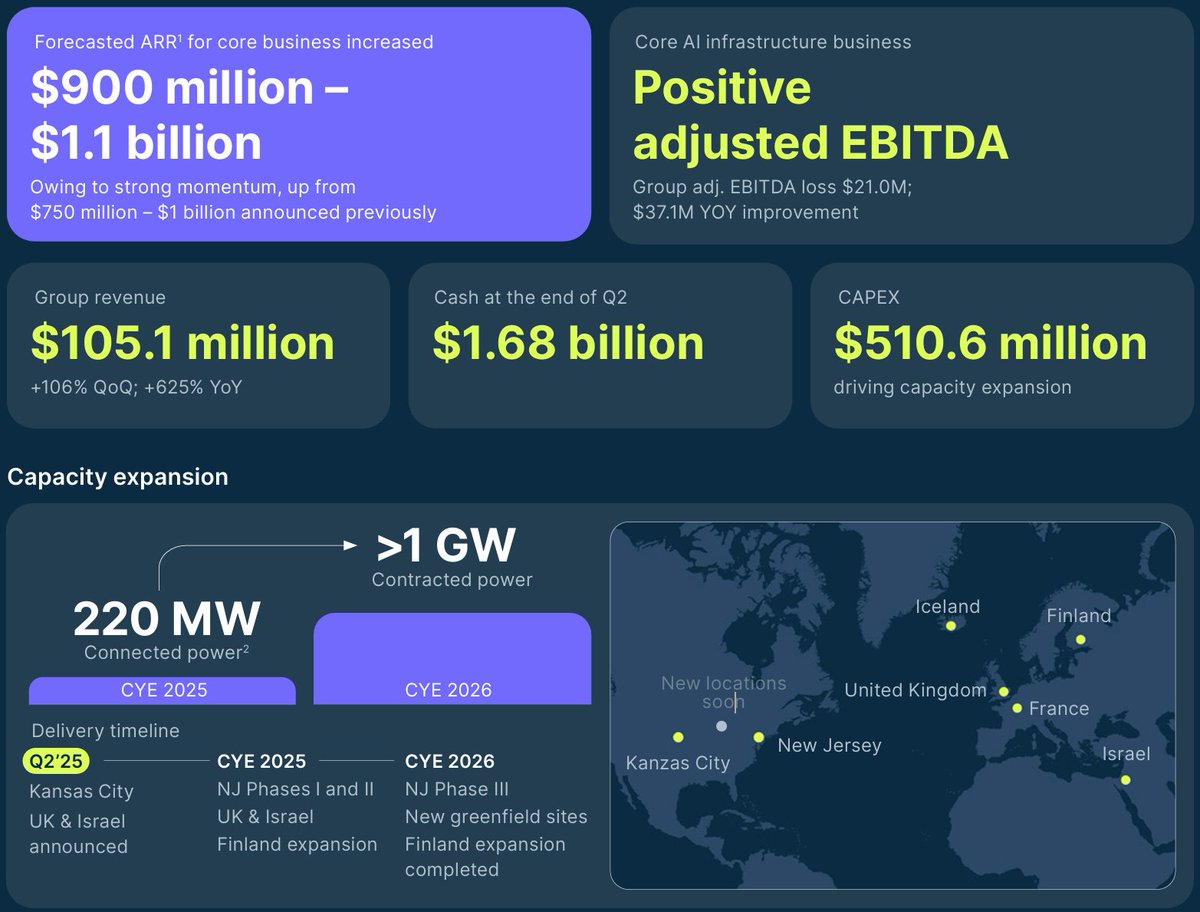
$NBIS with a crushing quarter!
Increased ARR guidance to $900 million - $1.1 billion by the end of 2025.
Q2 revenue of $105.1 million, a 625% increase year-over-year.
Achieved positive Adjusted EBITDA for the core business sooner than planned.
Working to secure over 1 GW of power by the end of 2026.