@ccg_unam Y sugerimos que la gran diversidad de grupos de genes biosintéticos codificados en estas bacterias podría explicar las propiedades antifúngicas del microbioma protector de la piel de los anfibios.
@ccg_unam En resumen, proponemos un conjunto de grupos de genes que pueden sintetizar compuestos antifúngicos, lo que los convierte en candidatos prometedores para estudios futuros.
And, we suggest that the vast diversity of biosynthetic gene clusters encoded in these bacteria could explain the antifungal properties of the protective skin microbiome of amphibians.
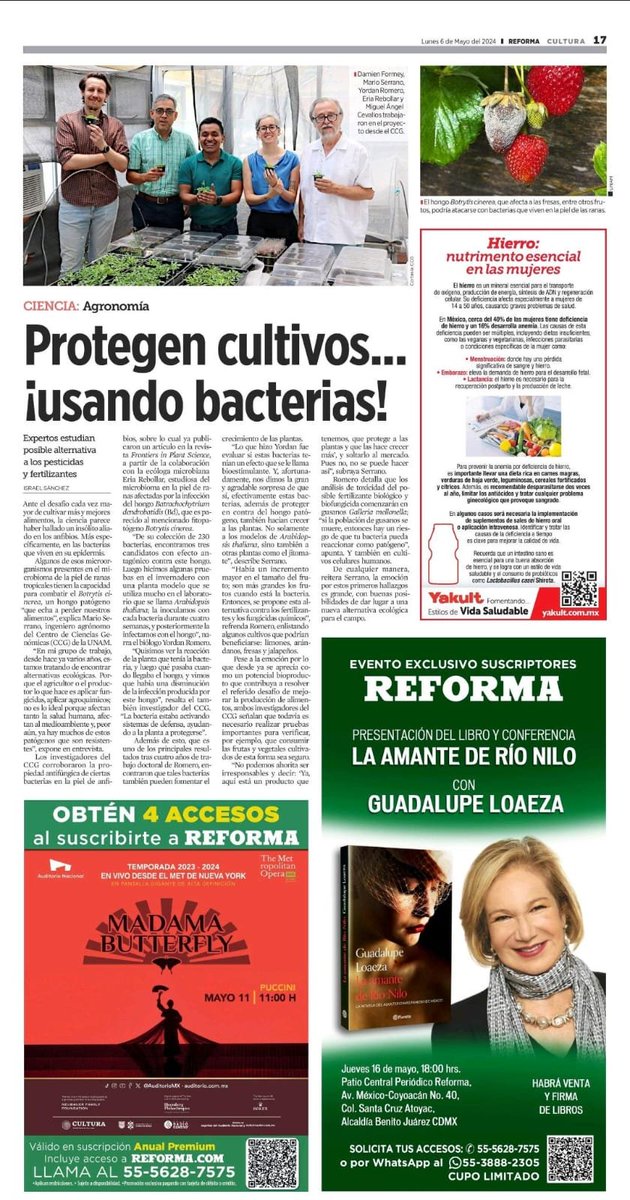
Protegen cultivos... ¡usando bacterias!
Les compartimos esta nota en el @Reforma @reformaciencia , a cargo de @israelgRim, sobre una investigación colaborativa desarrollada en el CCG.
https://t.co/2VQIzpJHgG
The ISME ECSC is spotlighting Santiago Ramírez Barahona (@LabSpiritu), a @ib_unam Assistant Professor, and his paper “Host phylogeny and environment shape the diversity of salamander skin bacterial communities.”
https://t.co/K7dLTwrA0V
(1/2)
In summary, all of this indicates that the phylogeny of the salamanders is also important in determining the diversity of their bacterial microbiota. In simpler terms, this suggests that closely related species will have a similar microbiota.
We found that the type of habitat had the most significant effect on the diversity of the microbiotas. The phylogenetic distance between hosts, particularly the structure of bacterial communities, also played are associated. Climate did have an impact but to a lesser extent.