The UCSC Genome Browser is a public, freely available, open-source web-based graphical viewer for the display of genome sequences and their annotations.
New on the UCSC Genome Browser (hg38): MPRA tracks. MPRA Base catalogs 40,938 experimentally tested enhancer elements across 6 cell lines; MPRAVarDB scores 239,028 allelic variant effects from 18 studies. Great for GWAS fine-mapping. Learn more: https://t.co/hoQ2c6FKp5
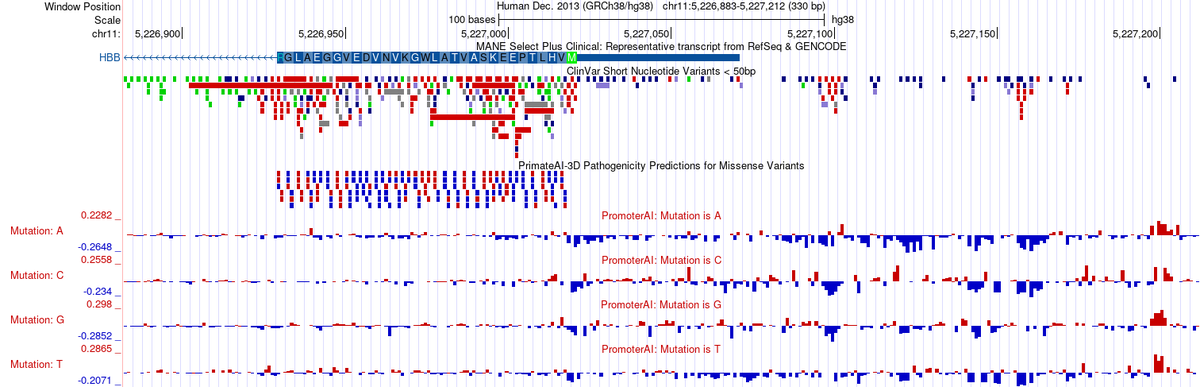
Two new variant-impact tracks from Illumina on the UCSC Genome Browser: PrimateAI-3D scores every coding missense variant (hg38/hg19); PromoterAI scores every non-coding substitution near transcription start sites (hg38). See our news for more: https://t.co/FMNe3en9L5
Check out our new NMD Escape tracks on hg38! They predict where premature stop codons escape nonsense-mediated decay. Useful for interpreting truncating variants under ACMG PVS1. Includes GENCODE+RefSeq rulesets + predictive scores. See our news for more: https://t.co/4i01Pn6x5U
New "Tandem Repeat Variation" tracks on hg38. Browse STR/VNTR data from WebSTR, STRchive, TRExplorer, ToMMo, and 1000 Genomes ONT, plus gnomAD STR genotypes at 87 disease loci. Explore allele frequencies across diverse populations.
Read more at: https://t.co/jf5JP4ECj8
New heatmap display mode for bigBed tracks in the UCSC Genome Browser! Visualize multi-sample quantitative data as color-coded grids directly in genomic context, great for variant effects, expression & methylation. See our docs & try it out: https://t.co/paRZiudSq5
@zikun__yang Hello,
Thank you for your question.
At this time, we do not plan to add this track to T2T-CHM13v2.0. You may find our QuickLift feature helpful. QuickLift maps genome annotations to another assembly on demand. More details are available here: https://t.co/UzhtayGPT4
We are excited to announce the release of the Human Methylation Atlas Summary and Signals tracks for hg38 and hg19. The tracks display genome-wide DNA methylation profiles across 39 primary human cell types from 205 healthy tissue samples.
Learn more at https://t.co/GB3hxaYo1H
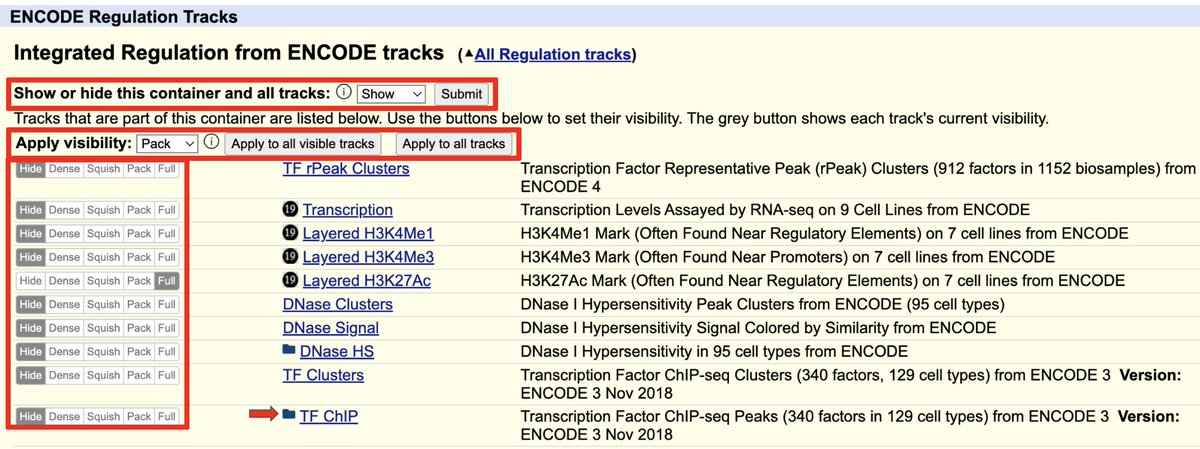
The supertrack configuration page has new controls for track visibility. "Apply visibility" buttons set visibility across visible or all tracks, Hide/Dense/Squish/Pack/Full buttons replace dropdowns, folder icons indicate container tracks.
More info: https://t.co/vqYTjtGw4M
We've added two gnomAD coverage tracks on human hg38:
gnomAD v4 Exome Coverage — mean/median depth & sample % at 1X–100X thresholds across exome samples.
gnomAD v3 Genome Coverage — same metrics for 71,702 whole-genome samples.
Learn more at:
https://t.co/A0EyBcTSRL
New Recent Genomes & Connected Hub Assemblies lists on the Gateway page, plus genome search across more tools. Recent Genomes also appears in the blue bar under Genomes. Species Tree now hidden by default (click “Show species tree” to view).
More info at https://t.co/cQXHSpSwDg
We are happy to announce our new public hub, VRMOD CRM for hg38/mm10. It shows experimentally defined, predicted, and epigenomically supported cis-regulatory elements across tissues & cell types: https://t.co/NcaWpjN3Jd
Thanks to Zhao Lab at WashU Medicine for creating this hub.
We are happy to announce the JASPAR 2026 tracks for hg38, mm39, danRer11, galGal6, dm6, ce11, ci3, and sacCer3, which represent genome-wide predicted binding sites for transcription factors with binding profiles in the JASPAR CORE collection.
More info: https://t.co/OO095bBDJo
A new Phased Variants container track for hg38 and hg19, and brings phased individual-level genotype data from: Human Diversity Genome Project, Simons Genome Diversity Project, gnomad's HGDP+1000 Genomes callset, and the Mexico Biobank.
Learn more at: https://t.co/ZZZ2bPxkrG
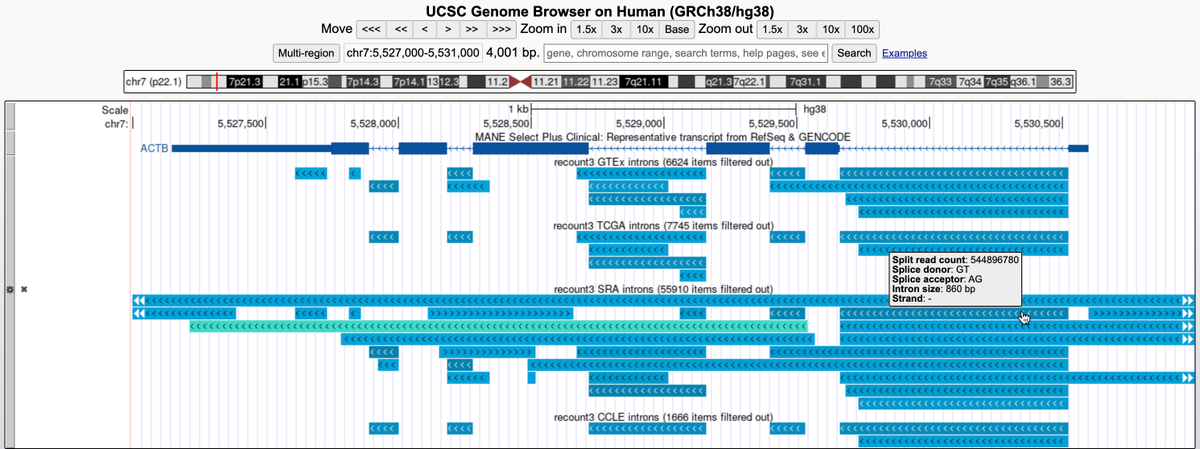
We are happy to announce the recount3 tracks for hg38 and mm10: uniformly processed RNA-seq data from multiple studies, featuring intron data, split read counts, and splice junction motifs for cross-study comparisons and meta-analyses.
Learn more at: https://t.co/BwVyj8H87S
We are excited to introduce Hub Space, a new hosting service that enables users to upload and visualize track hub files directly on the UCSC Genome Browser without relying on third-party hosting services such as Dropbox, Google Drive, or AWS.
Learn more: https://t.co/QVJtx22pXQ
We are excited to announce that the Genome Browser now includes a dynamic track group that automatically displays all currently visible tracks in one convenient location.
The group has more than 32 tracks available for a genome assembly.
Read more here: https://t.co/odmrNef2Qv
These data display regions identified by biochemical signatures predicted to regulate gene expression as promoters, enhancers, or other regulatory elements.
We would like to thank @ENCODE_NIH, @ZhipingWeng, and @MooreJillE for their work in producing and displaying these data.
We are proud to announce a new ENCODE Registry of cCREs (candidate Cis-Regulatory Elements) track for hg38 as described in Moore et al., Nature 2026.
See our news for more: https://t.co/WYx0T7bF5W
We recently added Neanderthal and Denisova variant tracks for GRCh38/hg38. Thanks to the Archaic Sequence Hub (https://t.co/WDO1gYQyAh) for compiling the data and making it available. View the data on the Genome Browser: https://t.co/aYwhV7C7Lg.