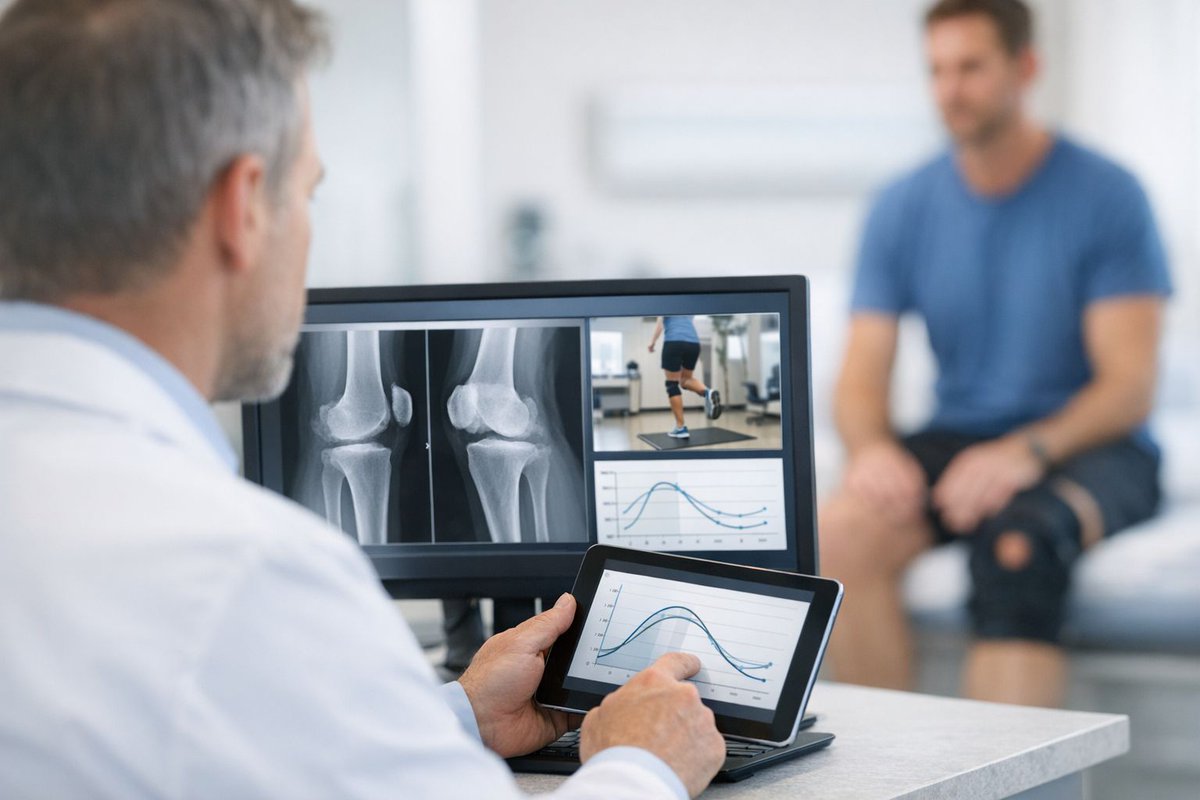
🔸Robotic Arthrometers: Knee Rotation 🔃 & Translation ↕️ testing
🔸Spine deep core muscle rehab devices
We create the new boundaries of orthopaedic care 💯🚀
@memphisdepay being tested on one of our #arthrometers 😃👌💯 Thank you @fcbarcelona for trusting our company 😌
Last year, following an #ACL injury one of the worlds greatest athletes has been tested on our #GNRB arthrometer which can be seen on the lower part of the pic!
Post-ACL reconstruction monitoring should not start only when problems appear. In high-risk athletes, clear baselines, timed follow-ups, and attention to red flags can support better-informed clinical decisions after ACL reconstruction. https://t.co/W5Z0IQnS1c
Pivot shift quantification matters because anterior translation alone does not fully describe ACL-related instability. This article reviews the clinical value of assessing rotational laxity and the need for more objective evaluation. https://t.co/p15mguwoSq
A side-to-side knee laxity value helps quantify asymmetry, but the number alone may miss how the ligament behaves under load. This article explains why compliance adds useful clinical context. https://t.co/lZGVKnJcOK
Knee giving way but MRI looks fine? Knee instability normal MRI can still be real. MRI is static, while laxity shows in a hands-on exam and sometimes instrumented stability testing. https://t.co/3t6uGxi1Fs
In ACL tears hyperlax patients, “normal” translation may reflect baseline laxity, not an intact ACL. Rely on context and repeatable objective laxity measures alongside exam and imaging, not one cutoff. https://t.co/87rH9dx8k2 #ACL
After ACL reconstruction, the calendar is not enough. Follow-up testing using objective knee laxity plus strength or hop symmetry helps guide safe progression and return-to-sport conversations. https://t.co/xhmQewcyB5 #ACLSurgery
No pop does not rule out ACL injury. A rapid effusion, instability, or a positive Lachman can still be there with an atypical story. Re-exam when guarding settles and consider instrumented laxity testing. https://t.co/9NmTpOmLmI #ACL
In suspected multi-ligament knee trauma, a structured multiligament knee injury assessment helps prevent missed neurovascular issues and supports consistent documentation from ER to clinic. Quick workflow here: https://t.co/xutMmR1jgz #Orthopedics
Partial ACL tear diagnosis often sits in the grey zone. The 2023 Theo Cojean study (GNRB vs MRI) highlights how instrumented laxity testing can complement MRI when results are equivocal. https://t.co/orgG6p3zHi
Persistent pivot shift after ACL? The anterolateral complex knee (ALL, capsule, ITB fibers) is a key restraint to internal rotation. Knowing the ALC helps interpret instability and plan workup and treatment. https://t.co/AoguWjWO72 #ACL
ACL graft stretch vs failure can look similar early. A structured workup helps: history + repeat exam, then confirm with imaging and objective knee laxity (instrumented) testing when needed. Read: https://t.co/QqqCmE96JC #ACL
High-grade pivot shift is a red flag for significant rotatory instability. Recheck for contributing lesions and plan how stability will be addressed and tracked, ideally with objective measures plus exam. https://t.co/As65RK8TbD #ACL
Dynamic knee laxity testing: multi-axis measures can complement exam/imaging when tracking instability in rehab and return-to-sport. Cites Dyneelax & GNRB arthrometer studies. https://t.co/XQST8zGnk1
In the MCL valgus stress test, angle matters: ~20–30° better isolates the MCL; laxity at 0° raises suspicion for additional restraints. A practical workflow for testing, grading, and monitoring: https://t.co/1BQCOw6Uqh #SportsMed
Pediatric ACL injury diagnosis can be blurred by guarding, partial tears, and growth-related anatomy. An objective baseline (instrumented knee laxity) can help track stability over time—alongside exam + imaging. https://t.co/wXvYQsD4ru
Rehab milestones can look good while knee stability metrics lag (or lead). If they diverge, don’t base RTS on milestones alone—add objective laxity assessment. https://t.co/0IziYsmK8z
Passing strength/hop tests doesn’t guarantee knee stability. ACL return to sport criteria are stronger when you also quantify objective laxity (e.g., instrumented arthrometry) alongside clinical exam + function. https://t.co/0yx0x2pFhF #ACL