@culturaltutor For Dürer, every composition was an expression of the divine. He would etch on to his earliest (1493) self-portrait:
"Things with me fare as ordained from above."
@culturaltutor Here are a few more wonders of Sudano-Sahelian architecture:
1. Larabanga Mosque, Ghana
2. Grand Mosque, Bani, Burkina Faso
3. Yaama Mosque, Niger
Architecture is not mere building, but beautiful building. It begins with a hut & ends with a temple.
@culturaltutor Brutalism can also be beautiful, as some Brazilian architects establish.
Or rather, nobody does Brutalism better than the Brazilians. Here are a few works by Oscar Niemeyer, Lina Bo Bardi and Vilanova Artigas.
In 3rd century BCE, Bindusara, the 2nd Mauryan king wrote to the Greek king, Antiochus I. He asked for sweet wine, dried figs & a philosopher. Antiochus sent wine & figs but Greece forbade selling philosophers.
Instead, fate gave Bindusara a philosopher-king in his son: Ashoka.
If you enjoyed reading this thread, you may also enjoy reading about Ashoka's predecessor - the founder of the Mauryan empire, Chandragupta Maurya.
I wrote about it previously here:
https://t.co/FGvJEsGhgr
In 327 B.C., Alexander the Great invaded India. Traversing the Hindu Kush, he established his rule in India.
Seven years later though, all trace of Macedonian authority in India had vanished entirely.
The chief agent of this removal was a young warrior: Chandragupta Maurya.
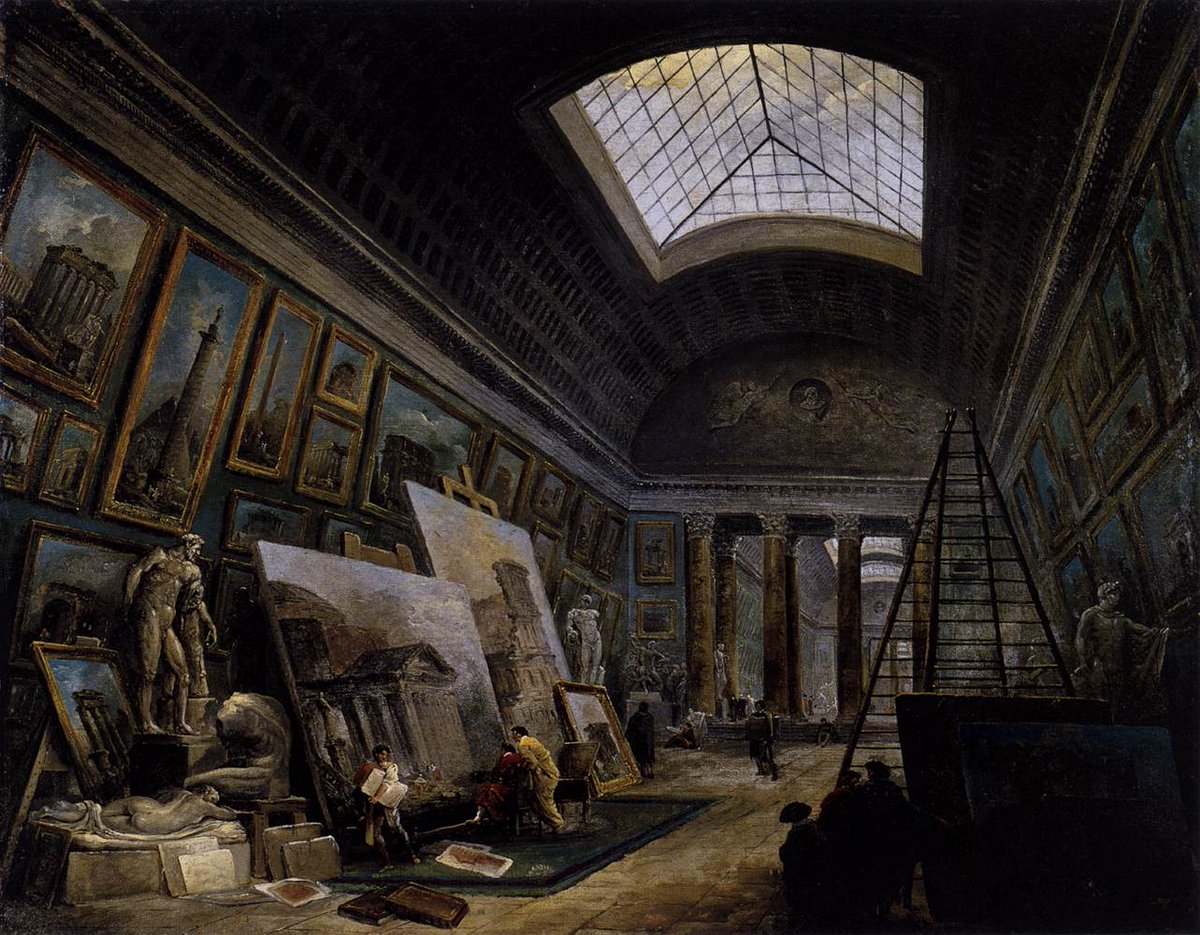
@culturaltutor In 1789, Hubert Robert composed a painting titling it "Imaginary View of the Grande Galerie in the Louvre," 4 years before the museum even opened.
Exactly a century later in 1989, M. Pei, an architect, by knowledge or sheer coincidence, designed its iconic "Pyramid" entrance.
@culturaltutor Amusing fact: One isn't allowed to photograph the Chapel. Story is when it underwent restoration (1980-94) the Nippon TV Corporation funded it in return for "exclusive rights to the artwork."
The Vatican decided to keep the ban in place to protect the artwork from camera flashes
@culturaltutor Rani ki Vav, like many other architectural structures in India, is designed as an "inverted temple," to highlight the sanctity of water.
Interestingly, its excavation in 1940 followed the oral histories of local folk speaking of the "old royal well nearby."
@culturaltutor A lesser known symbolist painting by Gustave Doré is "Les Saltimbanques (The Street Performers)."
In it, Doré sought to comment on the performers' misery & alienation, writing "To gain money, they have killed their child & in killing him, they've found they had hearts."
@culturaltutor Fanny López Jiménez was the only woman on the archaeological team excavating the site in 1994. Others on the team got to work on "cool" projects & buildings. Meanwhile, they tasked Lopez with the staircase because somebody had to do it.
She found the tombs instead.
@Rainmaker1973 Archaeological skeletons inhibit the imagination.
Instead, imagine him in all his grandeur, adorned with the outfit & jewellery, with this reconstruction:
@culturaltutor Piranesi trained early on arranging scenic design on a stage. Then, prison scenes on stage were common backgrounds against which actors would enact.
It is believed these experiences of Piranesi found their expression through Carceri (1750).
South Asia (India & Nepal) celebrates Buddha Purnima today, to mark the birth of Gautama Buddha - the founder of Buddhism.
But there is simply no Buddhism without Ashoka the Great. Buddha was content with his own salvation; Ashoka instead shared it with others:
In 3rd century BCE, Bindusara, the 2nd Mauryan king wrote to the Greek king, Antiochus I. He asked for sweet wine, dried figs & a philosopher. Antiochus sent wine & figs but Greece forbade selling philosophers.
Instead, fate gave Bindusara a philosopher-king in his son: Ashoka.
@culturaltutor Interestingly, The Arcade in Downtown Cleveland was modelled after Galleria Vittorio.
Moreover, the Galleria had no electricity when it was built. A little device ran along a track at the base of the dome pushed by a clockwork mechanism, and lit hundreds of gas burners.
@culturaltutor When archaeologists rediscovered Crete, they found the portrait of a stylish woman (or goddess) with a pleasant neck, an impertinent nose and a persuasive, provocative charm.
They named the excavated woman "La Parisienne."
@culturaltutor The Church, beginning Late Antiquity (3rd-7th century) arranged an ecclesiastical calendar in which every day celebrated a Saint. This later developed into the Tridentine calendar in the 20th century.
Every harsh reality of daily life found an emergency friend in the skies.