A new visualization has been released on @mediazzzona’s 200x map: showing not only where Russian soldiers came from, but also where they died.
https://t.co/ecktW9URSk
Quite a sight. It even shows the distance each of the dead travelled from their hometown to the place where they were killed. At least 1,000 km in many cases.
“You wanted this land so badly. Well, now become one with it.” (c)
Just imagine sending nearly a thousand men to die for a three-street village. Hundreds of times.
Glad I donate to Mediazona, even if it’s only a little.
🇺🇦Вооруженные Силы Украины выбили диверсионно-разведывательные группы противника из населенного пункта📍Купянск-Узловый, - свобождено ≈3,47 км².
Об этом свидетельствует видео, на котором офицер ВСУ демонстрирует полный контроль безопасности в центре населенного пункта.
I keep speaking out so that the whole world can see. The world must know what is happening in our country.
Today at 10:00 am, russian forces launched an airstrike on the city of Sloviansk. A 77-year-old man was killed right outside his driveway, and 11 other people were injured.
I want to thank the guys from the Special Operations Forces of Ukraine. Today, our drones struck a Russian military airfield. The very airfield from which Russian aircraft take off to wreck lives in Ukraine. We are now verifying the exact extent of the damage. We will continue responding: Russian aircraft, Russian warships, and vessels transporting Russian weapons are all legitimate targets for us.
❗️Ukraine has for the first time in history shot down a jet-powered Shahed with a laser air defense system. This happened a few days ago, said Serhiy “Flash,” advisor to the President of Ukraine.
“We shot it down with ‘Blysk’ — a Ukrainian anti-drone system. Testing is ongoing. If the technology proves effective, it will be scaled up. It will be used to protect critical infrastructure. This initiative is developing within the framework of state support for private air defense.”
💥 𝗦𝗔𝗩𝗔𝗦𝗟𝗘𝗬𝗞𝗔 𝗛𝗜𝗧. 𝗥𝗨𝗦𝗦𝗜𝗔’𝗦 𝗠𝗢𝗦𝗧 𝗗𝗘𝗙𝗘𝗡𝗗𝗘𝗗 𝗔𝗜𝗥𝗕𝗔𝗦𝗘 𝗗𝗘𝗘𝗣 𝗜𝗡𝗦𝗜𝗗𝗘 𝗜𝗧𝗦 𝗢𝗪𝗡 𝗧𝗘𝗥𝗥𝗜𝗧𝗢𝗥𝗬.
On 24 November and overnight into 25 November 2026, Ukrainian forces struck Savasleyka airbase in Nizhny Novgorod region, roughly 650–700 km from the Ukrainian border.
Ukrainian General Staff: three MiG-31s and two Su-34s hit. Damage assessment still ongoing. “There may be even better news.”
Savasleyka is a primary base for MiG-31K aircraft that carry Kinzhal hypersonic missiles, the weapons Russia uses to strike Ukrainian cities. It is one of the most heavily defended airfields in Russia and has now been hit for the fifth time since August 2024.
#OSINT #Ukraine #Russia #Savasleyka #Kinzhal
Russian strikes on businesses in Ukraine's Chernihiv Oblast killed a man born in 1965
Firefighters battling blazes across three districts repeatedly had to break off and take cover during air raid alerts, but still put out every fire
📷 Ukraine's Emergency Service
Ukraine officially took credit for the destruction of Russia's warship Merkury in Libya. Ukraine claims they launched their drone boats from a "mothership" somewhere in the Mediterranean.
Russia will spend a record 50 trillion rubles on the military and armaments over the next three years. Putin’a life depends on endless wars.
This is 10 trillion rubles more than was planned in last year's three-year budget, and almost four times more than was allocated for the 2023-2025 period.
In 2027, Russia will spend twice as much on the military and security forces as it will on social policy, healthcare, and education combined.
Ukraine's several months long campaign of destroying Russian bombers is now paying dividends with a 15% drop in aerial bombs strikes in the month of October.
October was a record month for taking out Su-30, Su-34 and Su-35, clearly visible in monthly totals.
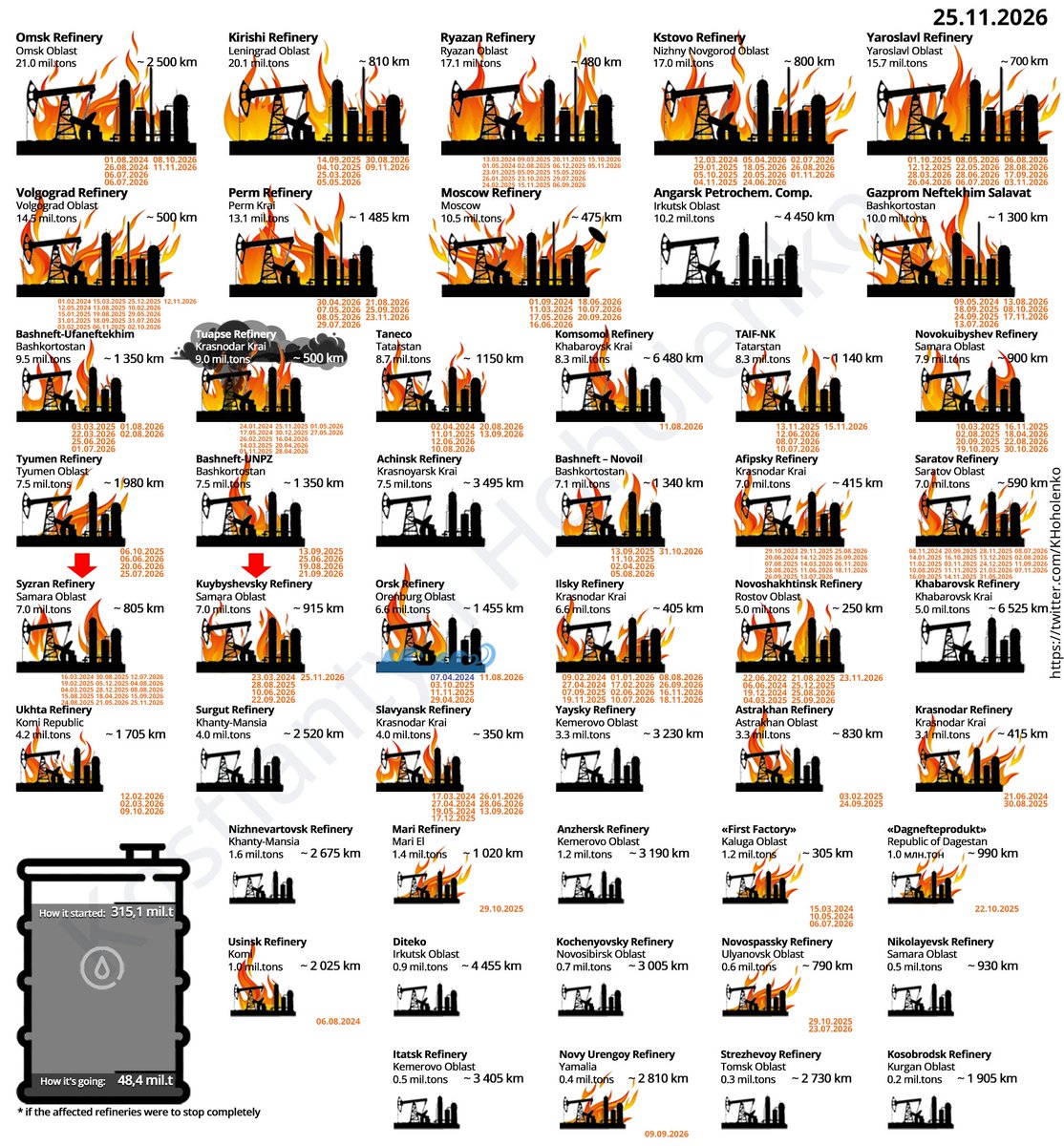
🔥🛢️Over 200 million tonnes of annual refining capacity targeted in less than a month.
Ukraine has struck 18 different Russian oil refineries in 27 days, from October 30 to November 25. Syzran and Kuibyshev are the today’s additions, bringing their combined nominal capacity to 203.55 million tonnes per year.
What stands out is the pace: 20 strikes in just 27 days, spread across a wide range of refineries. Only Ilsky and Afipsky have been hit twice during this wave; the other 16 have each been struck once.
So far, this campaign has overwhelmingly targeted different refineries, with very few repeat strikes.
The capacity figure covers the refineries targeted, not the amount of refining capacity knocked offline.
US lost 508,000 dead in every war since 1941 fighting Germany, Italy, Japan, Korea, Vietnam, etc.
Russia has lost 720,000 dead, per Meduza and Mediazona today, fighting Ukraine, the poorest country in Europe at the time war started:
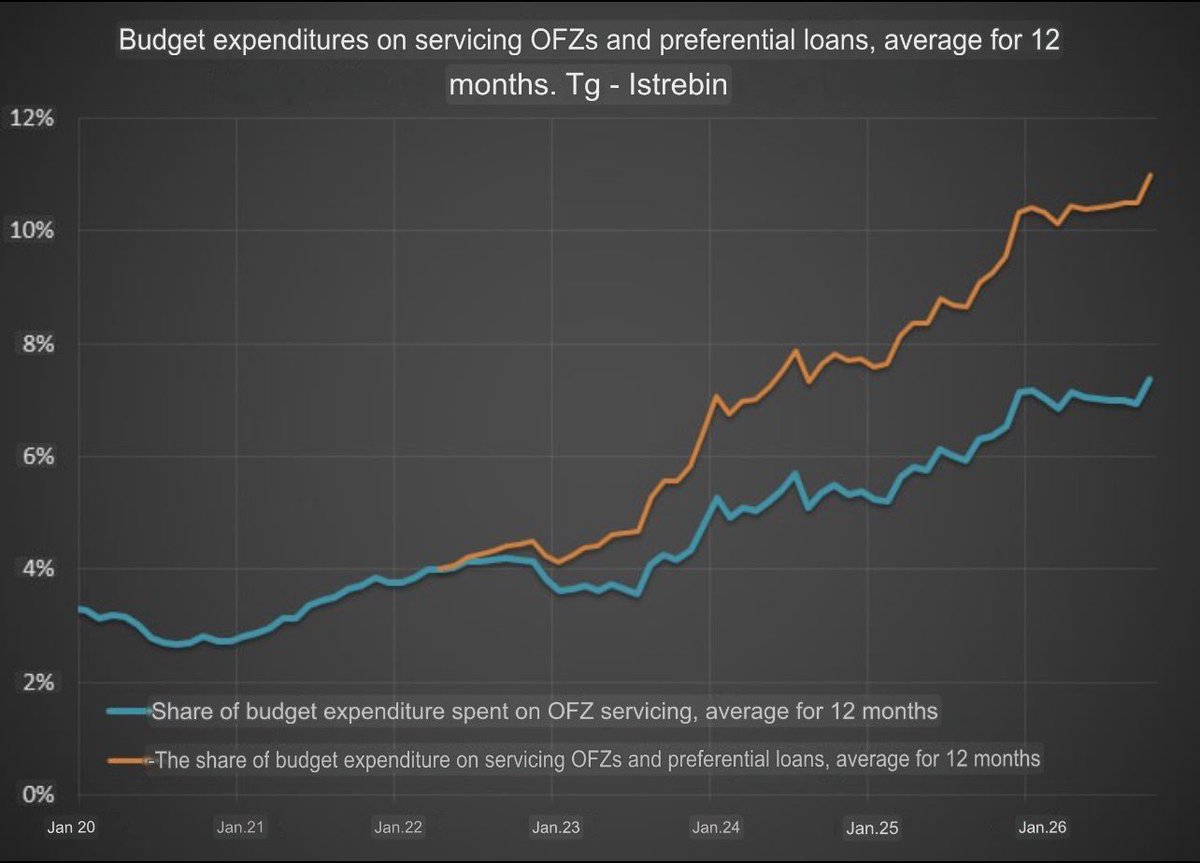
📉 Istrebin: Russia is on the brink of debt default!
For the past two months, the Russian budget's debt servicing expenditures have amounted to more than 600 billion rubles per month, accounting for 17-20% of total federal budget expenditures.
Nabiullina announced that subsidized loans had reached 19 trillion rubles. The difference between the loan interest rate and the market price plus servicing costs is paid to banks by the Russian Ministry of Finance.
The Ministry of Finance also regularly makes payments on domestic bonds. The main problem until recently was that the volume of subsidized loans provided by the government, primarily to the military sector and secondarily to weak economic entities, including mortgage lending, was unknown.
The average difference paid by the Ministry of Finance is 10%. The interest rate on such loans is around 6%, and the market price of the loan is around 16%.
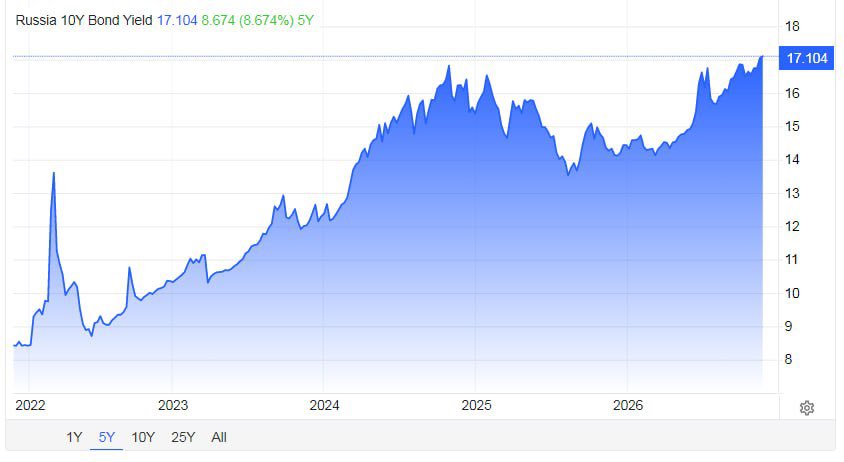
The worst thing for the Russian budget is that yesterday, benchmark 10-year bonds reached a new all-time high yield of 17.1%, representing a 2-percentage-point increase in yield over the year.
Today, the price of Brent crude oil fell to $88, while Russian Urals crude fell to $68. At these prices, budget oil and gas revenues will fall, the budget deficit will grow, and the Ministry of Finance will consequently issue even more OFZs to cover the deficit, which will automatically lead to an even greater premium for buyers, which will further pressure the volume of servicing payments.