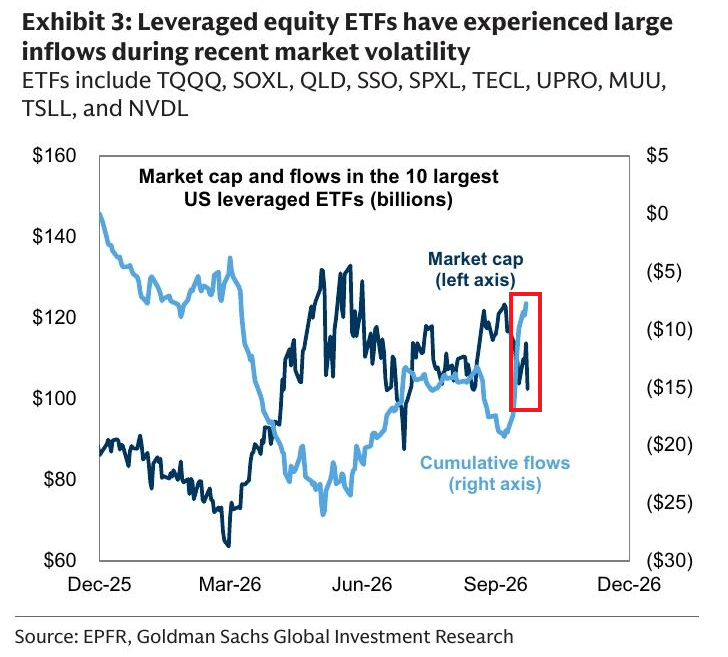
Investor appetite for leverage is through the roof:
10 largest US leveraged equity ETFs have attracted +$12 billion in inflows over the last month.
This is despite the market cap of these funds falling -$20 billion over the same period.
Recent inflow growth has been led by the 3x leveraged long Semiconductor ETF, $SOXL, which attracted +$9 billion over the last 2 weeks, its largest 2-week inflow on record.
The 3x leveraged long Nasdaq 100 ETF, $TQQQ, posted +$1.3 billion in inflows, its 2nd-largest 2-week intake of 2026.
Over the last 5 months, the 10 largest US leveraged equity ETFs have attracted +$19 billion in inflows.
Investors are piling into leveraged ETFs at a record pace.
I don’t understand. Why don’t they declare martial law; send in the army; and solve this problem once and for all. This is basically civil insurrection and the police cannot handle it.
Put the army on the streets and save your country!
@lisaabramowicz1 Good signal that the structural regime has potentially shifted.
If markets undergo a macro slowdown, or if corporate earnings simply miss expectations the fundamental case for holding expensive equities deteriorates immediately.
In 16 years of tracking and trading virtually every asset class and instrument imaginable, I’ve never seen anything like $INHD.
A highly liquid stock trading millions of shares per 1-minute bar halts at $20, up roughly 1,900%, unusual, but not unprecedented. What makes this situation extraordinary is that it halted with no apparent news and is now indicating a resume in the $90s.
This is one of the most extreme tail-risk events I’ve ever witnessed in small caps for short sellers. The issue is that even a disciplined trader with proper risk management could be completely wiped out by a move of this magnitude.
Yes, it’s a China-based stock, but this is not the type of risk traders should be expected to absorb or tolerate if the goal is long-term survival in the markets.
If this stock resumes anywhere near its current indication ($50+), I may officially retire from small-cap short trading. I'm mostly documenting this publicly so I can hold myself accountable to that decision.
For the record, I have no position in $INHD, long or short. I'm simply commenting on the risk profile and market structure implications of what we're witnessing.
And needless to say, this entire episode deserves scrutiny from the @SECGov, although I’m not holding my breath for any meaningful outcome. Good luck out there!
President Trump demanded the US boost annual defense spending by more than 50% to $1.5 trillion for 2027, an unprecedented jump that he said would be paid for by revenue brought in by the tariffs imposed over the last year https://t.co/gUjdUldVSj
@jfsrevg Have you started factoring in volatility adjustments (using ATR) in your Excel-based RS calculations? Or is it still the traditional RS calc.? Just curious
🔴Even if the United States imposes even higher tariffs, it would no longer make economic sense and ultimately go down as a joke in world economic history.
🔴Given that it's already impossible for the Chinese market to accept #US imports at the current tariff level, if the United States imposes further #tariffs on Chinese products, #China will ignore it.
🔴However, should the United States persist in substantially undermining #China's interests, China will take firm countermeasures and fight to the end.
--The Customs Tariff Commission of the State Council
https://t.co/seDd4WRBbs
https://t.co/nGcxyaUld8
@d4ytrad3 Today I was one of the quiet ones, and with that came it shares of frustration. Thank you for this D4, I really needed to hear it. Here’s to better days
Retail investors continue piling into stocks:
Retail investors’ net inflows into US ETFs and single stocks hit a record ~$40 billion in March.
This is ~$10 billion higher than the previous all-time high posted at the beginning of the 2022 bear market.
Not even the meme stock mania in 2021 saw such massive retail inflows into equities.
As retail investors buy the dip, major indices have pushed lower and entered bear market territory.
Many retail investors are experiencing their first bear market.