On the WORLD OF 0W1 website I explore the themes of the novel “0w1:believe” - dystopian horror, political dissidence & mystical spirituality. #WritingCommunity
The latest campaign on the World of 0wl. For more owlish things you can subscribe to the email list. #worldofowl#enterthevisionspace#politicaldissidence
Underground Literature and the Hermeneutics of Suspicion - https://t.co/W84pPpziqM
It’s World Mental Health Day & here’s a video from @Stage32 about how to create a healthy mental outlook on social media. PRT Thank you @RBwalksintoabar@giveanhour@stephshortstak
https://t.co/IF3tuiq5wz
@Stage32@Festival_Cannes Here’s a chilling story of the prosecution of Iranian filmmaker Saeed Roustaee, after showing his film “Leila’s Brothers” at Cannes. He refused to ‘correct’ it before showing it at the Festival. PRT & hashtag
#freesaeedroustaee
https://t.co/TPP9S7XPHd
Josie (6 years old), Bertha (6 years old) and Sophie (10 years old) worked regularly at the Maggioni Canning Company.
Work began at 4 AM and the three would make from $9 to $15 a week. Sophie would do six pots of oyster a day and her mother who also worked with her said "She don't go to school. Works all the time."
Through such photos, Lewis Hine documented the harsh working conditions borne by thousands of children, who were sent to work soon after they could walk, and were paid based on how many buckets of oysters they shucked daily.
Mr Hines wrote of one photograph: ‘All but the very smallest babies work. Begin work at 3:30am and expected to work until 5pm.’ He covered around 50,000 miles a year, photographing children from Chicago to Florida working in coal mines and factories.
These photos helped to raise an outcry against child labor and made the American public become widely aware of the scope of the problem. This resulted in the establishment of organizations such as the National Child Labor Committee, in 1904, which led the fight against child labor.
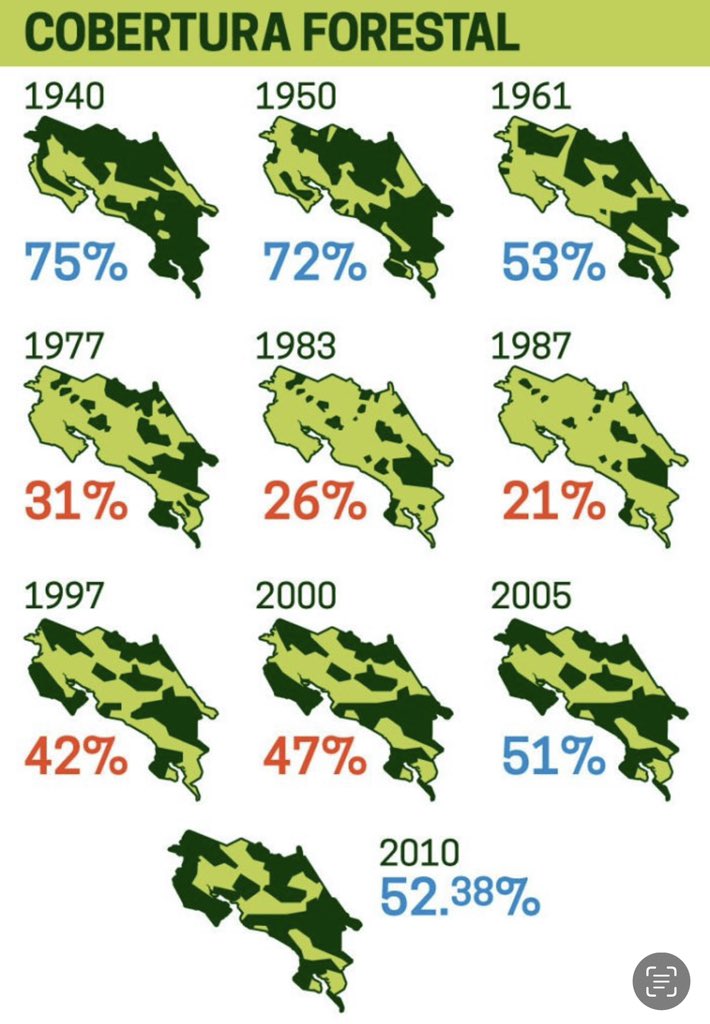
After decades of deforestation, suffering ever more flash flooding, drought, erosion and landslides, democratic Costa Rica took the decision in the 1980s to turn the tide. Since then, in one generation, forest cover has more than doubled, from a quarter of the country to half. How did Costa Rica do this? The government offered a subsidy to any landowner willing to establish new tree cover on their land. In the agriculturally productive areas, nothing much changed. It was simply more lucrative to grow food than to allow the forest to reclaim the land. But in agriculturally marginal areas, farmers swapped their cattle for trees, and made a new way of life revolving around wood and other forest products, small-scale market gardening, nature tourism and so on. Parched cattle ranch after cattle ranch has been transformed into lush, vibrant forest teeming with wildlife. In some areas the forest now stretches from horizon to horizon. In these areas flooding and water shortages are no more. There’s a powerful lesson here for all countries. Restoring nature is easy if bad incentives are replaced with good ones. England’s pioneering new Environment Land Management Scheme is another good example. Let’s hope others follow.
Happy Screenwriter’s Day to my fellow scribes. Shake the dust off your feet. Hone your skills. Love well. That includes yourself. #beleive#nationalscreenwritersday https://t.co/KvY4vB3xkQ
.@jonsopel with the story that BBC Chair Richard Sharp sat on the panel when the BBC was interviewing for their Head of News job.💥
The BBC Chair is supposed to sit separately from editorial decision-making.
On @GlobalPlayer 👇
https://t.co/TwhwAnQ0Tu
@maitlis | @lewis_goodall
🔴 NEW for @BylineTimes 🔴
Nadhim Zahawi's Tory leadership bid was funded by an investment manager listed in the Paradise Papers and linked to Bermuda, the offshore tax haven.
https://t.co/fNEcCKbEvU