Africa correspondent for The Globe and Mail (Canada). Based in Johannesburg; formerly in Moscow & Beijing.
Email: [email protected]
Bluesky: same user name
The Garima Gospels, one of the world's oldest surviving Christian manuscripts, is among the irreplaceable cultural treasures whose fate is unknown as the Tigray war rages on. Other historic manuscripts have been looted, and scholars are deeply worried.
https://t.co/lDWiX3f2Ko
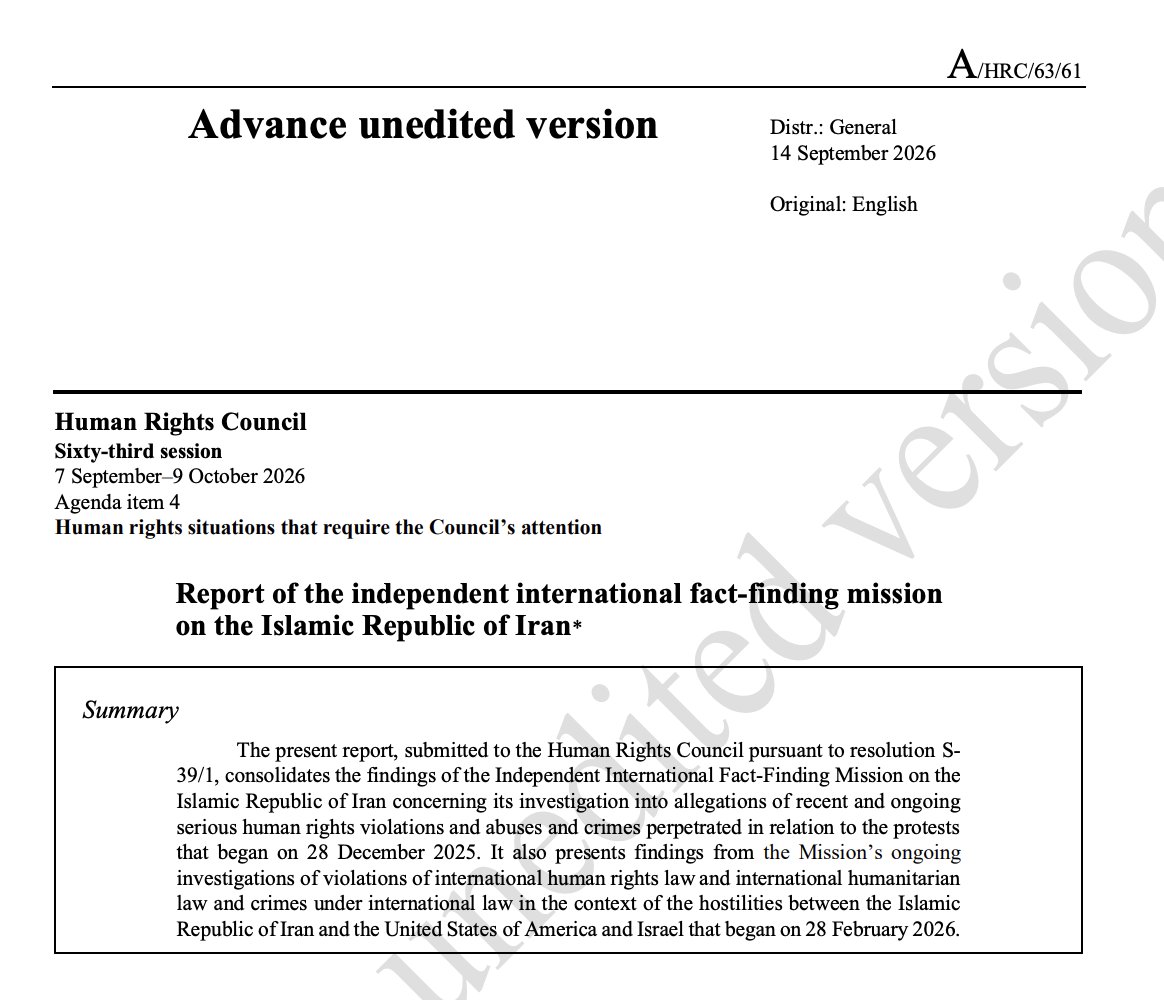
Independent International Fact-Finding Mission on Iran finds reasonable grounds to believe that:
Iran committed crimes against humanity in suppressing January protests
the United States committed war crimes in Minab and Lamerd attacks.
Citizen Lab, in Toronto, plays a priceless role exposing the sinister influence operations governments secretly use to mould and manipulate public opinion. This one was run by an Israeli firm working on behalf of the Angolan government. https://t.co/9PUvDsFqul
@Lesufi – do not tell us to "not be emotional". Where is your care and emotion amid a national crisis of gender-based violence and femicide? You promised safer communities. Maybe if you cared more, and were more "emotional" and outraged by this disaster, women would be safe in the province you run.
Seven leading legal and human rights organisations have issued a joint statement yesterday condemning what they described as a sustained assault on the rule of law, judicial independence and access to justice in Zambia surrounding the country's general election. The International Bar Association's Human Rights Institute, the Bar Human Rights Committee of England and Wales, the East Africa Law Society, the International Commission of Jurists, the Law Society of England and Wales, Lawyers for Lawyers and the Pan African Lawyers' Union said the developments, taken together, raised serious questions about security force conduct, the courts' independence and lawyers' ability to work without fear of reprisal.
Among the incidents cited were the deployment of the Zambia Army during and after polling, reported irregularities in the vote count flagged by observers including a European Union mission, and the fatal shooting a day after the election of former Cabinet Minister Mutotwe Kafwaya during a security operation at a property linked to the opposition presidential candidate, whose death authorities did not confirm for five days.
Perhaps most striking was the closure of Zambia's Constitutional Court, High Court, Supreme Court and other courts nationwide on 24 August, the penultimate day of the deadline for filing a presidential election petition. Police and military personnel cordoned off the premises on unsubstantiated security grounds, while the Chief Registrar's office had its email disabled, blocking electronic filings entirely.
The Law Association of Zambia said it received no formal explanation and called for courts to reopen immediately. Lawyers involved in election challenges, including former LAZ president Linda Kasonde, reportedly felt compelled to leave the country over threats to their safety, even as Kasonde still managed to lodge a petition through the Chief Justice's personal email within the statutory deadline.
The organisations also pointed to a pattern predating the election that they said had already weakened judicial independence, including the appointment of 40 judges in May 2026, months before the vote, and an executive-driven salary increase for judges that bypassed the constitutionally mandated Emoluments Commission.
They linked this to the 2024 removal of three of the five founding judges of the Constitutional Court, which they characterised as retaliation for rulings unfavourable to President Hakainde Hichilema's own past legal interests. Days before the statement, the government also cancelled the passports of six individuals, including opposition figures, a former diplomat, an academic and a media commentator, a move the signatories said breached both the Zambian constitution and international human rights law.
The signatories called on Zambia's government to investigate Kafwaya's killing, open an independent inquiry into the courts' closure and toll the filing deadline accordingly, publish a full list of election-related detainees, guarantee lawyers' safety and independence, restore the cancelled passports, and examine the legality of the judicial appointments, salary rise and 2024 removals. They framed the demands as necessary to bring Zambia back into line with its obligations under the International Covenant on Civil and Political Rights, the African Charter on Human and Peoples' Rights, and several regional and Commonwealth standards on judicial independence and the legal profession.
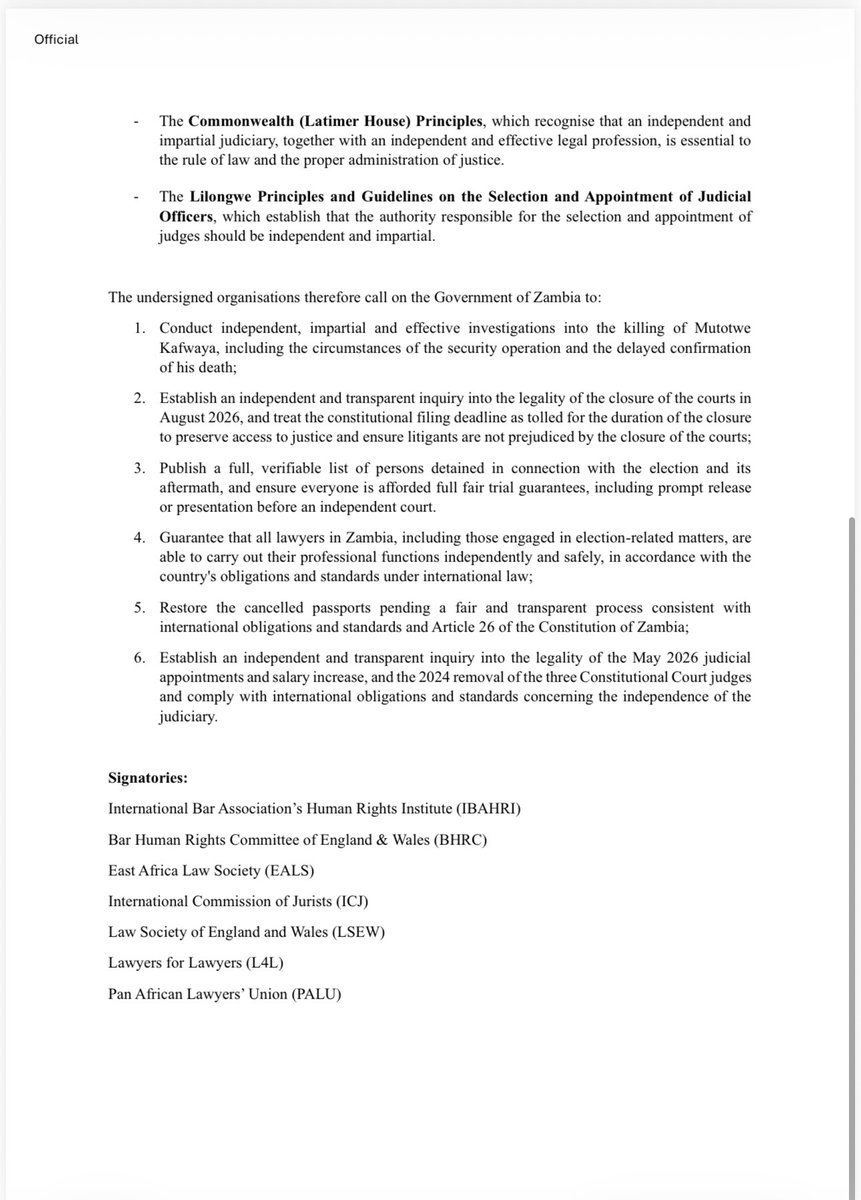
FULL STATEMENT 👇🏿
Joint Statement: Attacks on the Rule of Law, Judicial Independence and Access to Justice in Zambia Surrounding the General Election
16 September 2026
The International Bar Association's Human Rights Institute (IBAHRI), the Bar Human Rights Committee of England & Wales (BHRC), the East Africa Law Society (EALS), the International Commission of Jurists (ICJ), the Law Society of England and Wales (LSEW), Lawyers for Lawyers (L4L) and the Pan African Lawyers' Union (PALU) are gravely concerned by a series of developments in the lead up to and surrounding Zambia's general election, held on 13 August 2026.
Taken together, the incidents outlined below raise serious questions about the independence of the judiciary, security-force conduct and accountability, election-related access to justice, and the ability of lawyers to carry out their professional functions without fear of reprisal.
The undersigned view with grave concern that, on 13 August 2026, the Zambia Army and joint security task forces were reportedly deployed during and after polling, as well as reports by election observers, including a European Union observation mission, of serious incidents and procedural irregularities during the counting and tabulation, affecting the transparency and credibility of the election. On 14 August 2026, a security operation at a property linked to the opposition presidential candidate resulted in the fatal shooting of former Cabinet Minister Mutotwe Kafwaya; his death was publicly confirmed by the authorities five days later.
On 24 August 2026, the penultimate day of the constitutional deadline for filing a presidential election petition challenging the election outcome, the premises of the Constitutional Court, High Court, Supreme Court and other courts all across Zambia were closed and cordoned off by police and military personnel, on stated grounds of unspecified security concerns that have not, to our knowledge, been substantiated.
The email address of the Chief Registrar's office was also disabled, preventing petitions from being filed electronically, leading to a complete denial of access to justice. The Law Association of Zambia (LAZ) publicly stated that it had not, at the time, received a formal explanation for the closure, its scope or its duration, and called for the urgent restoration of access to the courts.
A significant number of opposition figures and persons associated with the opposition coalition have been arrested and detained, in circumstances that appear arbitrary and linked to their political connections and the election. This raises concern that the criminal justice system is being abused to stifle dissent and undermine the exercise of fundamental freedoms.
The undersigned are further troubled by reports that lawyers involved in preparing or lodging election-related legal challenges have felt forced to leave Zambia, due to threats to their personal safety. For instance, Linda Kasonde, former President of LAZ, who prepared and electronically lodged a petition through the personal email of the Chief Justice of Zambia within the 7-day deadline challenging the validity of the presidential election result, notwithstanding the physical closure of the courts referred to above.
These reports raise concern that lawyers were prevented from performing their professional functions free of intimidation, hindrance or improper interference, contrary to Principles 16 and 17 of the UN Basic Principles on the Role of Lawyers referred to below. The Commonwealth Lawyers Association has separately and independently expressed similar concerns regarding the safety of lawyers following the election.
The undersigned note with alarm a further escalation in the days immediately preceding this statement. On 11 September 2026, the Government of Zambia published the Statutory Instrument No. 1421 of 2026, cancelling the passports of six individuals, including opposition figures, a former diplomat, an academic and a media commentator, on unsubstantiated grounds of conduct said to be contrary to the interests of Zambia.
The arbitrary cancellation of passports is contrary to Article 12 of the International Covenant on Civil and Political Rights and Article 22 of the Constitution of Zambia, which guarantee freedom of movement. Article 26 of the Constitution of Zambia further requires that any restriction of that freedom be authorised by law, and that the person affected be entitled to reasons for the restriction and to have it reviewed.
Recent events occur in a context of reduced judicial independence in Zambia. In May 2026, three months before the election, 40 judges were appointed by President Hakainde Hichilema across Zambia's superior courts, reportedly the largest judicial appointment in the country's history. The timing of that appointment raises concerns, given its proximity to the dissolution of Parliament and the general election.
Around the same time, judicial salaries were increased unilaterally by the executive, unlawfully bypassing the Emoluments Commission, the body constitutionally mandated to determine judicial remuneration. This followed the removal, in October 2024, of three of the five founding judges of Zambia's Constitutional Court, on grounds of misconduct linked to a ruling made some eight years earlier.
Their removal appears to have been undertaken as retribution for decisions adverse to the President's own past legal interests, which would be a violation of the principle that judges may be removed only for reasons of incapacity or behaviour that renders them unfit to discharge their duties.
Taken together, these actions seriously undermine the rule of law in the country, as they narrow civic space, severely limit access to justice and erode the separation of powers. They appear to be in violation of domestic constitutional guarantees, as well as several international obligations and standards applicable to Zambia. These include, among others:
- The International Covenant on Civil and Political Rights and the African Charter on Human and Peoples' Rights, which protect the right to liberty and security, the freedoms of expression, assembly and association, movement as well as the right to a fair trial, to which an independent judiciary and access to a lawyer of one's choosing are foundational.
- The UN Basic Principles on the Role of Lawyers (Principles 16 and 17) and the IBA Standards for the Independence of the Legal Profession, which require states to ensure that lawyers can perform their professional functions without intimidation, hindrance, harassment or improper interference, and to protect them where their safety is threatened by reason of their work.
- The African Commission on Human and Peoples' Rights Principles and Guidelines on the Right to a Fair Trial and Legal Assistance in Africa, which set out in further detail these requirements for the Africa region.
- The UN Basic Principles on the Independence of the Judiciary, which reflect the further requirement of security of tenure and a fair, properly constituted disciplinary process before any judge is removed, as well as safeguards in the appointment process.
- The Commonwealth (Latimer House) Principles, which recognise that an independent and impartial judiciary, together with an independent and effective legal profession, is essential to the rule of law and the proper administration of justice.
- The Lilongwe Principles and Guidelines on the Selection and Appointment of Judicial Officers, which establish that the authority responsible for the selection and appointment of judges should be independent and impartial.
The undersigned organisations therefore call on the Government of Zambia to:
1. Conduct independent, impartial and effective investigations into the killing of Mutotwe Kafwaya, including the circumstances of the security operation and the delayed confirmation of his death;
2. Establish an independent and transparent inquiry into the legality of the closure of the courts in August 2026, and treat the constitutional filing deadline as tolled for the duration of the closure to preserve access to justice and ensure litigants are not prejudiced by the closure of the courts;
3. Publish a full, verifiable list of persons detained in connection with the election and its aftermath, and ensure everyone is afforded full fair trial guarantees, including prompt release or presentation before an independent court;
4. Guarantee that all lawyers in Zambia, including those engaged in election-related matters, are able to carry out their professional functions independently and safely, in accordance with the country's obligations and standards under international law;
5. Restore the cancelled passports pending a fair and transparent process consistent with international obligations and standards and Article 26 of the Constitution of Zambia;
6. Establish an independent and transparent inquiry into the legality of the May 2026 judicial appointments and salary increase, and the 2024 removal of the three Constitutional Court judges, and comply with international obligations and standards concerning the independence of the judiciary.
Signatories:
- International Bar Association's Human Rights Institute (IBAHRI)
- Bar Human Rights Committee of England & Wales (BHRC)
- East Africa Law Society (EALS)
- International Commission of Jurists (ICJ)
- Law Society of England and Wales (LSEW)
- Lawyers for Lawyers (L4L)
- Pan African Lawyers' Union (PALU)
Today marks a year since the Madlanga Commission - a profoundly consequential investigation into criminal infiltration of SA’s justice system - began hearings.
In a report back to South Africa, the commission has released this statement:
Another apartheid state did this too: Miriam Makeba was stripped of her South African citizenship by the apartheid regime in 1963 after she delivered a powerful testimony against apartheid before the United Nations, something our Constitution now prohibits.
The BRICS final declaration expressed "grave concern over the deteriorating situation in Sudan" but didn't mention that the United Arab Emirates is sending arms and mercenaries to the genocidal Rapid Support Forces.
https://t.co/vYkk4D7LiH
"At least 3,000 Africans from 37 countries have been recorded fighting for Russia in Ukraine. Many were promised security or technical jobs, only to have their passports confiscated and be forced into signing military contracts in Russian," writes Ieva Miyares, an independent consultant on illicit finance, anti-corruption, and governance, in this op-ed.
https://t.co/fXaaA4S70U
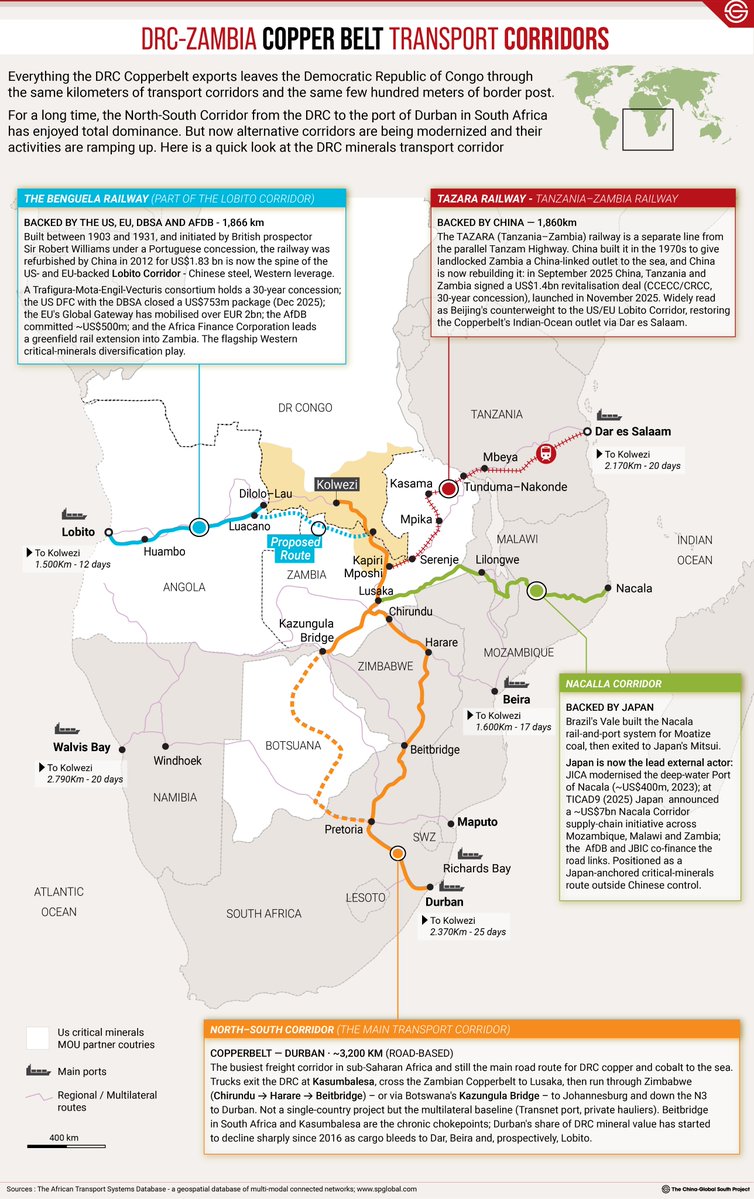
A good map of copper export routes from Zambia and DRC. The route to Durban is still often used, but it is diminishing in importance, partly due to crime and hijacking, also the slow border crossings.
Par où passent le cuivre et cobalt congolais avant d'atterrir en Chine, Suisse, Singapore..?
Un visuel pour répondre à ces questions dans un contexte de débat géopolitique sur la logistique de ces minerais.
On a rajouté une carte de plus dans le lot.
@AfrikChine@ChinaGSProject
America's Administration has catapaulted the US into a vortex of decline - "wars" with allies (e.g. Canada, Europe), depleted weapon stocks, loves dictators, supports far right, weakened its global position. All for what? Make America Great Again - a failed tag line - a tragedy.
SA govt response: "It is our sovereign right to put in place laws that address the nation’s concern over centuries of racial injustice. Legislation in the democratic era is intended to improve the plight of the people who had been excluded for centuries."
https://t.co/KliMwWU7hb
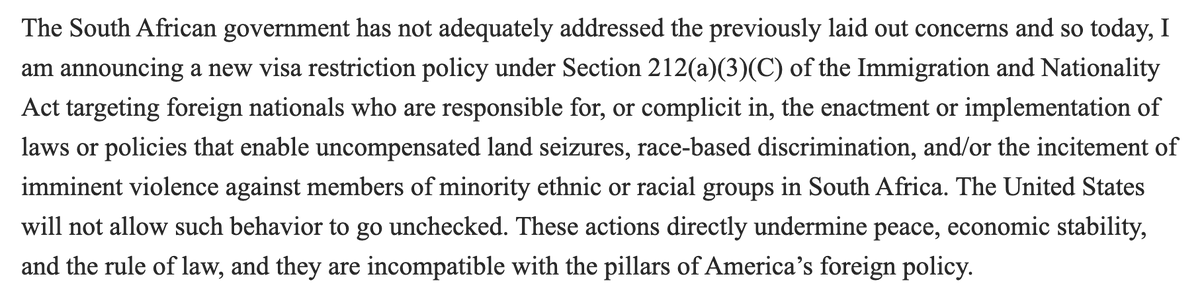
The Trump administration is announcing visa restrictions on South Africans who were allegedly responsible for "land seizures" and "incitement of imminent violence" against minority groups.
"More than 35 US embassies across Africa lack a Senate-confirmed ambassador. At a time when Russia and China compete aggressively for influence... the US has pulled back, with staffing reductions, aid and health programs cuts, and visa restrictions." -- US Senator Shaheen today.
Copper producers in Zambia have told me that they stopped exporting their copper via the port of Durban because their trucks would get hijacked in South Africa. Now they are exported via Dar es Salaam. An example of the problem:
Former JMPD Superintendent Phineas Manyama – who was chosen as its “Cop of the Year” and awarded a car in 2019 – has been accused of using Tactical Response Unit (TRU) officers to escort trucks transporting stolen copper and trying to stop drug busts.
https://t.co/KmXcCZOjsX
Houthi advances on the Red Sea are intensifying the "triple chokepoint" for relief supplies for Sudan and other African crises. Humanitarian agencies are worried it could cause another surge in food and fuel costs (after the Black Sea and Hormuz blockages)
https://t.co/SFqDkcc1D7
#DRC: The proposed amendment is likely to pass, paving the way for #Fatshi to contest the 2028 elections; protestors are going to face a very heavy-handed response, especially when the presidential guard is likely deployed again to contain them
@Sophie_Mokoena What impact? Please be specific. Trump's policy on SA is conducted entirely by executive orders, and Congress cannot have any impact on that.