America’s New Long War
Wars frequently pick up where the last ones left off. World War II ended where World War 1 ended. Operation Iraqi Freedom (Gulf War II) began where Desert Storm (Gulf War I) concluded.
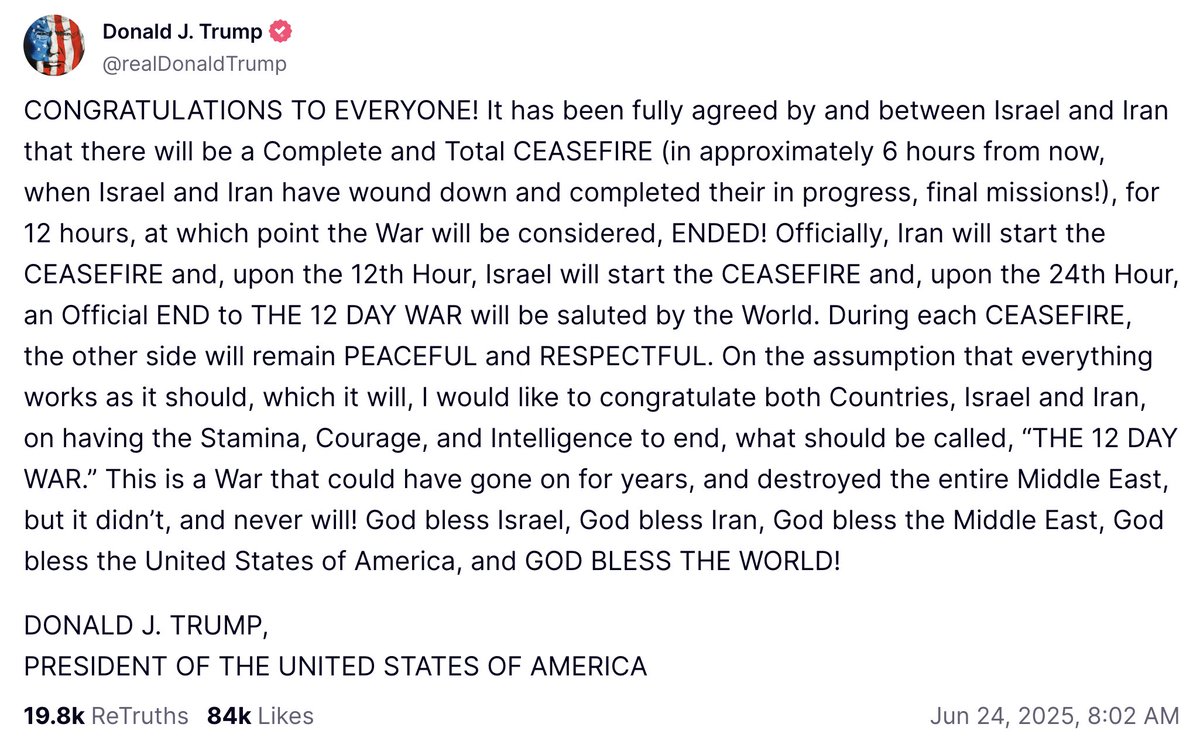
Today there is every reason to expect the recent 12-day conflict between Iran on one side and Israel and the United States on the other to resume when the Israeli and U.S. Forces have replenished their stocks of missiles. No doubt, the Iranians will work hard to radically improve their integrated air defenses. For simplicity, let’s call the current conflict, the “New Long War.”
As always, the New Long War continues with other means. GEN Erik Kurilla, the CENTCOM CDR is known for his close relationship with PM Bibi Netanyahu and his enthusiasm for the Greater Israel Project including seizure of Sinai and the Suez Canal. Fully aware of the impossibility of rapidly conquering and seizing the Suez Canal without active American military support, General Kurilla may have received authority from President Trump to conduct joint planning.
The presence of a newly established Russia phased array radar in Egypt suggests Moscow is aware of the possibility. The Russian phased array radar can reportedly track stealth aircraft and missile launches at long range.
Further east, some 1,200 miles away in Azerbaijan, Israel’s Azeri-Turkish ally is allegedly preparing to attack Armenia and, potentially, northern Iran. GEN Kurilla also knows that Iran, like Russia, has a long history of cooperation with Orthodox Christian Armenia. Israel provided critical drone technology to Azerbaijan in its last victorious campaign against Armenia, and Azerbaijan likely provided support for Israeli operations against Iran.
GEN Kurilla is also acquainted with the MEK (Mojahedin-e-Khalq) an anti-Iranian Kurdish Force formerly aligned with Saddam Hussein’s government in Iraq. The MEK fights for regime change in Iran and is predictably now aligned with the Trump Administration.
Azerbaijan’s goal is a greater Azerbaijan created by forcibly annexing Iran’s Turkic Azeri population centered on Tabriz in Northern Iran. The unspoken assumption in Washington, Jerusalem, and Baku is that the Azeri Turks in Northern Iran will welcome the opportunity to join with their Azeri neighbors. The national leaders in all three States view this operation as contributing to the breakup and destruction of Iranian national unity, as well as the desired regime changes in Tehran. These operations are in the planning stage but could be launched at any time. These may or may not wait for the U.S. and Israeli missile arsenals to be replenished.
A similar approach was employed in Ukraine against Russia. However, the operation to remove President Putin from power in Moscow, to foment unrest and violence against Moscow inside Russia, Kazakhstan and other neighboring states was botched.
Washington’s gamble failed. Russia remains intact. Russia’s resources remain beyond the reach of Western financial power. The Russian State and its military power are stronger than ever. Ukraine is destroyed.
The history of Washington’s military interventions is not encouraging. Washington’s interventions since 1953 failed to cultivate the emergence of any liberal democratic states. If anything, Washington’s near constant interventionism spread authoritarianism across North Africa and the Middle East. The new long war seeks to subvert and destroy Iran promising a similar outcome.
However, this time, the New Long War will invite broader participation from numerous Muslim states, Russia, and China. In contrast to past interventions, the new long war could also prove impossible to sustain inside American society. As seen during the Black Lives Matter (BLM)/Antifa riots in 2020 and, more recently, the appearance of Mexican flags during anti-ICE demonstrations in Los Angeles, American societal cohesion is low, with ominous connotations for American national power.
Notwithstanding President Trump’s tariff offensive, the trade policies sponsored by both parties for at least 40 years encouraged de-industrialization. The problem is inseparable from immigration policy. Since 1965, America has admitted over 50 million legal immigrants, most from the developing world. Today, there may be as many as 50 million illegal immigrants inside the U.S., including 20 to 30 million illegals that arrived during the Biden administration. Simultaneously, real wages for working-class Americans stagnated despite real increases in productivity and soaring corporate profits.
At the same time, Washington’s financialization of the economy—a form of rent extraction, with profits earned through privileged access to new money created by the Federal Reserve—combined with the destruction of American manufacturing, supports a massive wealth transfer mechanism. Economic data collected between 1979 and 2018 shows that while productivity increased by 59.7%, hourly compensation for non-supervisory workers rose by only 17.5%. The difference went to capital owners and financial intermediaries. Wealth moved from America’s dying middle class to the top 10 percent of income earners.
The implications of these developments for Washington’s global political, military, and economic power are profound. Why? There are multiple reasons, but three are of immediate importance:
First, in the five decades since Washington disestablished the gold standard, the debt-to-GDP ratio has grown from 40 percent to more than 120 percent of GDP and it continues to climb. Consequently, the Federal Reserve’s balance sheet expanded from $80 billion to well over $8 trillion. With spending levels and deficit trajectories that are not sustainable, the notion of a trillion-dollar defense budget is absurd.
Second, there is an undeniable shift in the global balance of economic power. A new intercontinental commercial trading and monetary system is rising. It’s called BRICS, an intergovernmental organization consisting of ten nation-states: Brazil, Russia, India, China, South Africa, Egypt, Ethiopia, Indonesia, Iran and the United Arab Emirates. Together, these nation-states constitute more than a third of global GDP. A further 50 or more nation-states that want to join BRICS will push it to nearly 50 percent of global GDP.
More important, China, Russia, India, and Iran are civilizational constructs—power centers that, after centuries of trailing in development behind the West (or enduring its exploitation), are now roaring back to life. In some ways, the world of the 21st century may be on track to resurrect the constellation of powers that dominated the world in the 11th century.
Third, the proliferation of technology across national borders combined with the growth of high human capital inside BRICS is conferring military capabilities on BRICS members that were previously unavailable to any but Western Powers. Put another way, the attempt to repeat a Desert Storm scenario anywhere on the Eurasian landmass would spell disaster for American military power.
Finally, Washington’s political class manifests much less regard for the long-term strategic interests of its own citizens—their security and prosperity. As a result, Washington pays an exorbitant price in reputation and treasure for policies that confront Palestinians with the choice of death or expulsion from their homelands.
There are many moving parts in the regional strategy outlined at the beginning of this post. Assumptions of tacit acceptance or rapid capitulation are implicit and dangerous.
When Hitler was briefed on the expected Soviet reaction to Operation Barbarossa, Major General Ernst Koestring, a Prussian officer fluent in Russian from a family that had lived in Moscow since the reign of Catherine the Great, advised: “Initially, German forces will advance rapidly. The various peoples on the Soviet periphery will likely welcome the German forces. Resistance will be weak. But when the Germans advance into Russian territory, the resistance will be tremendous. The Russian population will fight for every square meter of territory.”
Hitler politely thanked him but remained convinced that poor Soviet military performance in Finland in 1939 suggested a different outcome in 1941. Koestring, of course, was right.
Diplomacy is the art of the possible. Warfare is always a gamble.
A partial success in the diplomatic sphere is preferable to gambling on success in war that may turn into catastrophic failure. Unless the American electorate demands accountability for what the White House and Congress do in their name, Americans will face a grim reckoning with financial, political, and military reality at home and abroad.
*Graftful to Dave Ramaswamy for his edits and suggestions.
China — Iran — Europe: a war of transport routes?
On May 25, 2025, the first freight train from the Chinese city of Xi'an arrived in Iran.
The route has been under construction since 2021.
The railway corridor passes through Kazakhstan and Turkmenistan and enters the logistics center of Aprin near Tehran.
15 days of travel — twice as fast as by sea.
And — it bypasses the seas, sanctions, and American military bases.
China supplies machinery, electronics, and other goods.
And Iran is becoming more than just a recipient.
It is becoming a new transit hub on the map of Eurasia.
▫️ Iran gets:
– Gateway to the East: direct land connection with China
– South – North: connecting India, Iran and Russia via the International Transport Corridor (ITC)
– Exit to the West: route through Iraq and Syria to the Mediterranean Sea
– Position in the “Belt and Road” as a land hub between Russia, China and the Middle East
This breaks the US maritime monopoly.
The Strait of Hormuz and Suez are no longer the only transport arteries.
▫️ And just then — it hits:
June 13 — Israel bombs Iranian nuclear facilities
June 22 — US strikes
June 23 — Iran responds to attacks on Israel and a US base in Qatar
On the surface, it's about a nuclear program.
But basically, it's a fight for traffic routes.
▫️ Strategists understand: if Iran is able to escape its logistical isolation, it will become a bridge between two global power centers.
It's no longer about reactors — it's about logistics and control.
▫️ Why is that important?
– The new route shortens transport time and reduces the risk of maritime blockade
– Undermines the “maritime dependence” of the US
– Strengthens the China-Iran-Russia-India relationship
– Creates a land-based alternative to Western logistics
▫️The conflict with Iran is not just about plutonium.
This is a fight for supply maps, containers, and corridors.
The war is not only fought in the sky - it is also fought on the rails.
@AlternatNews That was a crazy rant but I consider you as a man of honor with moral high ground. Such irony that @DougAMacgregor and you who have experienced war and normal life can still have huge compassion. The war now is about humanity. Bring back the movies with the good endings
Israel is getting hammered. Ben-Gurion airport is gone. The Haifa refinery gone.
The IAEA happily said “no nuclear work happening”, while passing on the coordinates to Trump. Also doing impact assessment.
Ritter well worth watching. All 3 parts.
On the 21st of June, a day that will live in infamy, President Trump led the American People to War with Iran. Trump’s message to Americans? Striking Iran's three nuclear facilities is all that U.S. Forces do. Unless, of course, the Iranians have the temerity to strike back. In that case Trump promises to destroy Iran. Ridiculous.
Washington has launched its own Pearl Harbor operation. U.S. Air and Naval Power executed rehearsed strikes against a few "critical" Iranian targets. Then, American Forces pulled back, ostensibly waiting for Tehran to capitulate much like the Japanese in December 1941. Trump’s mindset echoes Israel's thinking when it attacked Iran last week, but Iran did not collapse after Israel's surprise attack.
And Tehran won't capitulate to Washington's opening moves. Initial assessments of the strikes’ effectiveness suggest nothing of consequence was destroyed. The facilities? Devoid of people. Empty of centrifuges and enriched uranium. But the lack of damage? That’s not yet relevant. It’s a question no one in Washington cares to answer.
The world now waits for Iran’s response. Tehran’s leaders aren't reckless or impetuous. Their counter-strike will be deliberate and likely decisive. And make no mistake, Iran will strike back. It will do so in ways Washington doesn't expect.
Why? Tehran controls the political and moral high ground. Israel violated international law. A program of mass murder in Gaza. Backing the murderous ISIS-led regime in Syria. Killing Christians. Killing other minorities. Israel's unprovoked attack on Iran. These are incontrovertible facts.
Escalation is inevitable, but Iran, not Washington, will control it. Remember the Houthis from Yemen and their war with Saudi Arabia? They struck Saudi oil fields. Repeatedly. Now, Iran has far greater reach. Far more ballistic missiles. Desalination plants. Across the Arabian Gulf are within striking distance of the Houthis. They are also within striking range of Iranian missiles. Millions depend on them for water.
Iran's parliament just voted to close the Strait of Hormuz. Markets won't react until Monday morning. But they will panic. Inevitably, oil prices will soar. The financial consequences for Americans? Eventually, devastating. Everyday, one out of every five barrels of oil flows through the Straits of Hormuz.
Washington spent six months bombing the Houthis. Then, Washington threw in the towel. Walking away from war with Iran won’t be so easy.
Russian Prime Minister Medvedev warned that many countries are now willing to transfer nuclear technology to Iran. Simple rule. Countries with nuclear weapons don't get bombed. Look at North Korea. Countries without them? They get bombed. Iraq. Libya and, now, Iran prove it. This is the universal lesson for the world beyond America’s borders.
Iran’s parliament voted to close the Straits of Hormuz, but Tehran doesn't need to formally close the Strait of Hormuz. Shipping companies will do it. If the risk of losing tankers is too great, the insurance companies will insist. The world's oil supply slow and the impact on industries that depend on petroleum products will be disastrous.
This is the real "battle damage assessment." The consequences will be felt for decades. Trump just invited war to America. Now, Americans must prepare for it. Tens of millions of foreigners crossed our borders illegally between 2020 and 2025. Washington is foolish to ignore the high probability that Islamist terror sleeper cells are here. No doubt, the Drug Cartels will be happy to cooperate with them against American Law Enforcement.
Dietrich Bonhoeffer, a German Pastor who resisted Hitler’s regime and was eventually executed by the Nazis, said evil carries the germ of its own subversion. But against stupidity, Bonhoeffer warned the well-intentioned are always defenseless.
Bonhoeffer explained why: "Against stupidity we are defenseless. Neither protests nor the use of force accomplishes anything here; reasons fall on deaf ears; facts that contradict one’s prejudgment simply need not be believed – in such moments the stupid person even becomes critical – and when facts are irrefutable, they are just pushed aside as inconsequential, as incidental. In all this the stupid person, in contrast to the malicious one, is utterly self-satisfied and, being easily irritated, becomes dangerous by going on the attack."
Washington's ruling political class, not just President Trump, decided to unconditionally support Israel in its war against Iran. Going to war when and where Israel dictates and for reasons Israel decrees is stupid. It’s worse than stupid. It’s stupidity on stilts. Israel’s war for Jewish Supremacy in the Middle East will fail and Washington will now fail with it. The war against Iran will fail because the war is unjust and the world will ensure that it fails.
I think now is a good time to remind everyone about that time President Trump shared a video of Jeffrey Sachs telling us how Bibi Netanyahu was responsible for the wars in Iraq and Syria and has been trying to bait the US to attack Iran.
Just in case you didn't think he knows.
Former Pentagon official Dan Caldwell explains what would happen if Ted Cruz gets his way in Iran.
(0:00) Introduction
(0:47) What Would Happen if the US Strikes Iran?
(9:23) American Troops in Iraq and Syria
(19:12) Did US Policy Makers Intentionally Put American Troops at Risk?
(21:49) How the War Could Escalate
(25:16) What Are the Casualties in Israel?
(29:39) How American Intervention Would Change Everything
(34:27) Will Russia or China Get Involved?
(42:43) Why Does Ted Cruz Think Iran Is Going to Nuke Los Angeles?
(50:41) Are We Seeing the Fall of the Neocons?
(54:54) Is It Possible to Shut Down a Nuclear Program With an Air Campaign?
(59:54) Why a War With Iran Would Make It Impossible to Continue Supporting Ukraine
(1:02:23) Does the American Military Have a Supply Problem?
(1:09:10) The Current Public Opinion of Israel
(1:16:01) Why Do Western Leaders Want the Ukraine War to Continue?
(1:27:27) Is the US Capable of Ending the War in Iran?
(1:30:21) The War Machine’s Attacks on Anti-War Voices
Includes Paid Partnerships.
The world can move on without the United States.
100 years ago, the British Empire dominated global commerce, commanding more than 20% of the world’s wealth. Many believed its sun would never set.
200 years ago, France bestrode Europe’s stage, its armies feared, its culture envied. Napoleon declared himself immortal.
400 years ago, the Spanish crown reigned from Manila to Mexico, its treasure fleets groaning with silver and silk. The kings thought their glory would last eternal.
Each empire proclaimed itself indispensable. Each was ultimately eclipsed.
Power wanes, influence migrates, and legitimacy dies the moment it’s assumed rather than earned. Should America forfeit the world’s respect, it will discover what every fallen empire learned too late:
The world moves on. Always.