The next phase of Geomacro is taking shape.
The direction is no longer just about identifying geopolitical risk. It is about making that risk usable in real decisions.
We are now building around four core pieces:
1. Global Risk Index: Explainable country and macro risk, backed by evidence, confidence and change attribution.
2. Risk Objects: Structured, machine-readable representations of risk that applications and agents can consume.
3. Risk Gate: A pre-decision layer that lets a financial application or autonomous agent check real-world risk before acting.
4. Intelligence APIs: The same underlying intelligence made available to institutions, developers and machine systems.
The principle behind all four is the same:
A risk signal should not just say what the score is. It should show what changed, why it changed, what evidence supports it and how confident the system is.
That is the infrastructure we are building toward.
Still early. Still building. More technical proof next.
@mitansh_j07@arc@BuildOnCircle@jerallaire That’s the design.
Risk Objects give the structured context. Risk Gate is the pre-decision check before an application or agent acts.
Ambitious, yes. That’s why we’re testing it in the open instead of only describing the pipeline.
The next layer of Geomacro is taking shape.
The APIs are only the entry point.
Geomacro is building a system that turns live geopolitical and macro events into structured, verifiable risk intelligence that financial applications and AI agents can consume before taking an action.
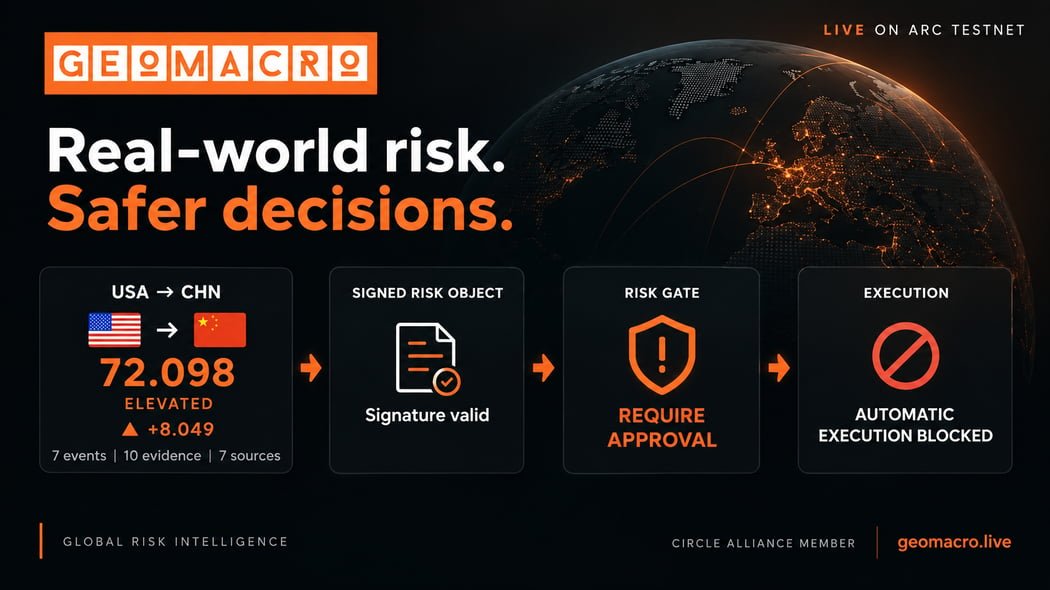
Real-time signals → Risk Objects → Verification → Risk Gate → Application / Agent
That's the flow.
A major focus now is making that intelligence more trustworthy, traceable and usable.
That means:
• source-aware event detection
• cross-source event validation
• structured Risk Objects
• signed and verifiable outputs
• transparent risk attribution
• pre-decision Risk Gate evaluation
• reliable delivery to applications and agents
Geomacro is also actively hardening its Testnet implementations.
There are still bugs and edge cases. Some have already been identified and are being fixed.
The goal is to find those weaknesses now, through real testing, rather than hide them behind a polished demo.
The bigger question is now,
Can geopolitical and macro risk intelligence become a reliable input to financial and autonomous systems, rather than just another dashboard or data feed?
That is the direction Geomacro is building toward.
We’re specially interested in builders working on:
payments • treasury • FX • lending • fintech • wallets • agentic finance • autonomous applications
If you’re building something where a geopolitical or macro event could change what an application should do next, we’d like to hear how you would want that signal delivered.
Also if you want to work directly on Geomacro, contribute technically, build an integration, or experiment with the system, reach out.
Building in public.
Testing in the open.
Fixing what breaks.
https://t.co/rLucW7nlNr
#RiskIntelligence #AgenticFinance #BuildInPublic
@yevloop@arc@BuildOnCircle@jerallaire That’s the product.
Dashboards summarize. Agents need bounded, structured, inspectable context they can evaluate before acting.
That’s the layer we’re building.
@AIGryffindor@arc@BuildOnCircle@jerallaire Agreed. Geopolitics is contested by nature.
That’s why Geomacro doesn’t output the truth. It outputs structured Risk Objects with source lineage, confidence and competing signals so a desk or agent can see where the uncertainty sits before acting.
@ADLXBT That’s the exact shift.
If the pipeline is explainable, verifiable and machine-readable, desks don’t wait for the morning note. They reprice when the evidence changes.
That’s what Geomacro is being built for.
Geomacro is looking for a commercial co-founder.
Geomacro is building geopolitical and macro risk intelligence infrastructure for financial institutions, investors, developers and autonomous AI systems.
The product and core infrastructure are already being built and moving toward commercial production.
We’re looking for a founder-level partner with experience in:
• B2B GTM and sales
• Enterprise customer development
• Strategic partnerships
• Fundraising
• Global business development
This is a co-founder opportunity, not an employee or contractor role.
If you have a strong track record taking technical products to market and want to build something globally ambitious, DM Geomacro.
Serious founder-level conversations only.
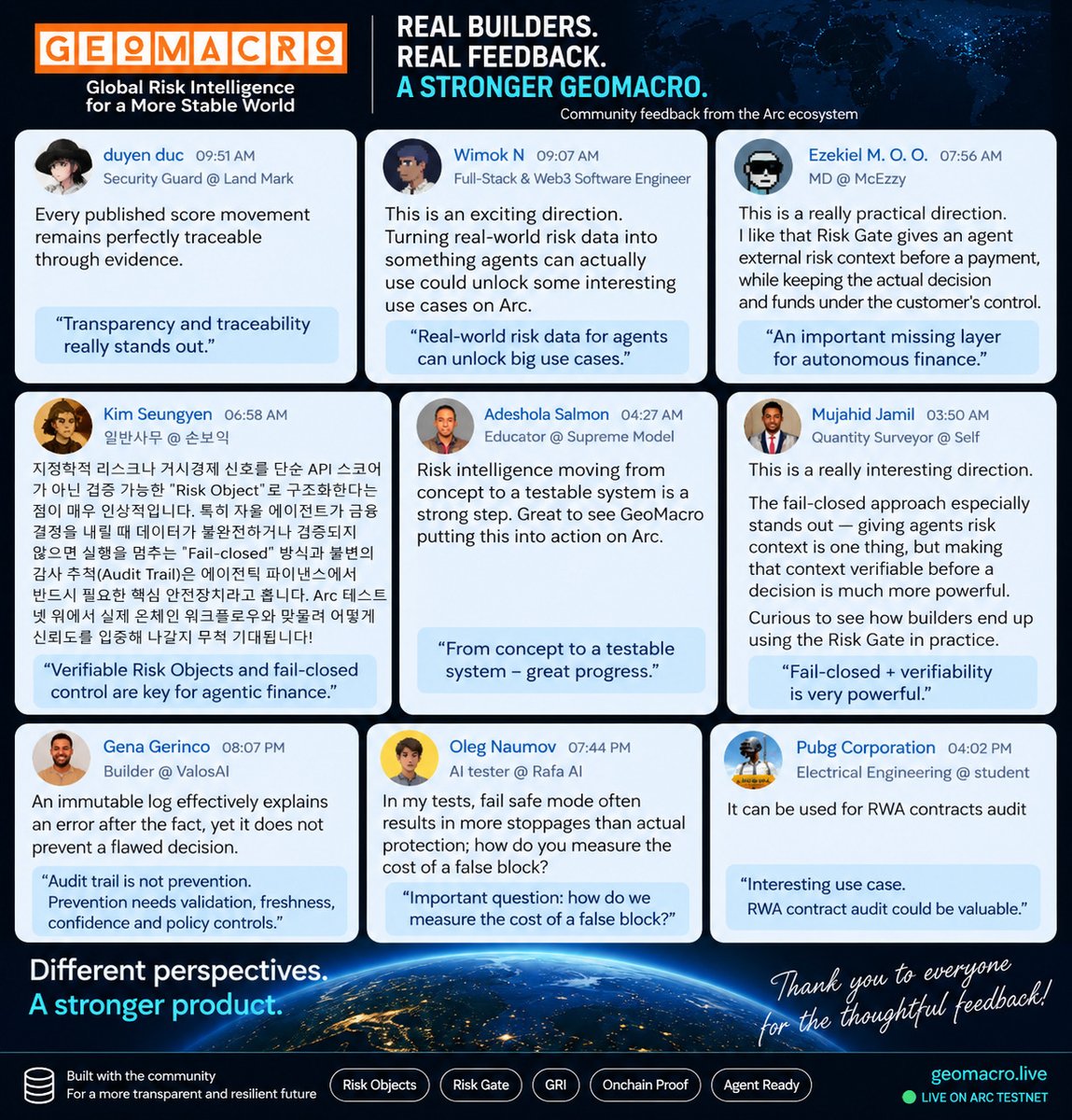
The best feedback isn’t always praise. Sometimes it finds the weakness you need to fix.
Arc builders have been testing the thinking behind Geomacro’s Risk Objects and Risk Gate.
They liked the traceability, verifiability and pre-execution risk checks. They also challenged us on false blocks, liveness, stale data and the limits of audit trails.
Good. That’s exactly what we need.
We’re taking those questions back into the product and hardening the system around real failure modes.
Build in public. Get challenged. Build better.
https://t.co/XKvlWH7vPb
@babyblueviper1@arc@BuildOnCircle Sounds good. We’ll send one signed Risk Object with the schema and a real payload via DM so we can keep the first test simple.
Looking forward to seeing how it maps into /review and running the dry flow together.
AI agents can move money.
But should they still move it when the world changes 5 minutes before execution?
We’ve been building that missing layer at Geomacro.
What started as an idea is now a testable system on Arc Testnet:
→ Machine-readable geopolitical & macro Risk Objects
→ Cryptographically signed + verifiable outputs
→ Risk Gate for pre-execution risk checks
→ Fail-closed when required context cannot be trusted
→ Decision audit trails
→ Reproducible risk methodology + attribution
The idea is simple:
Before an agent moves money, let it verify what changed in the real world.
Geomacro provides the risk context.
The application keeps control of its policy and final action.
We’re not calling this production-ready.
We’re still hardening API access, resilience, stale-data handling, idempotency, agent payments and institutional workflows and reproducible risk scores do not automatically mean the underlying assessment is correct or predictive. That validation is separate.
Now we need the part that can’t be built alone: real workflows.
If you’re building treasury, payments, FX, lending, wallets or agentic finance on Arc, what external risk signal would actually make your system change an action?
That’s what we want to test next.
Yes, this is very close to the integration model we have in mind.
A signed Geomacro Risk Object could provide the risk context, evidence, confidence, freshness and provenance, while your system owns the final verdict, execution controls and audit trail.
A /review-style pre-action check sounds like a strong integration point. We’d be interested in testing a real flow together.
@TheTokenXpress@joe_inkk@arc@base@0xPolygon Thanks for reaching out. We’re open to relevant collaborations around Geomacro.
Could you share a little more about the type of collaboration you have in mind? Happy to continue the conversation if there’s a good fit.
Geomacro Public API + Developer API are now open for testing across multiple testnets.
We’re testing a simple idea:
Can geopolitical and macro risk intelligence become something financial applications and AI agents can actually use before making a decision?
Builders can test:
• Public API access
• Wallet-based sign-in
• Developer credentials
• Machine-readable Risk Objects
• Signed, verifiable intelligence outputs
• Risk Gate pre-decision checks
• Test USDC pay-per-call
• Retry and idempotency handling
• App and AI agent integrations
Currently supported testnets:
• Arc Testnet
• Base Sepolia
• Polygon Amoy
We’re especially interested in builders working on payments, treasury, FX, lending, wallets, fintech and agentic finance.
Try the flow. Stress it. Find what is confusing. Break something if you can.
Most importantly:
Would your product use geopolitical or macro risk context before a financial action? What would Geomacro need to provide for you to trust it in a real workflow?
Testnet only. No real money.
Test Geomacro → https://t.co/WVIK62AaWv
#AgenticFinance #RiskIntelligence #BuildInPublic
@joe_inkk@arc@base@0xPolygon Not at all. We’re still building every day 🙂
A lot of the recent work has been behind the scenes, getting Geomacro production-ready and strengthening the core infrastructure.
More updates coming soon.
Yes, we’d be interested in taking a look.
At Geomacro, we’re building Risk Objects and Risk Gate around evidence, provenance, confidence, freshness and auditable decision paths for humans and AI agents.
There could be an interesting fit between the two approaches. Happy to explore the External Preview and see if there’s a useful way to test them together.
What happens when an AI agent can move money, but doesn’t know the world just became riskier?
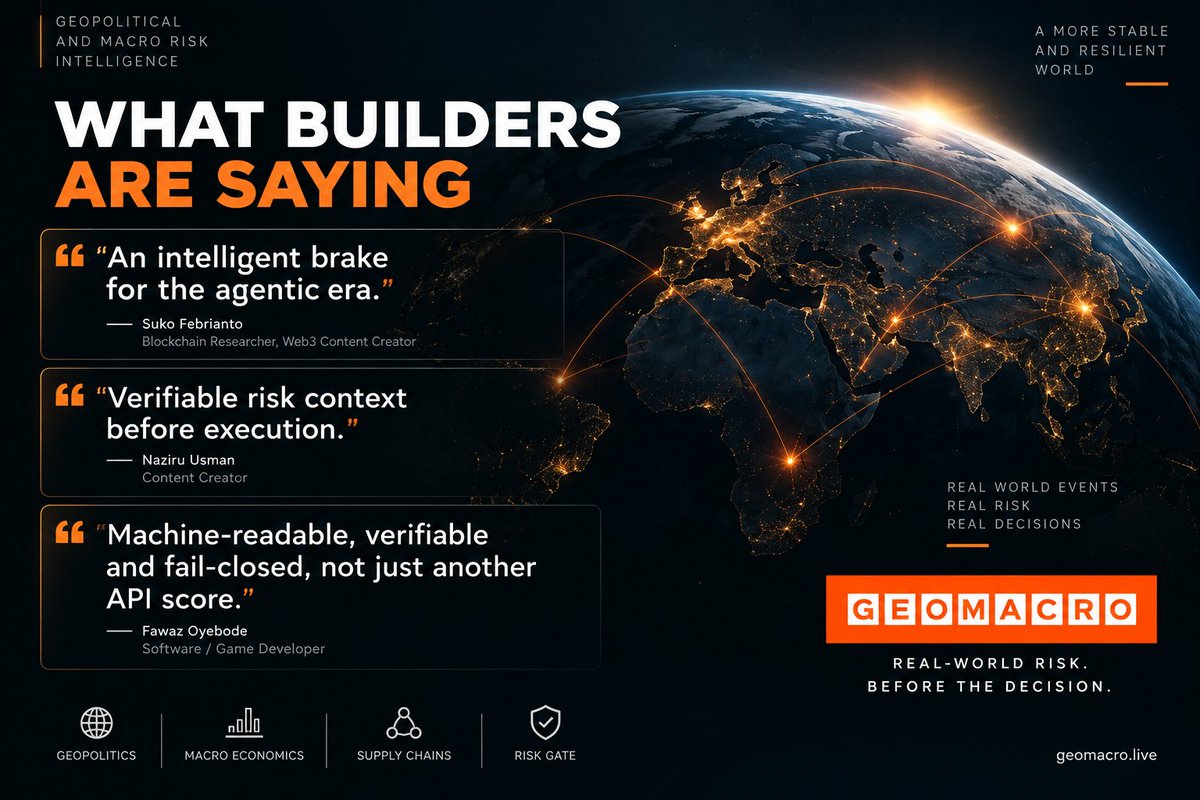
We recently shared Geomacro’s Risk Gate work with builders in the Arc community.
Their reactions kept coming back to the same idea:
“An intelligent brake for the agentic era.”
“Verifiable risk context before execution.”
“Machine-readable, verifiable and fail-closed, not just another API score.”
That’s the problem Geomacro is working on.
Before an autonomous financial system acts, it should be able to understand:
What changed?
Why did it change?
Can the risk context be verified?
Should the action still proceed?
We’re building Geomacro to turn geopolitical and macro risk into structured, explainable and machine-readable intelligence that financial systems and agents can actually use.
Still early. Still testing. Not production-ready.
But now we want to test the idea outside our own build cycle.
If you’re building an AI agent, treasury system, payments product, FX platform, lending protocol or financial application, what real-world risk would actually make your system stop or change an action?
We’d genuinely like to hear the answer.
https://t.co/XKvlWH7vPb
Geomacro is evolving.
We originally started by building geopolitical prediction markets on @arc.
But building them exposed a more fundamental problem.
Before a market, institution, application, or autonomous agent can act on geopolitical risk, it needs a reliable way to understand that risk in the first place.
Not just a headline.
Not just a probability.
It needs to know:
• What is happening?
• What evidence supports it?
• How significant is the risk?
• How reliable is the underlying information?
• What changed since the previous assessment?
• Which factors caused that change?
• And how should that context affect a decision?
That is the problem we are now building Geomacro around.
Geomacro is evolving into a geopolitical + macro risk intelligence layer designed for both human and machine decisions.
The goal is to transform fragmented real-world signals into structured intelligence:
Events → Evidence → Risk → Confidence → Attribution → Machine-readable signals.
This intelligence layer is being designed to power multiple Geomacro products and interfaces from the same underlying data and methodology:
• Global Risk Intelligence
• explainable country and macro risk
• change attribution
• Risk Gate for pre-decision checks
• Ask Geomacro
• structured data and APIs
• intelligence for autonomous agents
• institutional and embedded applications
For machines, the long term objective goes beyond returning a risk score.
An agent preparing to move value, interact with a country or corridor, or execute a financial action should be able to ask Geomacro for decision context first and receive structured risk, evidence, confidence and policy-aware signals before execution.
The prediction market work is not being abandoned.
It remains part of Geomacro as technical proof, experimentation and a potential market-based feedback layer.
But it is no longer the center of the product.
The larger opportunity we see is building the intelligence infrastructure between real-world geopolitical and macro events and the decisions made by humans, institutions and autonomous machines.
Arc can provide programmable financial infrastructure and USDC can move value.
Geomacro's role is to provide the risk context around those decisions.
We are still early, and several parts of this architecture are actively being built and validated.
More updates soon as we continue building.