Hace mucho tiempo dejé de tomar en serio a ese supuesto “apologista”. Me cuesta creer que alguien pueda presentarse como referente del arminianismo sin hacer el mínimo esfuerzo por estudiar la tradición que dice defender. Lo demostró cuando llamó semipelagianos a provisionistas como Adam Harwood, ignorando que la propia tradición arminiana, especialmente la wesleyana, sostiene una comprensión muy similar sobre la condición espiritual de los infantes. Lo mismo ocurrió cuando aseguró haber leído fuentes en inglés, pese a que sus propias interpretaciones evidencian que no domina el idioma. Lo preocupante es que muchos lo toman como un referente del arminianismo y terminan repitiendo sus errores. Y si a eso se le suman comentarios racistas y la manera en que intenta justificarlos, el resultado es bastante lamentable. Es una pena que parte del contenido cristiano en las redes haya cambiado el estudio serio por la polémica y el espectáculo.
Hubo algo que también me llamó la atención. Aunque los autores nunca dicen explícitamente desde qué escuela escriben, da la impresión de que están llegando a conclusiones que otras corrientes llevan décadas desarrollando. Leí todo el libro y no encontré una sola referencia a Paul Davidson, G. L. S. Shackle ni a otros economistas poskeynesianos que han trabajado la incertidumbre radical durante muchos años. Me hace pensar que, en economía, a veces hace falta leer más a quienes piensan distinto. De lo contrario, corremos el riesgo de presentar como novedosas ideas que ya habían sido desarrolladas y debatidas desde hace tiempo.
Great Books for Summer or Winter Reading!
"Radical Uncertainty: Decision-Making Beyond the Numbers" by John Kay and Mervyn King.
"The limits of certainty demonstrate the power of human judgment over artificial intelligence. In most critical decisions there can be no forecasts or probability distributions on which we might sensibly rely. Instead of inventing numbers to fill the gaps in our knowledge, we should adopt business, political, and personal strategies that will be robust to alternative futures and resilient to unpredictable events. Within the security of such a robust and resilient reference narrative, uncertainty can be embraced, because it is the source of creativity, excitement, and profit."
https://t.co/UFKUJ8aWbN
Tienes razón, mi comentario iba más en un sentido general. Pero, si nos centramos en Mises, sigo pensando que esa crítica no refleja del todo la postura de Keynes. En A Treatise on Probability, la idea del peso de la evidencia justamente evita hacer ese tipo de asignaciones probabilísticas cuando no hay evidencia suficiente.
As I understand it, Hicks was quite taken by Hayek's ideas during his time at the LSE, which may explain why the IS-LM model can be read in a fairly neoclassical way. Interestingly, later in life Hicks became critical of his own model, arguing that it did not really capture Keynes's ideas, and even published a critique of it in a Post-Keynesian journal.
Ese mismo argumento podría aplicarse aquí. Veo que muchos elogian a Rothbard por su formación matemática, pero suelen olvidar que Keynes también tuvo una sólida formación en matemáticas en Cambridge y que, además, fue un brillante estadístico. Como señala Skidelsky en su biografía, desde muy joven demostró un talento excepcional para las matemáticas, dominando la geometría euclidiana y adentrándose en el cálculo siendo aún adolescente. Por eso, presentar a Keynes como si solo hubiera sido economista deja de lado una parte importante de su formación intelectual.
@EditoraCPAD Este livro deveria ser traduzido para o espanhol. É uma verdadeira joia e merece estar disponível nesse idioma para que mais pessoas possam ter acesso ao seu conteúdo.
Hoy, Beca 18 no es accesible para los más pobres.
¿Por qué? Para ganarla, hay que pagar academias al menos dos veces.
¿Qué propongo? Programa Mi Academia 16, a través de becas por impuestos.
¡Esta es una propuesta basada en mis amigos de Remar! ¡Escúchenla! #VolverACreer
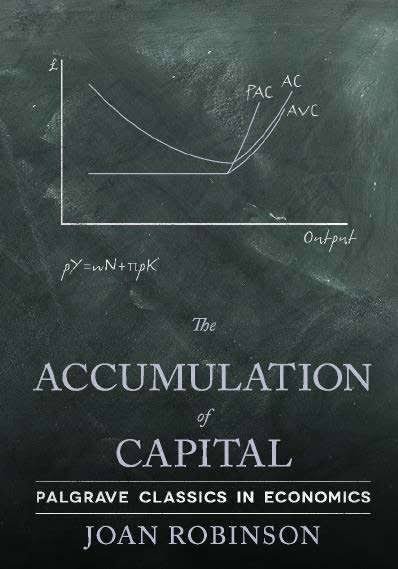
Varılan bu sonuçlar post-Keynesyen iktisatçıların uzun yıllardır bildiği ve tekrarladığı şeyler. Örneğin Joan Robinson 1956 tarihli bu kitabında yavaş nüfus artışının sonucu olabilecek bir emek kıtlığının olası sonuçlarını ele alıyor. Teknolojik/teknik ilerlemenin içselliği.
I've been saying this for a long time. Milei isn't really Austrian. And just to be clear, I'm not an Austrian economist either. At the end of the day, he's a straightforward neoclassical economist, whether he likes that label or not.
New academic economics paper from President @JMilei and @dreidel1 presenting a model of growth: “Minimum Viable Scale” (full paper here: https://t.co/wdgUl5MDDx)
@IgnaBarranquero Pásame tu correo. Hay un profe peruano que escribió un libro buenísimo sobre populismo (en economía ). Creo que te va a gustar; te lo envío.
@Lprochon@oktayozdn@ilhandogus I've even seen people talking about mark-up pricing without citing a single PK author. They write about it as if they came up with the idea themselves.
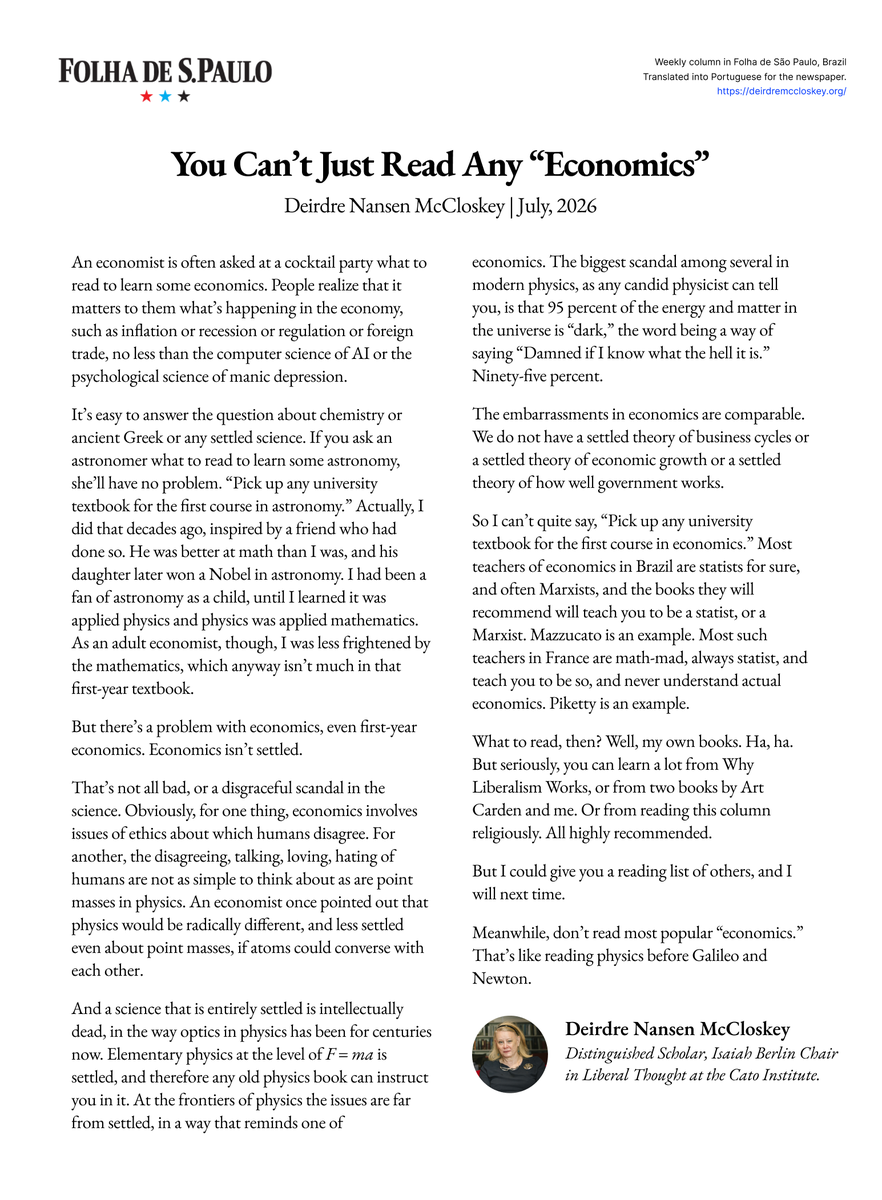
An economist is often asked at a cocktail party what to read to learn some economics.
It’s easy to answer the question about chemistry or ancient Greek or any settled science. If you ask an astronomer what to read to learn some astronomy, she’ll have no problem.
But there’s a problem with economics, even first-year economics. Economics isn’t settled.
My latest column for @folha
Latin American and Asian Perspectives on Development
These two books shed light on how some economists from the Global South did much to shape our thinking about development.
@mmfajardoh focuses on Raúl Prebisch. Engerman on Sen, Bhagwati, Singh, Ul Haq, Sobhan, & Jayawardene
Thought-provoking!
"Inflation and Debt" by John H. Cochrane.
"What determines the level of prices or, equivalently, the value of money? Why do we work so hard for mere pieces of paper or, now, bits in a computer? Where does inflation come from? How can inflation be better controlled? These seem like largely settled questions, needing only elaboration of “monetary transmission mechanism” epicycles. Central bankers and policy analysts express a verbal doctrine not much changed since the 1970s. They exude an aura of technocratic expertise. In fact, we live in a moment of great uncertainty in monetary economics. The standard policy doctrine is completely at odds with the actual equations and operation of contemporary economic theory. Events befuddle theory. Low and stable inflation was a puzzle in the 2010s. The great inflation of 2020-2021 revealed that central banks have much less control and understanding of inflation than most people believed."
https://t.co/2e5fUAGksP
Leyendo a Gerd Gigerenzer, quien para mí es el mejor psicólogo que ha trabajado la economía conductual y uno de los pocos que realmente continúa la tradición de Herbert Simon, me encontré con una anécdota que resume muy bien el problema de asumir que las personas siempre maximizan una función de utilidad.
«"Un profesor de la Universidad de Columbia estaba pensando seriamente si aceptar la oferta de una universidad rival o quedarse donde estaba. Un colega se le acercó y le dijo: 'Simplemente maximiza la utilidad esperada; tú siempre escribes sobre eso'. El profesor, ya algo desesperado, respondió: '¡Vamos, esto es algo serio!'."»
Cada vez que leo esa historia me parece más reveladora. Hay quienes siguen defendiendo el modelo neoclásico del consumidor como si las personas resolvieran sus decisiones importantes maximizando una función de utilidad. Pero cuando llega el momento de decidir con quién casarse, si cambiar de trabajo, mudarse a otra ciudad o iniciar un negocio, nadie se sienta a resolver un problema de optimización.
Las decisiones realmente importantes se toman en un mundo de incertidumbre, información incompleta y tiempo limitado. Por eso, la vida se parece mucho más a lo que describían Herbert Simon y Gerd Gigerenzer que a los modelos de optimización de los manuales.
As part of the Ergodicity Economics 2025 conference, we spent the last few days meeting in person in (stormy) Cascais, Portugal. This year, the aim of the conference was to get the EE crowd to meet the ecological rationality crowd around Gerd Gigerenzer.
Over dinner, Gerd brought up the two-envelopes paradox and how ecological rationality might address it. I found this worth sharing because it illustrates how ergodicity economics and ecological rationality can meet, and how the two approaches, vastly different in some ways, can be joined to support each other.
The two-envelopes paradox
Here comes the paradox. I have two envelopes, and I give you one of them. I tell you that one envelope contains twice as much money as the other, and I give you the option to swap envelopes with me.
Should you do it? The paradox (which we'll resolve formally below), is this: if you compute the expected value of what's in my envelope, you'll find that it's (2+1/2)/2=1.25 times whatever is in the envelope you currently have. This suggests that you should swap. But once you've swapped, you're in the same situation as before, you didn't learn anything new, so the same reasoning applied again will again tell you to swap and so on ad infinitum.
Intuitively, it also feels that it cannot possibly make a difference to swap because swapping doesn't change your situation in any way.
Ecological rationality to the rescue
Ecological rationality suggests the following solution. Instead of tangling yourself in mathematical imponderables, get real, and develop a heuristic for making the choice. Here is the heuristic Gerd mentioned: think about the context, your surroundings, and come up with a plausible range of what might be in the envelopes. For example, you may be at an academic conference. It's unlikely that you'll find $10,000 in the envelope. Something symbolic like $10 or $20 would make sense, given the context.
So you might choose $12 as a threshold, then open the envelope you've currently got, and keep it if it contains more than $12, otherwise swap.
The heuristic (unlike the mathematical analysis) allows you to make a definite decision, it requires no complicated computations and gets the job done quickly. Also, it's designed to be fairly good -- you can rely on your intuition about the situation, implicitly taking a lot of information into account.
I found this approach utterly refreshing -- if we're really talking about a real situation, and the story about the envelopes isn't just some cryptic encoding of an exercise in probability theory, then forget probability theory and focus on the real-world problem at hand!
Ergodicity economics insights
Expected value is meaningless here
Nonetheless, let's see how ergodicity thinking can be informative here. Let's go back to the formal problem. The first thing we realize is that the expected value has absolutely nothing to do with the problem. The expected value is the ensemble-average over all imagined possible worlds of what might be in the envelope I'm holding. But you don't have access to the ensemble of all imagined possible worlds, you're stuck in this one universe.
Tragically, the name "expected value" with its entirely inappropriate connotations, has become the standard word for referring to the average over the infinite statistical ensemble. Of course it's not what you should "expect": whatever is in my envelope, it's certainly not 1.25 times what's in yours -- it's either 0.5 or 2 times what's in yours. The "expected value" is not even in the set of possible values.
Once we try to attach physical meaning to the expected value, and once this really sinks in, we realize that making this choice (and many others) based on expected value is as sensible as measuring your left shoe lace and swapping envelopes if it's longer than Julius Cesar's right arm (whose length you don't know).
Long term growth
But how would an ergodicity economist address the problem? I think maybe like this: try embedding the problem in time; make it part of a dynamic, and think of the choice you're making as the result of a behavioral protocol. Then judge the different options by how they affect you in the long run (not in expectation). How?
You're currently holding an envelop. Let's call the (unknown) amount of money in that envelop x(0). You have the option to swap, or to keep the envelop. What's the growth rate of your wealth in the long run under either decision protocol?
Let's check option A) keep your envelope. In this case, the amount of money you have will stay what it is, x(t)=x(0). The long-time additive growth rate of your wealth will be
lim₍ₜ → ∞₎ 1/t [x(t)-x(0)]=0.
What about option B), swapping? If you choose to swap envelopes now, you will learn nothing new, so you will repeat the same choice at the next time step. In other words, you will keep swapping envelopes. If you've currently got the good envelope, your wealth will evolve according to
x(t)= x(0)/2 if t is odd
and
x(t)=x(0) if t is even
If you've currently got the bad envelope, it will be 2 x(0) and x(0). In either case, the long-term additive growth rate of your wealth will again be zero
lim₍ₜ → ∞₎ 1/t [x(t)-x(0)]=0.
That's because in the large-t limit the contribution of a doubling or halving of the amount of money contributes nothing to the time-average growth rate.
Paradox lost
So: ergodicity economics resolves the foundational puzzle and arrives at the intuitive result: whether you swap or not is irrelevant according to the simple criterion of maximizing time-average growth rates. This exposes the invalidity of the formal analysis that established the paradox in the first place, and we quite like that.
Back to reality: EE and ER synthesis
If you now ask an ergodicity economist what should be done in the real situation, I'd suspect he or she would say the first-order decision criterion of ergodicity economics gives no answer, and we have to look for extra information to make the choice.
Enter Ecological Rationality: it's exactly right -- look for more information than what we had immediately translated into a probabilistic mathematical model. Is this happening at an academic conference, or perhaps on live TV? Do you know me? Am I winking at the envelope in my hand and smiling at you? Am I trustworthy? Are we friends? Might I be trying to help you out?
The EE2025 conference was a wonderful opportunity to start a serious dialogue between the two communities around EE concepts and Ecological Rationality concepts. I look forward to continuing it.


![ole_b_peters's tweet photo. As part of the Ergodicity Economics 2025 conference, we spent the last few days meeting in person in (stormy) Cascais, Portugal. This year, the aim of the conference was to get the EE crowd to meet the ecological rationality crowd around Gerd Gigerenzer.
Over dinner, Gerd brought up the two-envelopes paradox and how ecological rationality might address it. I found this worth sharing because it illustrates how ergodicity economics and ecological rationality can meet, and how the two approaches, vastly different in some ways, can be joined to support each other.
The two-envelopes paradox
Here comes the paradox. I have two envelopes, and I give you one of them. I tell you that one envelope contains twice as much money as the other, and I give you the option to swap envelopes with me.
Should you do it? The paradox (which we'll resolve formally below), is this: if you compute the expected value of what's in my envelope, you'll find that it's (2+1/2)/2=1.25 times whatever is in the envelope you currently have. This suggests that you should swap. But once you've swapped, you're in the same situation as before, you didn't learn anything new, so the same reasoning applied again will again tell you to swap and so on ad infinitum.
Intuitively, it also feels that it cannot possibly make a difference to swap because swapping doesn't change your situation in any way.
Ecological rationality to the rescue
Ecological rationality suggests the following solution. Instead of tangling yourself in mathematical imponderables, get real, and develop a heuristic for making the choice. Here is the heuristic Gerd mentioned: think about the context, your surroundings, and come up with a plausible range of what might be in the envelopes. For example, you may be at an academic conference. It's unlikely that you'll find $10,000 in the envelope. Something symbolic like $10 or $20 would make sense, given the context.
So you might choose $12 as a threshold, then open the envelope you've currently got, and keep it if it contains more than $12, otherwise swap.
The heuristic (unlike the mathematical analysis) allows you to make a definite decision, it requires no complicated computations and gets the job done quickly. Also, it's designed to be fairly good -- you can rely on your intuition about the situation, implicitly taking a lot of information into account.
I found this approach utterly refreshing -- if we're really talking about a real situation, and the story about the envelopes isn't just some cryptic encoding of an exercise in probability theory, then forget probability theory and focus on the real-world problem at hand!
Ergodicity economics insights
Expected value is meaningless here
Nonetheless, let's see how ergodicity thinking can be informative here. Let's go back to the formal problem. The first thing we realize is that the expected value has absolutely nothing to do with the problem. The expected value is the ensemble-average over all imagined possible worlds of what might be in the envelope I'm holding. But you don't have access to the ensemble of all imagined possible worlds, you're stuck in this one universe.
Tragically, the name "expected value" with its entirely inappropriate connotations, has become the standard word for referring to the average over the infinite statistical ensemble. Of course it's not what you should "expect": whatever is in my envelope, it's certainly not 1.25 times what's in yours -- it's either 0.5 or 2 times what's in yours. The "expected value" is not even in the set of possible values.
Once we try to attach physical meaning to the expected value, and once this really sinks in, we realize that making this choice (and many others) based on expected value is as sensible as measuring your left shoe lace and swapping envelopes if it's longer than Julius Cesar's right arm (whose length you don't know).
Long term growth
But how would an ergodicity economist address the problem? I think maybe like this: try embedding the problem in time; make it part of a dynamic, and think of the choice you're making as the result of a behavioral protocol. Then judge the different options by how they affect you in the long run (not in expectation). How?
You're currently holding an envelop. Let's call the (unknown) amount of money in that envelop x(0). You have the option to swap, or to keep the envelop. What's the growth rate of your wealth in the long run under either decision protocol?
Let's check option A) keep your envelope. In this case, the amount of money you have will stay what it is, x(t)=x(0). The long-time additive growth rate of your wealth will be
lim₍ₜ → ∞₎ 1/t [x(t)-x(0)]=0.
What about option B), swapping? If you choose to swap envelopes now, you will learn nothing new, so you will repeat the same choice at the next time step. In other words, you will keep swapping envelopes. If you've currently got the good envelope, your wealth will evolve according to
x(t)= x(0)/2 if t is odd
and
x(t)=x(0) if t is even
If you've currently got the bad envelope, it will be 2 x(0) and x(0). In either case, the long-term additive growth rate of your wealth will again be zero
lim₍ₜ → ∞₎ 1/t [x(t)-x(0)]=0.
That's because in the large-t limit the contribution of a doubling or halving of the amount of money contributes nothing to the time-average growth rate.
Paradox lost
So: ergodicity economics resolves the foundational puzzle and arrives at the intuitive result: whether you swap or not is irrelevant according to the simple criterion of maximizing time-average growth rates. This exposes the invalidity of the formal analysis that established the paradox in the first place, and we quite like that.
Back to reality: EE and ER synthesis
If you now ask an ergodicity economist what should be done in the real situation, I'd suspect he or she would say the first-order decision criterion of ergodicity economics gives no answer, and we have to look for extra information to make the choice.
Enter Ecological Rationality: it's exactly right -- look for more information than what we had immediately translated into a probabilistic mathematical model. Is this happening at an academic conference, or perhaps on live TV? Do you know me? Am I winking at the envelope in my hand and smiling at you? Am I trustworthy? Are we friends? Might I be trying to help you out?
The EE2025 conference was a wonderful opportunity to start a serious dialogue between the two communities around EE concepts and Ecological Rationality concepts. I look forward to continuing it.](https://pbs.twimg.com/media/GnDaKWAXMAAi533.jpg)
![ole_b_peters's tweet photo. As part of the Ergodicity Economics 2025 conference, we spent the last few days meeting in person in (stormy) Cascais, Portugal. This year, the aim of the conference was to get the EE crowd to meet the ecological rationality crowd around Gerd Gigerenzer.
Over dinner, Gerd brought up the two-envelopes paradox and how ecological rationality might address it. I found this worth sharing because it illustrates how ergodicity economics and ecological rationality can meet, and how the two approaches, vastly different in some ways, can be joined to support each other.
The two-envelopes paradox
Here comes the paradox. I have two envelopes, and I give you one of them. I tell you that one envelope contains twice as much money as the other, and I give you the option to swap envelopes with me.
Should you do it? The paradox (which we'll resolve formally below), is this: if you compute the expected value of what's in my envelope, you'll find that it's (2+1/2)/2=1.25 times whatever is in the envelope you currently have. This suggests that you should swap. But once you've swapped, you're in the same situation as before, you didn't learn anything new, so the same reasoning applied again will again tell you to swap and so on ad infinitum.
Intuitively, it also feels that it cannot possibly make a difference to swap because swapping doesn't change your situation in any way.
Ecological rationality to the rescue
Ecological rationality suggests the following solution. Instead of tangling yourself in mathematical imponderables, get real, and develop a heuristic for making the choice. Here is the heuristic Gerd mentioned: think about the context, your surroundings, and come up with a plausible range of what might be in the envelopes. For example, you may be at an academic conference. It's unlikely that you'll find $10,000 in the envelope. Something symbolic like $10 or $20 would make sense, given the context.
So you might choose $12 as a threshold, then open the envelope you've currently got, and keep it if it contains more than $12, otherwise swap.
The heuristic (unlike the mathematical analysis) allows you to make a definite decision, it requires no complicated computations and gets the job done quickly. Also, it's designed to be fairly good -- you can rely on your intuition about the situation, implicitly taking a lot of information into account.
I found this approach utterly refreshing -- if we're really talking about a real situation, and the story about the envelopes isn't just some cryptic encoding of an exercise in probability theory, then forget probability theory and focus on the real-world problem at hand!
Ergodicity economics insights
Expected value is meaningless here
Nonetheless, let's see how ergodicity thinking can be informative here. Let's go back to the formal problem. The first thing we realize is that the expected value has absolutely nothing to do with the problem. The expected value is the ensemble-average over all imagined possible worlds of what might be in the envelope I'm holding. But you don't have access to the ensemble of all imagined possible worlds, you're stuck in this one universe.
Tragically, the name "expected value" with its entirely inappropriate connotations, has become the standard word for referring to the average over the infinite statistical ensemble. Of course it's not what you should "expect": whatever is in my envelope, it's certainly not 1.25 times what's in yours -- it's either 0.5 or 2 times what's in yours. The "expected value" is not even in the set of possible values.
Once we try to attach physical meaning to the expected value, and once this really sinks in, we realize that making this choice (and many others) based on expected value is as sensible as measuring your left shoe lace and swapping envelopes if it's longer than Julius Cesar's right arm (whose length you don't know).
Long term growth
But how would an ergodicity economist address the problem? I think maybe like this: try embedding the problem in time; make it part of a dynamic, and think of the choice you're making as the result of a behavioral protocol. Then judge the different options by how they affect you in the long run (not in expectation). How?
You're currently holding an envelop. Let's call the (unknown) amount of money in that envelop x(0). You have the option to swap, or to keep the envelop. What's the growth rate of your wealth in the long run under either decision protocol?
Let's check option A) keep your envelope. In this case, the amount of money you have will stay what it is, x(t)=x(0). The long-time additive growth rate of your wealth will be
lim₍ₜ → ∞₎ 1/t [x(t)-x(0)]=0.
What about option B), swapping? If you choose to swap envelopes now, you will learn nothing new, so you will repeat the same choice at the next time step. In other words, you will keep swapping envelopes. If you've currently got the good envelope, your wealth will evolve according to
x(t)= x(0)/2 if t is odd
and
x(t)=x(0) if t is even
If you've currently got the bad envelope, it will be 2 x(0) and x(0). In either case, the long-term additive growth rate of your wealth will again be zero
lim₍ₜ → ∞₎ 1/t [x(t)-x(0)]=0.
That's because in the large-t limit the contribution of a doubling or halving of the amount of money contributes nothing to the time-average growth rate.
Paradox lost
So: ergodicity economics resolves the foundational puzzle and arrives at the intuitive result: whether you swap or not is irrelevant according to the simple criterion of maximizing time-average growth rates. This exposes the invalidity of the formal analysis that established the paradox in the first place, and we quite like that.
Back to reality: EE and ER synthesis
If you now ask an ergodicity economist what should be done in the real situation, I'd suspect he or she would say the first-order decision criterion of ergodicity economics gives no answer, and we have to look for extra information to make the choice.
Enter Ecological Rationality: it's exactly right -- look for more information than what we had immediately translated into a probabilistic mathematical model. Is this happening at an academic conference, or perhaps on live TV? Do you know me? Am I winking at the envelope in my hand and smiling at you? Am I trustworthy? Are we friends? Might I be trying to help you out?
The EE2025 conference was a wonderful opportunity to start a serious dialogue between the two communities around EE concepts and Ecological Rationality concepts. I look forward to continuing it.](https://pbs.twimg.com/media/GnDZ3r7W4AAg7x9.jpg)



![ole_b_peters's tweet photo. As part of the Ergodicity Economics 2025 conference, we spent the last few days meeting in person in (stormy) Cascais, Portugal. This year, the aim of the conference was to get the EE crowd to meet the ecological rationality crowd around Gerd Gigerenzer.
Over dinner, Gerd brought up the two-envelopes paradox and how ecological rationality might address it. I found this worth sharing because it illustrates how ergodicity economics and ecological rationality can meet, and how the two approaches, vastly different in some ways, can be joined to support each other.
The two-envelopes paradox
Here comes the paradox. I have two envelopes, and I give you one of them. I tell you that one envelope contains twice as much money as the other, and I give you the option to swap envelopes with me.
Should you do it? The paradox (which we'll resolve formally below), is this: if you compute the expected value of what's in my envelope, you'll find that it's (2+1/2)/2=1.25 times whatever is in the envelope you currently have. This suggests that you should swap. But once you've swapped, you're in the same situation as before, you didn't learn anything new, so the same reasoning applied again will again tell you to swap and so on ad infinitum.
Intuitively, it also feels that it cannot possibly make a difference to swap because swapping doesn't change your situation in any way.
Ecological rationality to the rescue
Ecological rationality suggests the following solution. Instead of tangling yourself in mathematical imponderables, get real, and develop a heuristic for making the choice. Here is the heuristic Gerd mentioned: think about the context, your surroundings, and come up with a plausible range of what might be in the envelopes. For example, you may be at an academic conference. It's unlikely that you'll find $10,000 in the envelope. Something symbolic like $10 or $20 would make sense, given the context.
So you might choose $12 as a threshold, then open the envelope you've currently got, and keep it if it contains more than $12, otherwise swap.
The heuristic (unlike the mathematical analysis) allows you to make a definite decision, it requires no complicated computations and gets the job done quickly. Also, it's designed to be fairly good -- you can rely on your intuition about the situation, implicitly taking a lot of information into account.
I found this approach utterly refreshing -- if we're really talking about a real situation, and the story about the envelopes isn't just some cryptic encoding of an exercise in probability theory, then forget probability theory and focus on the real-world problem at hand!
Ergodicity economics insights
Expected value is meaningless here
Nonetheless, let's see how ergodicity thinking can be informative here. Let's go back to the formal problem. The first thing we realize is that the expected value has absolutely nothing to do with the problem. The expected value is the ensemble-average over all imagined possible worlds of what might be in the envelope I'm holding. But you don't have access to the ensemble of all imagined possible worlds, you're stuck in this one universe.
Tragically, the name "expected value" with its entirely inappropriate connotations, has become the standard word for referring to the average over the infinite statistical ensemble. Of course it's not what you should "expect": whatever is in my envelope, it's certainly not 1.25 times what's in yours -- it's either 0.5 or 2 times what's in yours. The "expected value" is not even in the set of possible values.
Once we try to attach physical meaning to the expected value, and once this really sinks in, we realize that making this choice (and many others) based on expected value is as sensible as measuring your left shoe lace and swapping envelopes if it's longer than Julius Cesar's right arm (whose length you don't know).
Long term growth
But how would an ergodicity economist address the problem? I think maybe like this: try embedding the problem in time; make it part of a dynamic, and think of the choice you're making as the result of a behavioral protocol. Then judge the different options by how they affect you in the long run (not in expectation). How?
You're currently holding an envelop. Let's call the (unknown) amount of money in that envelop x(0). You have the option to swap, or to keep the envelop. What's the growth rate of your wealth in the long run under either decision protocol?
Let's check option A) keep your envelope. In this case, the amount of money you have will stay what it is, x(t)=x(0). The long-time additive growth rate of your wealth will be
lim₍ₜ → ∞₎ 1/t [x(t)-x(0)]=0.
What about option B), swapping? If you choose to swap envelopes now, you will learn nothing new, so you will repeat the same choice at the next time step. In other words, you will keep swapping envelopes. If you've currently got the good envelope, your wealth will evolve according to
x(t)= x(0)/2 if t is odd
and
x(t)=x(0) if t is even
If you've currently got the bad envelope, it will be 2 x(0) and x(0). In either case, the long-term additive growth rate of your wealth will again be zero
lim₍ₜ → ∞₎ 1/t [x(t)-x(0)]=0.
That's because in the large-t limit the contribution of a doubling or halving of the amount of money contributes nothing to the time-average growth rate.
Paradox lost
So: ergodicity economics resolves the foundational puzzle and arrives at the intuitive result: whether you swap or not is irrelevant according to the simple criterion of maximizing time-average growth rates. This exposes the invalidity of the formal analysis that established the paradox in the first place, and we quite like that.
Back to reality: EE and ER synthesis
If you now ask an ergodicity economist what should be done in the real situation, I'd suspect he or she would say the first-order decision criterion of ergodicity economics gives no answer, and we have to look for extra information to make the choice.
Enter Ecological Rationality: it's exactly right -- look for more information than what we had immediately translated into a probabilistic mathematical model. Is this happening at an academic conference, or perhaps on live TV? Do you know me? Am I winking at the envelope in my hand and smiling at you? Am I trustworthy? Are we friends? Might I be trying to help you out?
The EE2025 conference was a wonderful opportunity to start a serious dialogue between the two communities around EE concepts and Ecological Rationality concepts. I look forward to continuing it.](https://pbs.twimg.com/media/GnDaNpnXEAAsVnz.jpg)





