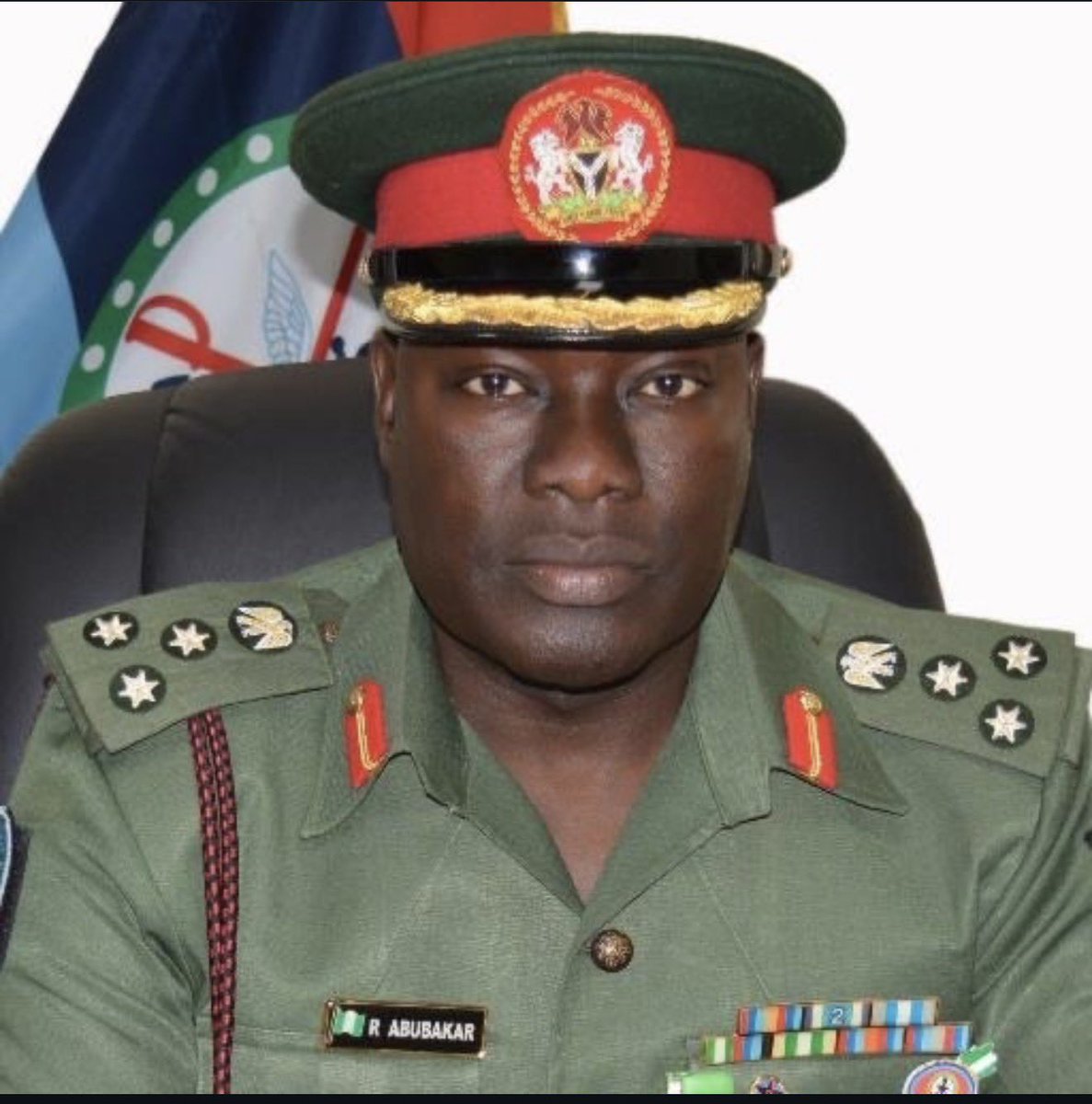
@okoliecollins5@kayodeteslim We have generals who have undergone courses on how to solve this logistics issue from some of the best war colleges in the world. I am baffled that NA have chosen to not invest more in tech esp. recon. drones, employing nighttime ops & more air raids
🚨 WANTED FOR CONTEMPT OF COURT 🚨
IGP OLATUNJI RILWAN DISU has REFUSED to obey a 2015 Federal High Court judgment ordering the Nigeria Police Force to pay my right-hand reconstruction medical bill. I am a graphics animator SHOT by a police officer at a checkpoint in Lagos.
10 YEARS. No payment. No justice.
I face permanent disability without help.
Suit No: FHC/L/CS/573/13
#JusticeForTomori
Video of SP Abdurrazak Hassan, Commander of the EOD Unit in Zamfara State, recorded just yesterday before he and his team embarked on an operation that would tragically become his last.
He was one of three police officers killed on Monday after their vehicle struck an IED planted by terrorists in Zamfara. The officers were conducting a routine patrol targeting armed groups along the Anka–Bagega axis when one of the police unit’s armoured personnel carriers ran over the IED buried by the terrorists.
All three fallen officers were trained Explosive Ordnance Disposal (EOD) specialists attached to the Zamfara State Police Command.
According to reports, following the explosion, armed bandits emerged from the surrounding forest, torched the damaged armoured vehicle, and then retreated back into the bush.
🤐🚨
الفيفا لن يتسامح مع الحكم الاسترالي شون إيفانز حتى ولو لم يقصد شي
الحكم عمل حركه غبيه بدون داعي 👌 ولكن البعض يقول انها تشبه رمزًا مرتبطًا بتفوق العرق الأبيض
Banditry is not surviving in Northern Nigeria merely because of government failure. It is surviving because the North, over time, has built an ecosystem that allows it to thrive.
Behind the man with the gun, there is often a village that fears him or protects him. There is a relative who knows where he sleeps. There is an informant who watches the road. There is a supplier who sells him fuel, food, motorcycles, or ammunition. There is a negotiator who profits from ransom. There is a praise singer who turns him into a legend. There is a politician who makes statements after every tragedy and returns to silence. And there is an educated northern public that can trend gossip or sex scandals for days but treat mass abduction like bad weather.
That is the part we do not like to say.
The forest did not create banditry. It simply gave it room to grow.
Banditry in Northern Nigeria did not begin today. Long before today’s headlines, northern trade routes and rural frontiers had a history of armed raids, cattle theft, attacks on traders, and criminal gangs operating in places where authority was weak.
That is one of the ironies of our history. Many people today, especially in Southern Nigeria, look at banditry and conclude that Nigeria should break apart. Yet insecurity along northern routes was one of the problems colonial rule claimed it was trying to solve when Nigeria was amalgamated in 1914.
Colonial authorities quickly discovered that the frontier was far less obedient than the maps they drew. Trade routes were disrupted by raids and ambushes. Traders and herders faced harassment. Rural authority was weak. Roads were unsafe. Violence had already become part of the region’s political economy. Even Lugard himself had some skimishes with armed bandits.
So the problem is old.
What changed was the scale, the weapons, the money involved, the collapse of local restraints, and the weakness of the modern state.
The modern form of banditry did not begin with mass kidnappings or attacks on schools Either. It started in ways that seemed smaller and easier to ignore.
In many rural parts of Zamfara, Katsina, Sokoto, Kebbi, and neighbouring areas, the first signs were cattle theft, highway robbery, and revenge attacks between communities. One man’s cattle would be stolen. Another group would retaliate. Villages accused one another of helping criminals. Violence gradually escalated.
This was the environment that produced men like Kundu and Buharin Daji.
Today, they are remembered as notorious bandit leaders. But before they became feared names, they emerged from communities already struggling with insecurity, poverty, and weak government presence.
In those communities, cattle were not just livestock. They were savings, school fees, food, and family wealth.
Losing fifty cows could mean losing everything.
At the same time, many people felt abandoned by the state. Some villages rarely saw police officers. Others believed security agencies only arrived after attacks had already happened. Many felt the courts were too slow or too corrupt to provide justice.
Then communities formed vigilante groups to defend themselves.
In many places, people welcomed them because they were desperate for protection. Nobody should mock people for trying to survive when the state has failed them. But over time, some vigilantes were accused of targeting entire Fulani communities instead of focusing on criminals. Others were accused of killing suspects without trial or punishing innocent people for crimes they did not commit.
Whether every accusation was true or not, the stories spread.
Young men heard that relatives had been beaten, arrested, or killed. They heard that Yan Sakai groups treated every Fulani man as a suspect. They heard that nobody would protect them. They believed nobody would listen to them.
Every abuse became evidence.
Every dead relative became a story.
Every injustice became a recruitment tool.
That does not excuse banditry. But It explains how it grows.
Some men entered the bush claiming self-defence. But to survive in the forest, they needed guns. Guns cost money. So they stole cattle. The stolen cattle were sold to buy more weapons. The more weapons they bought, the stronger they became. The stronger they became, the more young men joined them.
What may have started as a claim of self-defence slowly turned into organised crime.
But that was one doorway into banditry.
Another doorway was greed.
Not everyone entered the bush with a grievance. Some people simply saw that violence had become profitable. A man with a gun could steal cattle, collect levies, block roads, command fear, settle scores, and become more powerful than the honest farmer or herder trying to survive.
Once crime begins to pay more than work, society has already started advertising criminal life to desperate young men.
Then the cycle began feeding itself.
A man buys weapons for “self-defence.” Then he needs boys to carry those weapons. The boys need food. The food needs money. The money comes from cattle rustling. The rustling brings retaliation. The retaliation brings more weapons. More weapons bring more recruits. More recruits bring more mouths. More mouths bring more raids.
At some point, the original excuse dies, but the business continues.
That is how a grievance becomes an economy.
From there, the violence became more organised. Cattle rustlers became armed commanders. Armed commanders became negotiators. Negotiators became local power brokers. Eventually, some became men that governments found themselves bargaining with.
This is where figures like Dogo Gide and Awwalun Daudawa enter the story. They represent the stage where banditry moved beyond cattle rustling and rural raids and became a full ransom economy.
Roads became dangerous. Villages became sources of taxation. Farmers paid levies before harvesting crops. Travellers became targets. Schools became opportunities.
Daudawa’s role in the Kankara school abduction changed the trajectory of modern banditry. It showed that abducting schoolchildren could generate far more attention, pressure, and profit than traditional kidnappings.
Kankara opened the floodgates.
Bandit leaders across the region watched the panic, the headlines, the negotiations, and the pressure on government. What once seemed extraordinary quickly became a template. Schools became targets. Children became bargaining tools in a criminal economy.
But there is a question that should bother anyone who thinks seriously about this problem.
How do hundreds of schoolchildren get moved across difficult terrain by men on motorcycles and disappear into forests for days or weeks? How do armed men move, feed themselves, communicate, negotiate, and avoid capture across vast territories?
The answer is simple.
Bandits do not operate alone.
They rely on informants. They rely on people who know the terrain. They rely on suppliers. They rely on people who help them sell stolen cattle and buy weapons. They rely on negotiators who contact families and governments during ransom discussions. They rely on relatives, sympathisers, and terrified communities where silence has become a survival strategy.
As the Minister of Defence put it, the people around them are the oxygen of the business.
That is the ecosystem.
The men carrying the guns are only one part of it.
In many cases, people around them know who they are, where they operate, who supplies them, and who benefits from their activities. Some stay silent because they are afraid. Others stay silent because they are related to them. Some profit from the system. Others simply do not want trouble.
That is one reason banditry is so difficult to defeat.
But this ecosystem is not only about food, fuel, weapons, and informants. It also has a cultural side.
For generations, northern societies have had traditions of celebrating powerful and feared men. Figures like Kasu Zurmi and Gambo belonged to an older culture in which outlaws could become larger than life through stories, songs, and folklore.
Modern banditry inherited that tradition and adapted it.
Today, singers such as Late Suraju, Adamu Ayuba, Hamadu Makaho, Malam Jaka, Megari, and others help circulate the names of contemporary bandit leaders. The medium has changed, but the function remains the same. The criminal is transformed into a figure of prestige.
That matters because prestige attracts followers.
A young man is more likely to join a movement when its leaders are treated as powerful men rather than ordinary criminals. The praise song becomes part of recruitment. It becomes part of intimidation. It becomes part of the mythology that keeps the ecosystem alive.
Social media has only expanded the reach of that mythology.
The videos of bandits displaying weapons, cash, motorcycles, and armed escorts are not random acts of vanity. They advertise power. They project invincibility. They reinforce the status of particular commanders within the hierarchy of banditry.
But this is where the argument must leave the forest and enter the city.
Yes, communities around bandits have questions to answer. Some people are terrified. Some are trapped. Some are benefiting. Some know who supplies information. Some know who suddenly became wealthy. Some know which houses receive suspicious visitors. Some know which young men disappeared into the bush and later returned with money, motorcycles, women, and guns.
But the problem is not limited to rural communities.
The educated North also bears responsibility because too many of us have become accustomed to northern suffering.
A leaked chat can dominate discussion for days. A celebrity scandal can dominate discussion for days. Social media drama can dominate discussion for days. Yet villages are attacked, students are kidnapped, farmers are taxed by criminals, highways become unsafe, and entire communities are displaced, only for public outrage to disappear almost immediately.
We have attention.
We simply waste it.
That is why I struggle when people say the North lacks media power. The problem is often not the absence of a voice. The problem is how that voice is used.
We can spend endless hours discussing gossip, politicians, celebrities, tribal disputes, religious arguments, and social media controversies. But when farmers are paying taxes to criminals before harvesting their crops, many people suddenly lose interest.
That silence matters because banditry benefits when society quickly moves on. It benefits when attacks become routine news. It benefits when politicians know public anger will fade within days.
Compare this with Southern Nigeria. The South is far from perfect. It has its own problems, hypocrisies, and distractions. But when insecurity affects some southern communities, the public reaction is often different. People organise. Unions speak out. Community leaders are pressured to respond. The media keeps the issue alive.
In the North, we have become used to horror.
That is not resilience.
It is decay.
There is nothing admirable about becoming comfortable with the abnormal. The more we normalise it, the easier it becomes for leaders to ignore it. The easier leaders ignore it, the stronger the criminals become.
The farmer who cannot farm affects food prices in the city. The trader who cannot travel affects markets. The child who cannot attend school affects the future. A village paying levies to bandits is not buying peace. It is financing future violence.
Banditry does not stay in the forest.
The first thing we must do is strip away the romance.
The bandit is not a hero. He is not a defender. He is not a freedom fighter. He is not protecting any community by taxing poor villagers, kidnapping travellers, destroying farms, and turning schoolchildren into bargaining chips. Whatever grievance may have existed at the beginning has long been overwhelmed by criminality.
The second thing is to confront the ecosystem around him.
Praise singers are not harmless entertainers. Informants are not minor actors. Negotiation rackets must be exposed. Communities that knowingly protect criminals must face consequences, while innocent communities must be protected from vigilante abuse.
Security operations must be firm without becoming ethnic revenge. Traditional leaders must be held accountable. Rural economies must be rebuilt so that young men do not see the bush as their only path to power.
And the educated North must stop acting like spectators.
If we can make gossip trend, we can make the names of attacked villages trend. If we can spend days arguing about celebrities, we can spend days demanding action from governors. If we can organise political rallies, weddings, naming ceremonies, and religious gatherings, we can organise sustained pressure around insecurity.
This is not about blaming victims. Many northern communities are trapped between bandits, vigilantes, poverty, and a failing state.
But a society that wants to survive must tell itself the truth.
These men do not come from nowhere.
They come from communities. They rely on relationships. They depend on information, supplies, money, prestige, fear, and silence.
Until the North confronts the entire ecosystem, we will keep chasing the man with the gun while ignoring everything that allows him to keep fighting.
Nigeria could not rescue an Army General and his wife. Yet, within 24 hours, his body was recovered so he could be buried according to Muslim rites, while officials repeated the cause of death supplied by the terrorists themselves. And we're expected to believe this without question?
Not only did they land a Bombardier Challenger 601 on a road, but they also took off from the same road without notifying ATC. What was so urgent that they had to take such risks?? Who or what did they pick up, and how much were they paid? Nigeria is a mad place!
@AdamJoseph I respect his MU career, and have always been a big fan of his talent.
BUT he sat down with Henry Winter 18 months into a 5 year contract and made his position at MU untenable.
He doesn’t want to play for us, therefore he is not held in the same esteem as others.
Thats life.
South East Development Commission was established in July 2024, SEDC’s board was inaugurated in February 2025. By 2026, they have mismanaged 16 billion Naira.
Meanwhile their kinsmen are asking what Tinubu has done.
The NDDC spends $8 million annually on foreign scholarships for 200 of its people, though I feel it is excessive.
SEDC spends nothing on education.
Even ₦16.6 billion cannot be accounted for. No plans for railways, nothing for the region aside from conferences and photo ops. N159 million for annual office rent in Abuja. Kai!!
ISEE is so transparent that every kobo is accounted for publicly.
It breaks my heart to see people given the opportunity to make a lasting impact in our region, only for them to mess it up.
How come it is cheaper to catch fish in China, freeze it in China, transport it frozen down to Lagos, Nigeria, clear it frozen, truck it frozen to Onitsha, truck it frozen to Ikot Ekpene ---
than to catch it it Oron and sell it in Ikot Ekpene?
This is a video of Halilu Sububu, the godfather of Bello Turji, calling on his fellow terrorists addressing each Kachalla kingpin by name urging them to spare Fulani people and their properties.
He appeals to the “Fulani way” and “Fulani milk,” stating: “Even a Hausa man that has drunk Fulani milk should be spared.” This is a heavy statement because they view the Hausawa as their number one enemy. He says, “Whoever kills mine, I will kill his own as long as he is a Hausa man.” He reiterates, “I will kill their people as long as they’re Hausa.”
To those shouting: “Fulani are also victims of the bandits” and “They don’t spare Fulani,” we challenge them to produce a video of a Fulani victim being tortured by bandits and calling for help in Fulfulde. You will never find it, because the moment you speak Fulfulde they let you go. We have survivors narrating how they were spared by speaking Fulfulde. Yes, Hausawa are the biggest victims of these Fulani terrorists and we will speak out. No amount of gaslighting and propaganda will make us back down.
#ƘasarHausa
#Hausazalla
#Hausaactivist
#HausaRenaissance
@RisingGemsz You will still see tweets here criticising United if they choose to quickly lock him down to avoid being drawn into a bidding war. Personally, I care less. There are many options available to us.
@RisingGemsz Calm down. He is not "generational talent". Am not saying he won't improve us but losing out on him as a matter of PSG choosing to pay upwards of £80m for him will not be the end of the world. There are options still available to United, the MF rebuild can go on without him.
@icekied Quick question, have you ever driven a Lexus?
Whats the fuss about road noise when corollas are budget focused compact sedans.
If road noise is what you don't like, there is IS & ES series.
@otoiks PK shootouts are always touch-and-go. If you miss 1 or 2 in the first takes, it doesn't matter how good the remaining takers are, the GK can always guess correctly. You're better off staying in it with the best takers than saving them for later.
@BashirElRufai Mr brother, this is what I was telling you about. Keep talking about terrorists being "misunderstood" because you think Nigerians are stupid or you can play politics with the National Security of the country. Just you wait, one day this will hit you too.