One of the hardest disciplines in running a multi-jurisdiction group is knowing when not to intervene.
If every major decision still flows back to the Group CEO, you haven't built businesses. You've built dependencies.
The real measure of group leadership is the quality of decisions made when you're not in the room.
Before buying growth outside the group, look at the value trapped between your own businesses.
Shared customers. Shared capabilities. Relationships that aren't leveraged across the group.
That value stays trapped when every business operates as if it were alone.
Unlocking it is the group's job.
I've seen businesses celebrate double-digit growth while their economics quietly deteriorated.
Revenue tells you the business got bigger. Margins, cash generation and capital tell you whether it got better.
Growth should strengthen a business, not just enlarge it.
Saudi Arabia has been an important part of my professional journey, and a country for which I have deep respect.
My thoughts are with the Kingdom and its people, with sincere wishes for their safety, security and stability.
حفظ الله المملكة وشعبها، وأدام عليها الأمن والاستقرار والسلام
Most acquisitions are celebrated at signing. Their trajectory is shaped in the first hundred days.
Scale is bought. Value is built by leadership that aligns quickly without slowing the businesses down.
If the integration plan isn't part of the investment case, the case isn't finished.
Lebanon’s advantage has long been people who compete far beyond the size of their home market.
AI can certainly amplify that advantage.
Firms that use it to expand what they can deliver, not just cut costs, can compete for more clients across the region.
If we debate the IRR for hours and the leader for five minutes, the investment case is incomplete.
A growth bet consumes leadership capacity before it returns capital.
Who leads it and what it requires, deserve the same scrutiny as the numbers.
@FT Cost control will surely become a pillar of AI governance.
Guardrails will apply not only to what agents can do, but also to how much compute and capital it is allowed to consume while doing it.
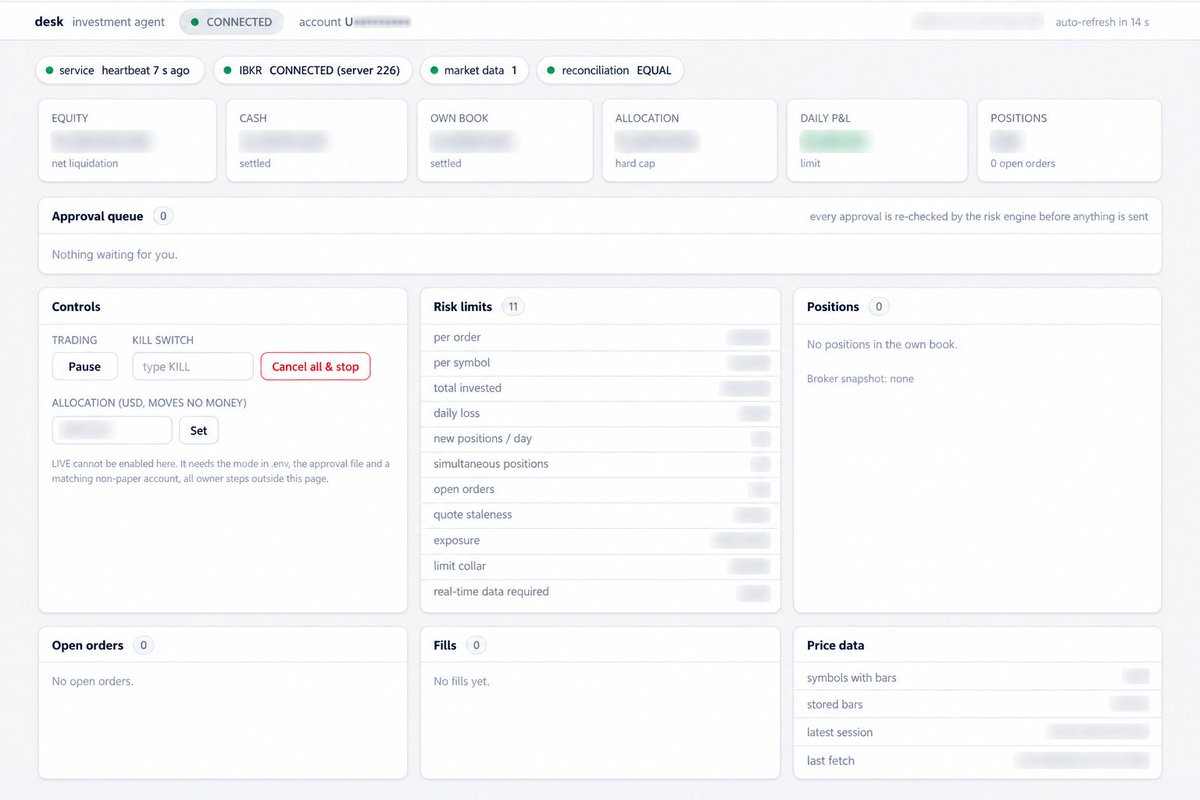
The system is not trading live yet. That is intentional.
For me, the experiment has reinforced a broader lesson from more than 20 years in regulated businesses:
The more capable AI becomes, the more important the architecture of accountability becomes.
AI capability is advancing quickly. Institutional trust will depend on what we build around it.
Personal project. Not investment advice.
I’ve spent the past few weeks using investment decision-making as a practical test of something I care about much more broadly:
How do you let AI operate in a high-consequence environment without giving it control of the environment?
So most of the work has gone into what surrounds the model:
• risk limits
• approval gates
• validated data
• audit trails
• automated testing
• reconciliation
• fail-safe shutdowns
246 automated tests currently pass with zero failures.
The most interesting business stories in this region are no longer confined to one sector.
Capital, technology, regulation and execution are increasingly converging.
The leaders who can connect those pieces will shape the next generation of regional businesses.
A discussion with my leadership team brought cyber risk back to the balance sheet.
Prevention matters. So does deciding how much loss the business is prepared to retain and what it should transfer.
Leaving that decision implicit is still a decision to carry the risk.
Dubai is treating longevity as a sector, not simply a healthcare trend.
Aligning regulation, investment and innovation around it could create both better health outcomes and a meaningful new economic platform.
HH Sheikh Hamdan bin Mohammed has approved the strategy and operating budget of the Dubai Longevity Authority (DLA) following the Authority's inaugural board meeting.
#EmiratesNews#DubaiOneTv#Dubai#News
Agentic AI should be treated as delegated authority, not full fledge software access.
Once an agent can move data or act externally, decision rights, permitted destinations and monitoring need to be designed with the same discipline as financial or operational controls.
@satyanadella The strategic shift is from AI as a productivity tool to AI as an operating layer.
That changes the management question from adoption to redesign: what should be delegated, where human judgment remains essential, and most important of all how accountability is preserved.
@BurjeelHoldings Treating women’s health as a longitudinal system, not as a collection of episodic services; Changes both outcomes and economics by shifting capital toward prevention, earlier intervention and continuity of care.