Alaska has had a small annual universal basic income since 1982. You might think it has only increased prices but every year when the checks go out, businesses compete for customers by lowering their prices. It has decreased poverty there. It's also increased overall employment.
We advocate for a future where natural and publically created wealth is better shared via dividends and land value tax -- to reduce the cost of living, protect the commons, and ensure progress benefits everyone.
Floyd explains why we're on this mission.
Kind of frustrating how cities will occasionally create these great shared public places for folks to hangout (simply by excluding cars from a few streets) for big sporting events, but usually IMMEDIATELY rededicate the space for automobiles instead of doubling down on success.
Housing Twitter, it's time to pull the big Tax Policy lever!
Whether it's land value tax, accelerated depreciation, tax credits & deferrals, or taxing the rich to build public housing, there's a lot that can be done with it.
Local governments should see LVT as a way to recoup public investment dollars — "a free tax revenue card" — that doesn't harm the economy.
We could have more public transit that pays for itself from the land value it creates in the first place.
Monopoly pays a UBI so every player has liquidity to participate in the economy.
The inventor Liz Magie originally named it "The Landlord's Game" to show how privatizing land wealth drives extreme inequality and poverty. One set of rules showed how land value tax solves this.
"Universal Basic Income (UBI) finds its historical origins in the writings of Thomas Spence, Thomas Paine, and Henry George, who all argued for an equitable distribution of the planet’s natural resources, and especially to land. This principle can be actualized by charging landowners a recurrent land value tax (LVT) and redistributing the revenues through a UBI, a symbiotic relationship that we call the Universal Land Dividend."
London’s new Elizabeth line moves almost twice as many people per day as the 28-lane Katy Freeway in Houston
highways are simply not an efficient way to move a lot of people in an urban area
Canada's natural resource rents should pay dividends to citizens. Instead, most of it is lost.
In Canada, there's over $240B/year of land & resource rents that could be invested in sovereign wealth funds or fund a $7,500/year universal dividend to all.
Letting inequality grow more and more extreme within a system where we treat housing as an asset class is a really bad idea. We all need housing. We can't just let the rich continually bid against each other on housing. We need a land value tax plus UBI to alter this equation.
A Universal Land Dividend (UBI funded by land rents) could leave 80% of Canadian households and 70% of UK households with more income, while addressing the housing crisis.
If you support UBI or LVT, here's why they're even better together:
https://t.co/COjDrT1rGb
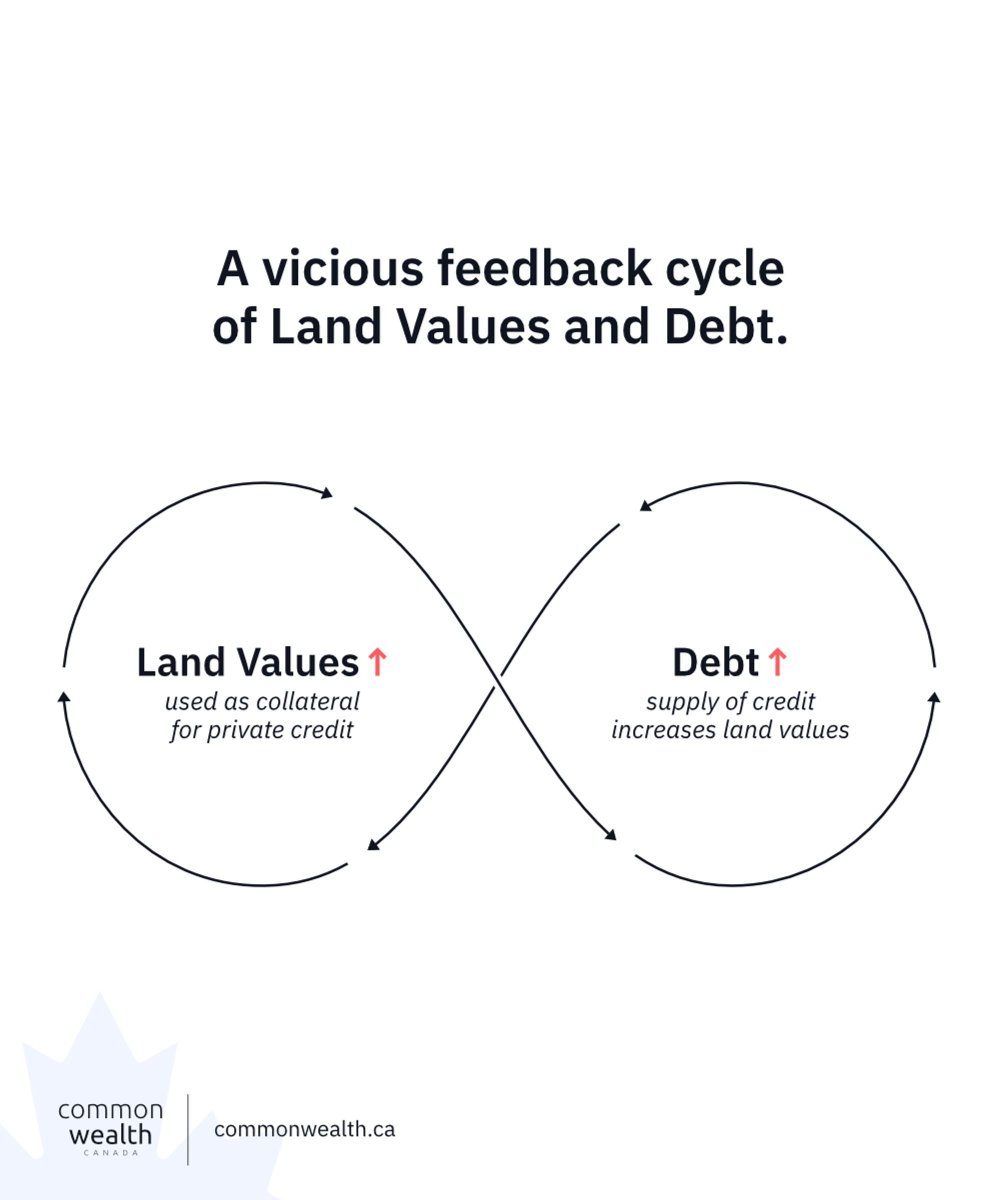
97% of money was created by commercial banks as loans, mostly to buy existing assets like land.
The result is a vicious feedback loop of ever-rising land prices and ever-increasing mortgages, trapping Canadians in lifetimes of crushing debt. Land value tax is a circuit breaker.
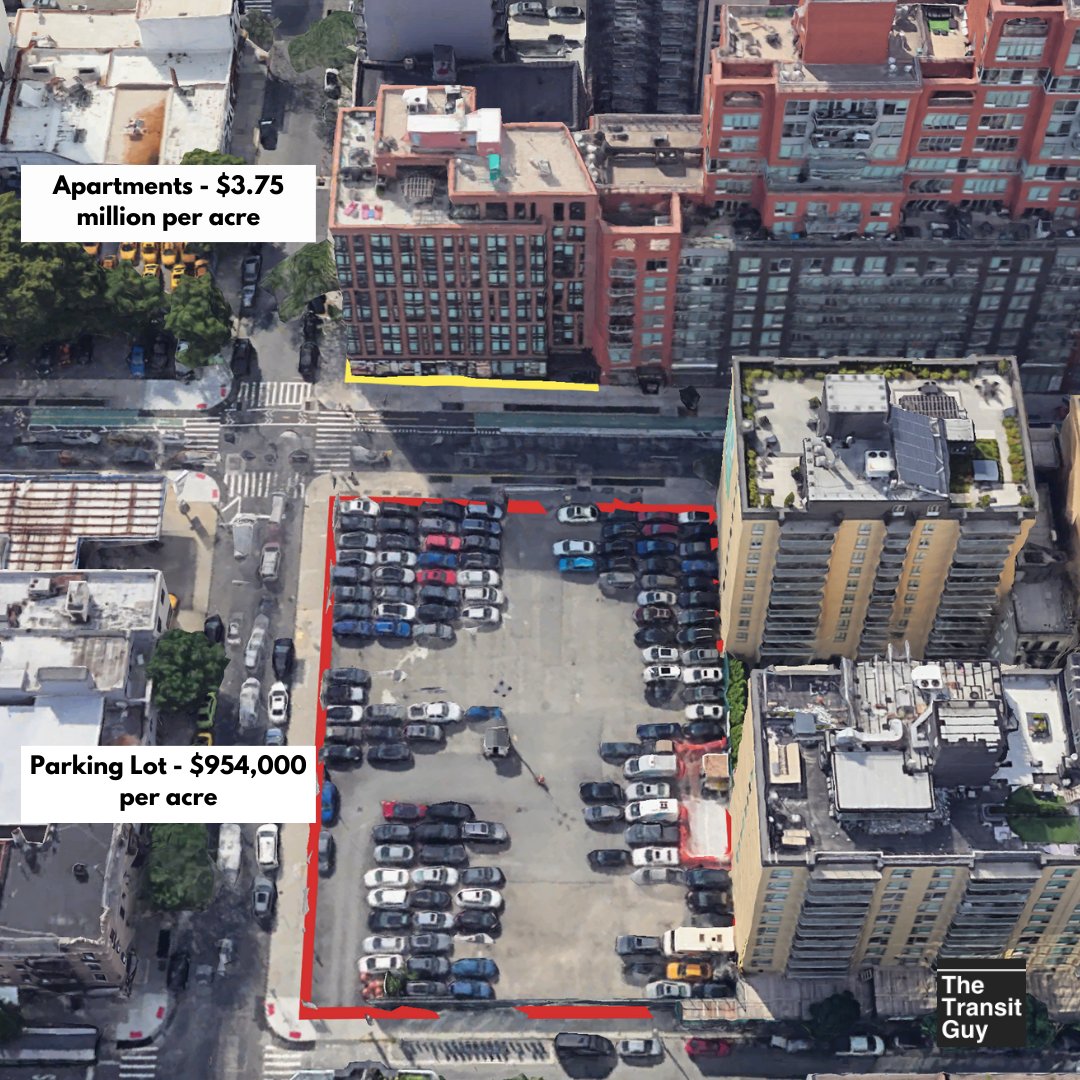
A half-block away from 6 subway lines in Queens, a parking lot pays $954,000 in taxes/acre, while an apartment building across the street pays $3.75 million/acre. If the parking lot were apartments, it would generate enough property tax revenue to hire 19 teachers annually.
The moment private land ownership became a thing, universal basic income became a right. When we decided to become the only species on Earth who had to pay to live here, we removed free access to land. It must be recompensed with an income for life in exchange for what was taken.