Hoy en El mercurio argumento que Chile y Argentina deberían aprovechar de hacer una política activa y profunda para atraer talento europeo que busca irse del viejo continente por su decadencia, económica, social y cultural.
Me corrijo, no estoy de acuerdo con el punto 6. El problema es el mal gasto del dinero. Bajar el gasto corriente es prioridad sobre recaudación. Hay plata.
Cuáles son las tareas más urgentes que tiene que enfrentar el gobierno desde el 28 de julio?
1. El fenómeno El Niño 2. El caso Petroperu.3. Reinfo y la ley MAPE. 4. Llevar al TC alguna ley para que el TC recule sobre su opinión en contra del artículo 79 de la Constitución
1/2
¿Sabías que el Estado peruano tiene 19 ministerios, muchos duplicando funciones, mientras la corrupción nos cuesta S/ 24 mil millones al año?
Lanzo una propuesta para el nuevo gobierno:
• Reducir de 19 a 13 Ministerios.
• 500+ trámites eliminados (menos burocracia y menos corrupción).
• ~S/ 4 mil millones menos en burocracia
• ~S/ 6 mil millones de ahorro con IA en el Estado
No más aparato estatal gigante e ineficiente. Menos burocracia. Más resultados. Más tecnología. Menos posibilidad de corrupción.
El Perú no necesita más Estado. Necesita un Estado inteligente. 🇵🇪
✒️|"El Estado tiene dos manos: una blanda para dar y una dura para quitar. Cuánto más blanda es la mano que da, más dura es la mano que quita".
- Frédéric Bastiat
In 1994, Fidel Castro's government did something no Marxist textbook prepared anyone for. It legalized the U.S. dollar, the currency of the imperialist enemy, and built a parallel money around it called the convertible peso, or CUC. Cubans now lived under two currencies: the worthless national peso (CUP) they earned in state wages, and the CUC they actually needed to buy anything worth having. A doctor pulling 20 CUP a month and a taxi driver pocketing CUC tips occupied two different economic universes. You can guess who ate better.
Think about what a dual-currency system confesses. A government that claims to abolish markets and prices still cannot escape the fact that its own money is garbage. The CUP did not buy soap, beef, or working appliances at any reliable rate, so the regime created a second money pegged to the dollar to capture the tourist trade and remittances from Miami. The state needed hard money it could not print at will. Socialist planners cannot calculate without real prices: this is the discipline Mises described in 1920.
You cannot run an economy on slogans. You run it on prices, and prices require honest money and private property. Castro abolished both and then spent decades quietly importing the dollar's price signals through the back door because his planners were flying blind. The CUC was a parasite feeding on Federal Reserve credibility, which tells you the planned economy could not generate a unit of account anyone trusted.
The system limped on until 2021, when the government finally killed the CUC under the "Tarea Ordenamiento" unification. The result was instant. Inflation tore through the island, the black-market dollar exchange rate exploded past 300 CUP, and shelves emptied while the state printed pesos to cover its deficits. Unification removed the borrowed crutch and let the patient collapse.
Cuba spent 27 years admitting that a worker's salary was a fiction and that survival depended on touching the enemy's money. Socialism filed its own bankruptcy paperwork in two denominations.
Germany, 1948. The Reichsmark is worthless. Cigarettes function as currency. Factory output sits at half its 1936 level, and the Allied occupation runs a price-control regime so absurd that farmers feed grain to livestock rather than sell it at the dictated price. Then Ludwig Erhard walks into a radio studio on June 20 and tells the German people the controls are gone. He did not ask the occupation authorities first. He told General Lucius Clay afterward that he hadn't altered the regulations, he had abolished them.
What followed embarrassed every Keynesian planner watching from Washington and London.
The Deutsche Mark replaced the Reichsmark at brutal terms: roughly 100 old marks for 6.5 new ones. Hard money, scarce by design. The black markets emptied overnight because goods reappeared in shop windows the moment prices could speak. Industrial production jumped over 50 percent in the second half of 1948 alone. And here is the part the textbooks bury: through the 1950s, as the economy grew at better than 8 percent a year, the cost of living stayed remarkably flat. Germans got richer while prices held or fell. Productivity outran the money supply, which is exactly what's supposed to happen when a central bank keeps its greedy paws to itself.
Falling prices alongside roaring growth, rising real wages, and a currency people actually wanted to hold rewarded Erhard's Germany. Deflation is not the disease. It is the natural reward for producing more than you did last year.
The Bundesbank inherited this discipline and guarded the Mark with a stinginess that drove politicians to fury for forty years. That stinginess built the strongest economy in Europe. Then the same political class buried the Mark under the euro in 2002 and handed monetary policy to people who consider 2 percent annual theft a "target."
Erhard proved sound money and free prices rebuild a bombed nation in a decade. Every finance minister since has worked very hard to forget it.
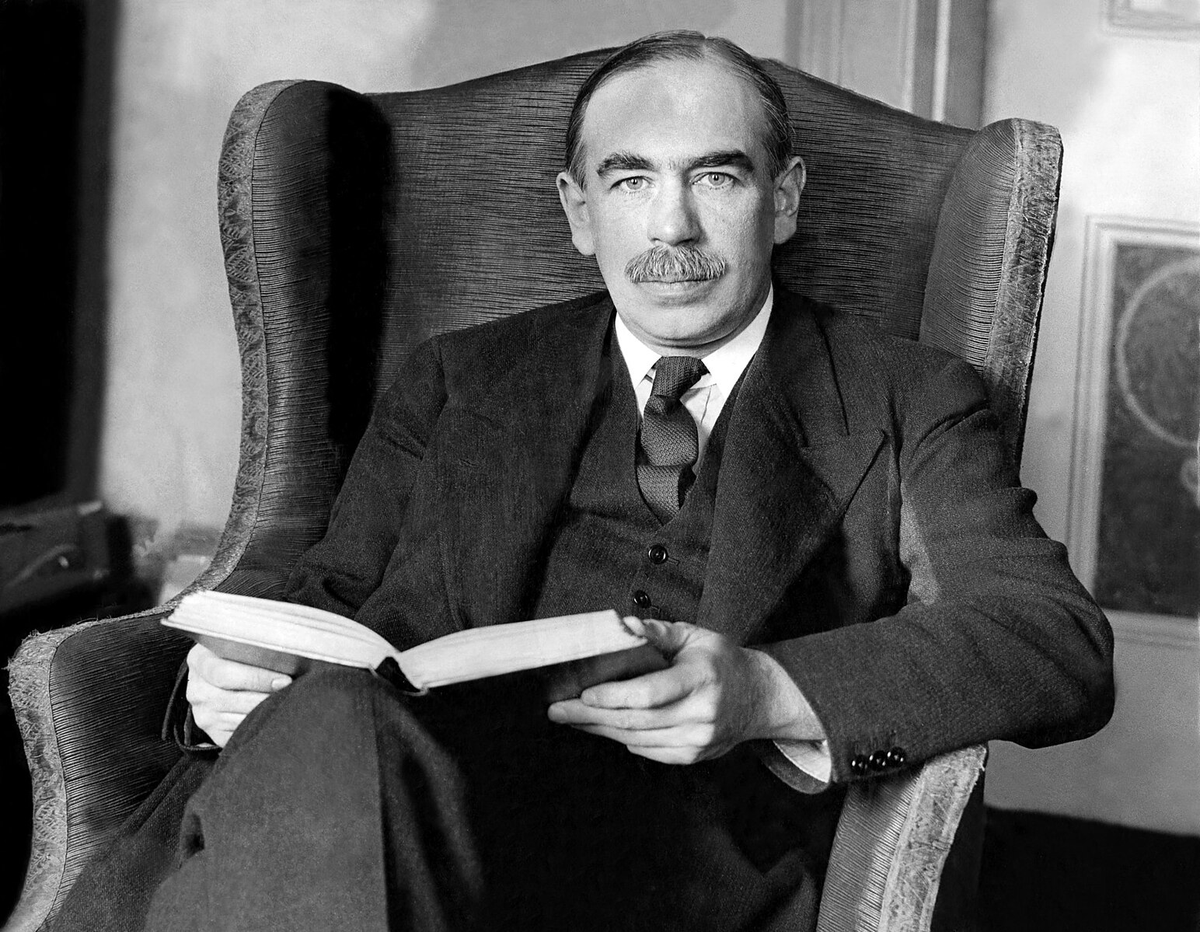
Keynes built his entire system on a confusion a first-year student should catch: he treated saving and investment as enemies. Pull a dollar out of consumption and stuff it under the mattress, and the whole economy supposedly seizes up. Demand collapses. Workers get fired. The "paradox of thrift" arrives, and Keynes hands you the policy prescription: spend, borrow, dig holes and fill them back in.
You're meant to believe that thrift is a vice. That the prudent man saving for his children's education is sabotaging his neighbors. This is a remarkable inversion, and it's wrong from the foundation up.
What actually happens when you save? You forgo a steak dinner tonight, and you lend that money out through your bank or your bond purchase. That capital flows to a firm building a factory, a baker buying a second oven, a fishing fleet building more boats so it can catch more fish next year. Böhm-Bawerk explained this in the 1880s with his fishermen: you eat less now so you can construct the net that feeds you far more later. Saving is the raw material of every roundabout production process that ever raised a wage.
Keynes saw spending as the engine of prosperity. He never asked where the factories came from. He treated consumption as the cause of prosperity when consumption is the reward you collect after the capital structure has done its work. A society that consumes everything it produces stays exactly where it is forever, like the man who eats his seed corn and wonders why spring brings no harvest.
This "cure" poisons the patient. When central banks suppress interest rates to "stimulate demand," they sever the signal that coordinates saving with investment. Entrepreneurs read cheap credit as genuine thrift and build projects no one saved to complete. Then the bust arrives to liquidate the malinvestment, and the same economists who caused it demand more of the cure. Greenspan ran this script after 2001. You watched the result in 2008.
Saving was never the disease. It was the only medicine, and Keynes taught us to spit it out.