Great interview with @TrevorPTweets one of the architects of the Equality Act.
“We never imagined that there would be people peddling the fantasy that you can just make up what sex you are. And it never occurred to me that people who make decisions on these things would be engulfed by this fantasy”.
Link to article (free) in replies
@owenjonesjourno@roisinmurphy@serengwyneud You’re missing the point here @owenjonesjourno and you’re making quite an extended assumption from a question about what letters or banner people sit under to suggesting that those 900 people find sex realist opinions loathsome
@owenjonesjourno@roisinmurphy@serengwyneud The alphabet community you speak of doesn’t exist… lesbian here who worked in schools during section 28 days… you are not doing a service to truth … please get a grip and stop attacking women who know what safeguarding is
Just like tiktokkers to fast food franchises, Dublin Pintdrinkers have been flocking to Bill Ahearnes on Aston Quay in their droves in the last week.
This is all on account of them now doing Guinness at room temperature.
Poured from Guinness' debutante 1960s counter box...(1/3)
I’ve just seen a post from yet another man who thinks my position has shifted since I wrote my 2020 essay about gender identity ideology and the consequent clash of rights https://t.co/pasxBD1Hzl
For the avoidance of doubt, I stand by every word I wrote then. For instance: ‘woman isn’t a costume.’ If it surprises you that I say men don’t become women by wearing make up and dresses, you didn’t understand the essay. I’ve been crystal clear all along that I believe people are free to live and present themselves as the opposite sex if that’s what feels comfortable and authentic TO THEM. This appears to have been interpreted (most often, tellingly, by men) as ‘and it naturally follows that I, as a woman, will validate a man’s belief that he is now, to all intents and purposes, the same sex as me, and I will use only the speech he deems appropriate and will be very careful to protect his sensitive ego, no matter the cost to myself in pretending to believe a falsehood, or the loss of my own rights due to this pretence.’
Dress as you like within normal bounds of situational decency, wear lipstick, sequins and a beard if you want, call yourself whatever you like, have sex with any consenting adult you please: I wish you health, happiness and safety. What you don’t get is the power to compel my speech and belief.
When I call a man a man, I am speaking verifiable truth. It is essential to be able to accurately name sex when discussing fair sport, facilities and services for women and girls and the right of gay people not to be demonised for their same-sex attraction. In years to come, a lot of useful idiots are going to awake to the fact that they’ve been complicit in enormous harm done to women, girls, gay people who stood against the insanity, and some extremely vulnerable young people. I don’t doubt we’ll hear a lot of, ‘I thought I was just being kind.’ Such individuals, especially those in positions of power, should be asked why they never had anything to say about the loud, public, widespread unkindness directed against those who refused to adopt their fashionable, elitist beliefs, eg, the detransitioners being bullied and vilified by former ‘allies’, the whistleblowers who tried to stop an unregulated experiment on troubled children, the women who lost their careers and livelihoods by standing up for all women’s rights.
Some people appear to believe it a worse crime for a woman to call a man a man than for trans activists to call loudly and publicly for the assault and assassination of all women who refuse to bend the knee. I have never wished violence or any other kind of harm on a trans-identified person, but, like many other people who’ve defended women’s and girls’ rights over the past few years, I have received thousands of threats of death, rape and torture. The wilful blindness of those who bleat ‘both sides’ will rightly be judged harshly in times to come.
TL;DR Trans women aren’t women, and if that hurts your feelings, be grateful you live in a society where you are just as free to espouse gender ideology as I am to speak the truth. As Orwell said: ‘Freedom is the freedom to say that two plus two make four. If that is granted, all else follows.’
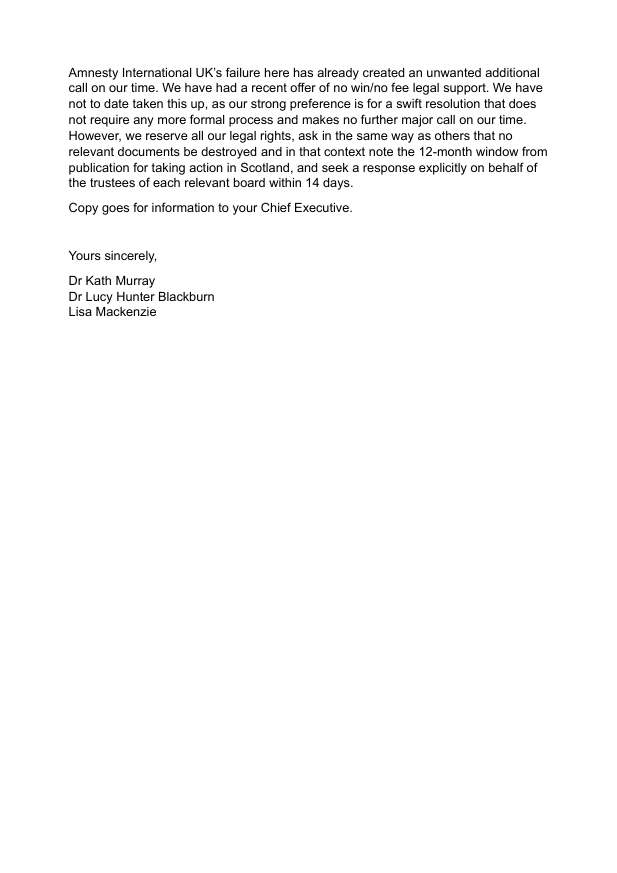
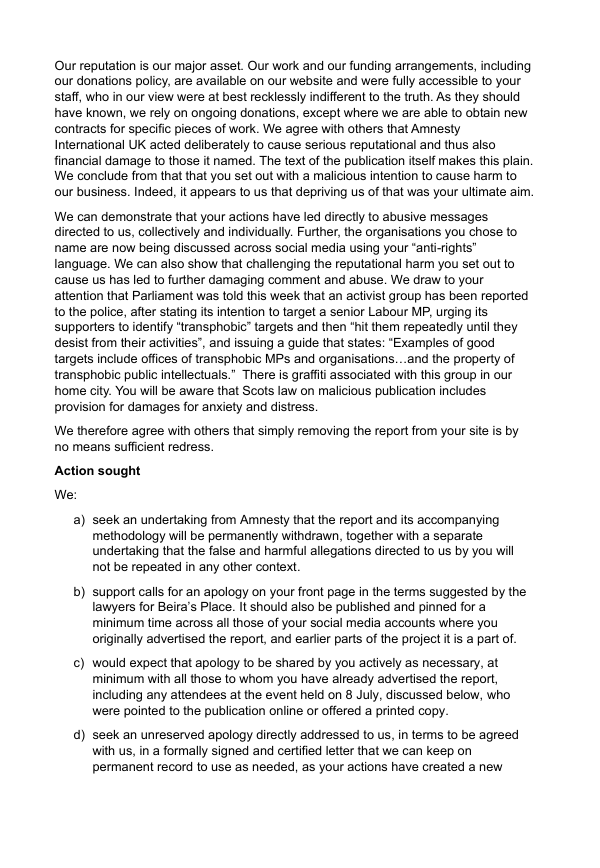
We wrote again late last week, setting out the steps we believe that Amnesty International UK should now take, and drawing attention to some further points that an external investigation should consider. https://t.co/PE4Cx1fVx0
It’s Eric Ravilious’ birthday today: he was born in Acton #OTD in 1903, although he spent his young life in Eastbourne after his family moved to #Sussex. It’s wonderful there are so many of us who continue to appreciate his work. Long may it continue!
Today in 1922, a single explosion wiped out centuries of Irish memory. The Public Record Office of Ireland, a purpose-built, fireproof strongroom nestled in the western wing of the Four Courts, was obliterated in a blast that tore through time itself. In an instant, 700 years of parchment and paper were destroyed.
Countless wills, deeds, censuses, court proceedings, and parish records were consumed by fire. Their ashes scattered like snowflakes into the summer sky.
It happened during the opening salvo of the Irish Civil War. Since April, the Four Courts had been held by the anti-Treaty IRA. The building had become both barracks and bunker. Mines and ammunition were stockpiled in the basement of the Record Office itself.
When the Provisional Government, backed by British artillery, finally acted to end the occupation by demanding the release of J. J. ‘Ginger’ O’Connell and the surrender of the rebels, they shelled the complex.
Hours later, amid the chaos, an enormous explosion rocked the city. Whether the mine was detonated deliberately remains unclear. The government accused the anti-Treaty forces of a scorched earth betrayal:
‘By their treacherous explosion of a mine shortly before their unconditional surrender, they destroyed one of the most beautiful buildings in Dublin, the invaluable historical records it held and inflicted serious and unnecessary injuries on National Forces.’
The anti-Treaty side denied this. In a statement, they countered:
‘There was a munitions dump at the HQ Block including material for mines which caught fire in the bombardment.
The responsibility for the destruction of the Four Courts lies with the “government” that has usurped the Republic.’ And yet, Ernie O’Malley, in his memoir The Singing Flame, records a chilling remark from officer Paddy O’Brien: ‘I’ll blow up or burn the Four Courts rather than hand them over.’
Whoever lit the fuse, the damage was apocalyptic. Entire genealogies were erased. Every Irish census from 1821 to 1851. Church of Ireland parish registers, stretching back to the seventeenth century. Wills reaching as far back as 1500, court records from the 1200s, land deeds from 1174. The medieval voice of Ireland, encoded in vellum and ink, had been silenced not by foreign invaders, but by its own children at war. It was our version of the Library of Alexandria.
The Irish Times captured the mood of national mourning: ‘Those precious records, which would have been so useful to the future historian, have been devoured by the flames or scattered in fragments by the four winds of heaven.’ Fragments of charred parchment were found days later in Howth and Killiney, drifting on the summer breeze like blackened leaves from a burnt library.
The Virtual Record Treasury of Ireland, launched on the centenary of the blast in 2022, is painstakingly rebuilding what was lost digitally through copies, transcripts, and international collaboration. It’s a resurrection of sorts, though it can never replace the originals.
For me, the quote which sums up the terrible reality of the lost history comes from Winston Churchill. When asked about the explosion, the ever pragmatic politician is said to have remarked: ‘Better a state without archives than archives without a state.’