#Blockchain doesn’t just need innovations; it needs privacy for full scale adoption🚀
Privacy builds confidence, so people are more likely to use crypto if their financial activity isn't publicly exposed
@zano_project is one of the few projects that understands this
A Thread🧵
Early circle matters 🤝
The best communities aren't built by one founder.
They're built by the early circle who shows up. 🌱
It's the IRL7 working assumption. ✨
📌 RT if you agree·
🔗 Join Telegram: https://t.co/YglwQfEjB3
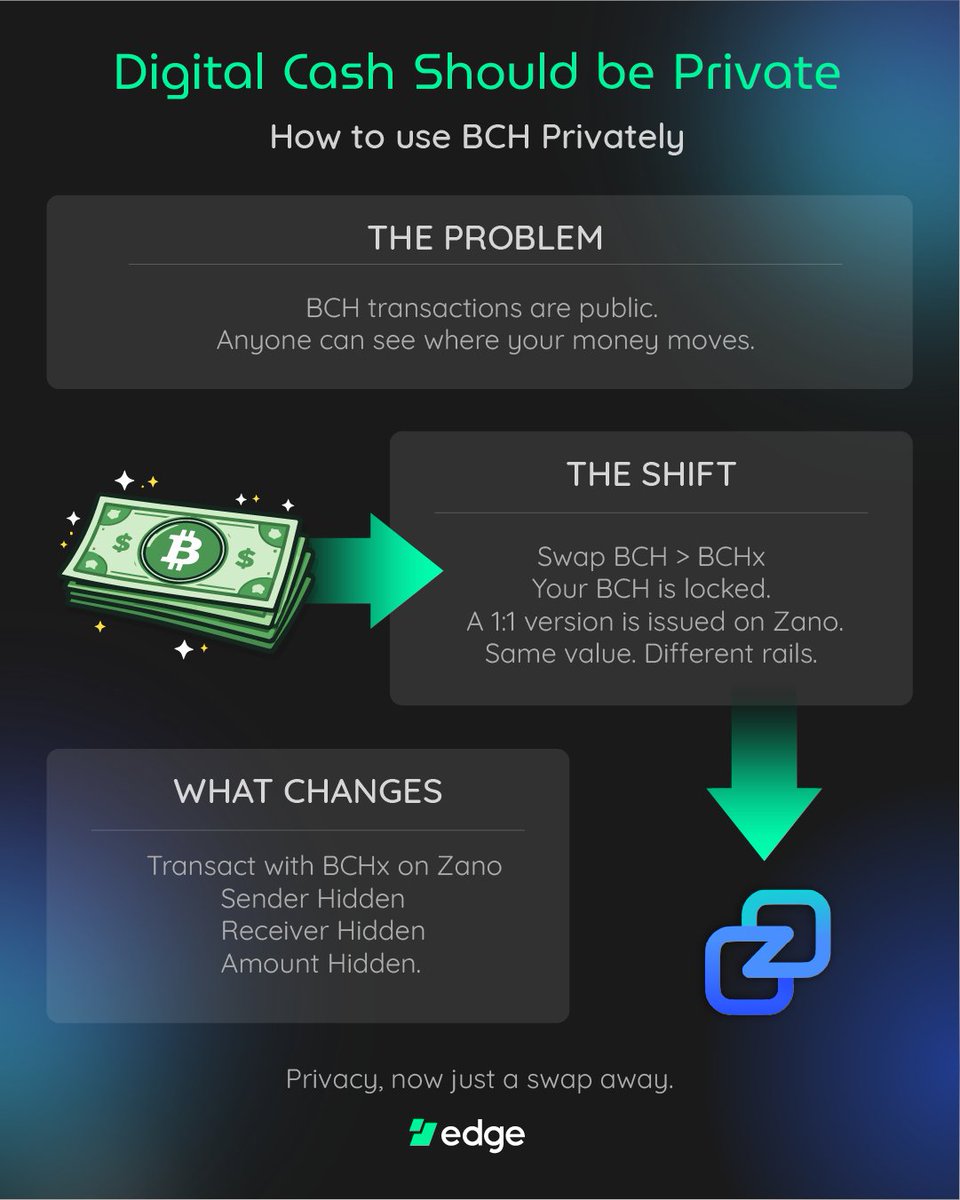
Your BCH should be yours.
Not yours plus a public map of your activity.
BCHx helps close the privacy gap by letting users swap BCH into a 1:1 private asset on the @zano_project blockchain, directly inside Edge.
Keep your crypto. Upgrade your privacy.
Digital Credit. Digital Money. Digital Equity. Digital Treasury.
My conversation with @ColeMacro at @BTCPrague on the future of capital markets, followed by Q&A on the nuances of Bitcoin-backed securities and corporate finance.
Who shows up first ✨
Every movement is shaped by who shows up first.
Founders. Artists. Athletes. Builders. Scientists. People who are already doing the work.
That's the circle we're curating for IRL7. 🌍
📌 Save this.
Centralized AI retains your prompts for months, sometimes years. Not a glitch — the business model.
PAI3: local inference, encrypted cabinets, zero retention layer. You own the compute.
Ownership is the only real privacy.
You can now swap $ZANO on @official_fswap! 🔄
https://t.co/qSNYVcJngH is a secure, fully automated crypto exchange with no registration required. Fast swaps from 2 minutes and support for 4,000+ cryptocurrencies.
Another fast, registration-free way to get $ZANO whenever you want it. 🔒
Tokenized on day one.
The largest IPO in history is being tokenized on day one, accessible across leading blockchains, like @solana.
SPCXon, coming to Ondo Global Markets.
Decentralization is often explained as removing intermediaries.
That’s incomplete, the real shift is about making verification cheaper than trust. Once it becomes easier to verify than to rely on institutions, coordination naturally redistributes.
Not because systems are replaced, but because the cost structure changes underneath them.
@_PradeepGoel The challenge here is that many organizations still treats AI as a productivity feature rather than redesigning the systems around continuous sensing, decision-making, and adaptation.
AI doesn’t just automate tasks, it changes what a system means.
We used to build software around fixed workflows and human decision points. Now systems can observe, decide, and act continuously.
That turns infrastructure from something you operate into something that operates itself. Most orgs haven’t adjusted their thinking to that yet.
Tokenization is usually discussed as a finance story, but it’s really a coordination mechanism.
Tokens turn incentives into something programmable, which means alignment doesn’t have to rely on traditional structures sitting in the middle.
Groups of people can start coordinating directly through systems that encode behavior and outcomes. The financial angle is just what’s easiest to see right now.
One of the more notable developments in AI this year is that some of the industry's biggest competitors are aligned on the same issue. Leaders from @OpenAI, @AnthropicAI, @GoogleDeepMind, @Microsoft AI, and @Meta have jointly called for mandatory screening of synthetic DNA and RNA orders.
The concern is not that AI can suddenly create biological weapons on its own. It is that AI is steadily lowering the barriers to highly specialized knowledge that was once accessible only to a small number of experts.
The singularity will bring rapid change, but only for a short time.
We are already close to the limits of science, technology, and intelligence.
We will reach these limits by 2030.
However, the impact of these final changes will be dramatic.
AI will accelerate its own development, and the development of technology, for a few years.
After that, super-abundant superintelligence will completely transform the economy and our lives.
When I predict that in ten years prices will drop to 1% of what they are today, making us all 100X richer, people think it can't be true.
It's not even really a prediction.
It's simply the logical and direct consequence of an unlimited number of instances of intelligence at the limit of intelligence.
However, as great as the economic impact may be, it will be small compared to the impact on our minds.
We will be personally transformed by the presence of superintelligence in our lives.
The psychological, social, and spiritual impact of superintelligence will make material things meaningless by comparison.
These impacts are more difficult to communicate than the simple, direct impact on the economy, and are even more difficult for people to understand.
Most people will have to just wait and see.
There is not much longer to wait.