I’ve always found the “bond vigilante” argument somewhat weak. Where have they been when Fed has missed its target 2% every month since Covid? IMHO markets move and analysts try to create a narrative around it. Causality is backwards.
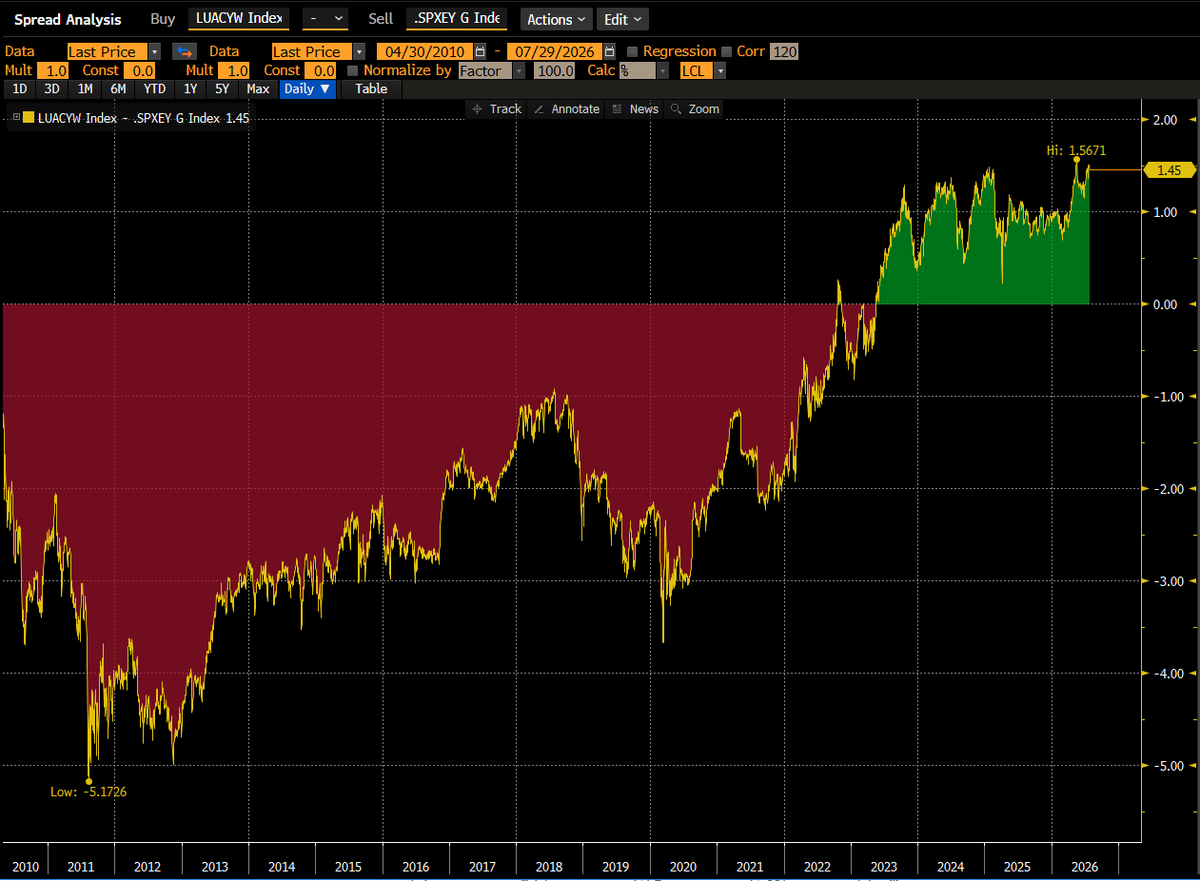
U.S. investment-grade bond yields have risen to about the highest since 2002 relative to a comparable measure - the earnings yield - on the S&P 500. Bond vigilantes are reasserting themselves, even as corporate profits keep climbing.
Yazılımcılar daha iyi bilir ancak para yükleme makinasının 200TL kabul edilebilir hale gelmesi yapay zeka çağında aylar sürmüyor olması gerekir. İzban ile Demirköprü - Adnan Menderes havalimanı 149,62 ancak makinalar hala 200TL almıyor. @izmirbld
As per my comments yesterday I think we should add Türkiye to the list of countries which need adjusting their domestic economy to accommodate surplus country imbalances
Stephen Roach: "Ever-mounting imbalances brought the US and the world economy to its knees during the great financial crisis of 2008-09. It could do the same for China."
Roach has long worried about Chinese imbalances, but his views on how the global imbalances were created have shifted from a very accommodative view towards China (they are mainly caused by US fiscal policies that force down domestic saving) to a much more confrontational one (they are mainly caused by Chinese credit and investment policies that force up Chinese saving).
He goes on to argue that "China’s steadfast reliance on the producer model is not just a test of the character of its economy. It is a test of the future for the global economy. The country is demanding far too much of a world fixated on cheap consumer goods."
It is becoming more and more obvious among analysts and policymakers that the current global trading system is unsustainable and bad for overall global growth, even if it has been good for growth among some of the most aggressively mercantilist economies.
These great imbalances could probably have been resolved at a fairly low and manageable cost 10-15 years ago, and perhaps even 5-6 years ago. But by now, it seems to me that the world is locked into a system in which some economies (and not just China) depend so heavily on growing their already-excessive manufacturing capacity at the expense of domestic demand that it will be extremely painful for them to adjust, except very slowly, perhaps over a 15-20-year period.
At the same times other economies (and not just the US and the EU, but also Mexico, Brazil, India, and many other large developing economies hoping to build their manufacturing sectors) will be increasingly reluctant to absorb the resulting imbalances for even a few more years because of the speed with which their manufacturing sectors and their strategic resilience are being undermined. What is more, every time one of them acts to reduce its role in absorbing excess manufacturing capacity, this increases the damage to those that don't act.
This suggests that the next big question for global policymakers is whether the imbalances can be resolved through global coordination and a minimization of the associated adjustment costs, or will be resolved in the form of a very difficult adjustment in which the major economies all try to force the bulk of adjustment costs onto their trading partners.
The former is very unlikely in my opinion, and increasingly so, which suggests that over the next few years we are likely to see major, and disruptive, changes in the global trading system and, more importantly for long-term growth, in the way manufacturing is distributed around the world.
https://t.co/v8ZuLQHzwB
Turkiye’de de yaşanan endüstriyel büyüme sorununu anlamak için Çin’in merkezde olduğu geniş spektrumlu analiz gerekir. Bu söyleşi iyi bir başlangıç bence. The Second China Shock - Why Europe is the Front Line with Brad Setser |... https://t.co/6f18Tzelg5 via @YouTube
A wealth tax doesn't tax factories. It taxes ownership claims over wealth. That distinction matters.
The idea that a billionaire paying a wealth tax somehow causes a factory to disappear only works if you assume investment comes from accumulated savings. post-Keynesians reject that entirely.
Firms invest because they expect sales. Banks create the credit to finance that investment. Saving is the accounting result of investment and income, not its prerequisite.
The other problem is pretending today's great fortunes are mostly factories and tractors. A huge share of modern wealth is financial assets, land, monopoly rents, and capital gains. Taxing part of those claims is not the same thing as dismantling productive capacity.
France and Sweden are always brought up, but those cases say as much about tax avoidance, loopholes, and international tax competition as they do about wealth taxes themselves. They are not proof that taxing wealth inevitably destroys an economy.
The real danger isn't that the wealthy contribute more. The real danger is allowing wealth to become so concentrated that purchasing power is drained from the broader economy while more and more capital chases existing assets instead of creating new productive investment.
An economy doesn't become richer because billionaires accumulate larger fortunes. It becomes richer when businesses invest, workers are employed, productivity rises, and incomes grow. Those are not the same thing.
I remember a certain investment committee meeting in early 90s where a senior colleague of mine argued vehemently that Japan was going to hell given its fiscal position. JGB yields were at 8% then.
The worst thing about being out of fiscal space is that every new political leader thinks the constraints that dogged their predecessor don't apply to them. That's the story with Takaichi in Japan. There's a big risk it'll now also be the story in the UK.
https://t.co/wLyQata4uf
I guess same is happening in Türkiye where industrial sector is losing ground to services. This quote from Michael is important: “But the point that they miss is that these shifts were not the result of local market conditions, nor of the decisions of their own policymakers.”
Jamieson Greer: "If America doesn’t develop and implement its own policies to protect its industry and its workers, we will end up being policy takers. So if we’re not policymakers, we end up being policytakers."
I think this is among the most important points Greer makes in this New York Times interview, but it is not nearly as well-understood by policymakers around the world as it should be.
What Greer is arguing is that in a hyperglobalized world in which some economies exert much greater control over their external accounts, while others exert much less, if the former also implement aggressive domestic industrial policies, they will be able to externalize the resulting imbalances through their trade and capital accounts.
This has extremely important implications that mainstream economists almost alway miss. Not only are economies that exert much greater control over their external accounts able to determine their domestic imbalances, they are also able to determine the domestic imbalances of their more open trade partners through their control of both countries' external imbalances.
In effect the former are able to make their domestic industrial policies also the industrial polices, in reverse, of the latter.
For example, if a country that can control its external accounts decides that as a matter of domestic industrial policy it wants to shift out of producing services and/or commodities and into manufacturing, and so increase its share of global manufacturing, its more open trade partners will automatically reduce their share of global manufacturing as they shift either into services, like the EU, or into commodity production, like Brazil.
There will of course be constituencies in the EU that say that producing services is better than producing manufactured goods, and constituencies in Brazil that say that producing commodities is better than producing manufactured goods, and in some cases they may even be right.
But the point that they miss is that these shifts were not the result of local market conditions, nor of the decisions of their own policymakers. The shifts were imposed upon them by the policymakers of their more closed and more aggressive trade partners.
The changes in their economies were designed, in other words, not to accommodate their own economic needs but rather to accommodate the economic needs of their trade partners. It should be obvious (but isn't to many economists) that this is not how free markets work.
https://t.co/SCf5ohZrG9
Important point on how a country's trade surplus and its financial surplus can be directed to different countries, forcing the overall imbalances to overcome the original bilateral imbalances.
Put another way, if China runs trade surpluses with Europe, but balances these surpluses by acquiring US assets, Europe will have balanced trade overall, while the US will run the corresponding overall deficit.
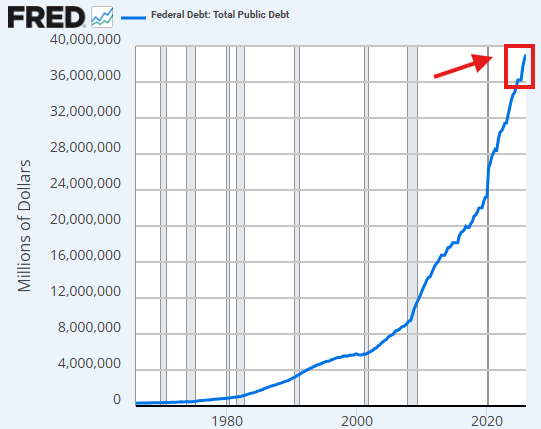
BREAKING: Total US federal debt is now up to a record $39.4 trillion, rising +$3.2 trillion over the last 12 months.
Since 2020, US federal debt is now up a massive +$16.3 trillion.
This marks a +$2.5 trillion average annual increase, or +$209 billion per month.
At this pace, total US debt will surge to $50.0 trillion before 2030.
The US debt crisis has no end in sight.
One of the most persistent misconceptions about Social Security is that it must function like a private pension fund. Many people assume payroll taxes are deposited into an account, invested over time, and eventually returned to workers in retirement. That has never been how the program operates.
Social Security is a public social insurance system administered by a government that issues its own currency. Payroll taxes are not placed into individual investment accounts waiting to be redeemed decades later. Benefits are paid because Congress authorizes those payments as part of the federal budget. The Trust Fund serves as an accounting record of past fiscal operations, not a vault filled with financial assets that retirees eventually draw down.
This distinction matters because it changes the entire debate. The ability to make benefit payments is not determined by the balance of a savings account. It depends on the government's fiscal authority and, more importantly, the productive capacity of the economy. The real challenge of an aging population is not whether enough dollars exist to pay retirees. It is whether the economy can produce enough housing, healthcare, food, energy, and other goods and services for both workers and retirees without creating inflationary pressures.
Demographic trends are certainly important. As the ratio of workers to retirees declines, a greater share of current production must be devoted to supporting those who have left the workforce. That is a real economic constraint, but it is fundamentally different from a financial one. It reflects the productive capacity of the economy, not the government's ability to issue its own currency.
This is why discussions about Social Security "running out of money" often create more confusion than clarity. The federal government cannot become unable to make payments denominated in the currency it alone issues. What can happen is that Congress chooses to reduce benefits, raise payroll taxes, increase the retirement age, or pursue other policy changes. Those are political decisions, not financial necessities imposed by an empty bank account.
None of this implies that payroll taxes are meaningless. They affect the distribution of income, influence aggregate demand, and shape the overall fiscal stance of the economy. They also reinforce the political perception that workers have earned their benefits through contributions. But they are not the source of the government's capacity to make Social Security payments.
The future of Social Security therefore depends less on accounting balances than on the nation's productive potential and the political choices surrounding how that output is distributed. A wealthier, more productive economy can support a larger retired population more easily than a stagnant one. Likewise, policy choices regarding productivity growth, labour force participation, immigration, healthcare, and investment will ultimately do more to determine the program's sustainability than any balance recorded in the Trust Fund.
The real debate should not be whether the government can find enough dollars to pay retirees. The debate should be whether the economy can generate the real goods and services retirees need, and whether society chooses to dedicate a sufficient share of those resources to providing a dignified retirement.
I think the first two has been going on for a while now. As for the third one I wonder if “forward looking” new Fed will go on to do what all forward lookers do: trial and error. Are we ready for that? Perhaps that has also been happening.
Here are three structural transitions that the global economy and markets are navigating, and will continue to do so for some time to come:
Geo-economics: We are pivoting to a world in which the mix of geopolitics, national security, and domestic politics increasingly displaces traditional economic and commercial considerations in determining outcomes for households, companies, investors, and economies.
Technological Innovations: What Google’s James Manyika so elegantly describes as the rare combination of an industrial revolution (driven by general-purpose technologies) and an enlightenment (the structural "invention of invention" itself).
Central Banking: The start of an overdue regime change at the Federal Reserve, one that leaves behind a protracted period of intellectual inertia and excessive data dependence. In its place, we are seeing the emergence of a reform-oriented, intellectually curious, and more forward-looking Fed.
And what makes all this even more analytically intriguing is that the consequential stand-alone implications of each are compounded by their interactions.
More to follow.
#economy #markets #geoeconomics #tech #centralbanks #federalreserve #ai
A good thread for those who believe that trade and current account drive the value of a country’s currency. BoP needs to be considered as a whole. Plus reserve changes are a policy choice not an automatic result of changes in BoP items.
Sometimes you just have to admire how strange the world can be -- Korea's May current account surplus was over $38 billion or $450 billion annualized
Absolutely massive number, the trailing 12m sum hasn't yet caught up
1/
Another example of Jevons paradox. That said I am still not entirely convinced about the longer term effects f AI on employment since causalities are not that clear yet.
Companies that invest more in AI are also seeing greater workforce expansion:
Firms with the highest AI spending posted a +10.2% increase in headcount over the last 2 years, according to a study covering ~22,000 US companies.
At the same time, entry-level jobs rose +12.0% on average among these firms.
Job gains typically accelerate 6-12 months after a surge in AI spending.
By comparison, firms with low AI adoption saw headcount remain roughly unchanged over the same period.
In other words, companies that materially invest in AI tend to see stronger hiring, but only once investment reaches a level sufficient to unlock productivity gains.
AI is reshaping where hiring happens.
Nice essay from my friend Paul London, former U.S. Deputy Under Secretary of Commerce. "The old idea is simple: Government debt is inherently dangerous, while private investment and spending are the virtuous engines of growth.
The historical record, however, tells us something different. The worst economic crises in American history have been driven by private-sector speculation, collapsing private debts, falling prices and the unwillingness of government to act boldly to avoid disaster."
Enflasyon Raporu toplantısında beklentiler uzunca tartışıldı. Önce bir parantez açmak istiyorum: sektörel beklenti anketini kamuoyuyla paylaşan Başkan Karahan'a teşekkür etmek gerekir. Bu hassas konu ondan önce konuşulamıyordu çünkü veri paylaşımı yoktu.
Hanehalkı beklentilerine gelince, benim savaş sonrası dönemde görüşüm biraz daha farklı. KU anketimiz savaş sonrası dönemde henüz ilave bir bozulma göstermiyor. Seviye yüksek (%49), ama değişmiyor. TCMB anketindeki bozulmanın gıda fiyatlarıyla değil, anket öncesi manşet enflasyon bilgisi verilmesiyle açıklanabileceğini düşünüyorum. Bu tür bir bilgilendirmeyi (somuçtan bağımsız olarak) metodolojik olarak hatalı bulduğumu daha önce de söylemiştim
Yakın zamanda yaptığımız deney sonuçlarımız yukarıdaki çıkarımımı destekliyor: manşet enflasyon hatırlatılan grup,kontrol grubuna göre beklentilerini yukarı çekiyor. Görünen o ki, yüksek enflasyon ortamında bu tür bir bilgi verilmesi enflasyonu daha görünür kılıp beklentiyi yükseltiyor.