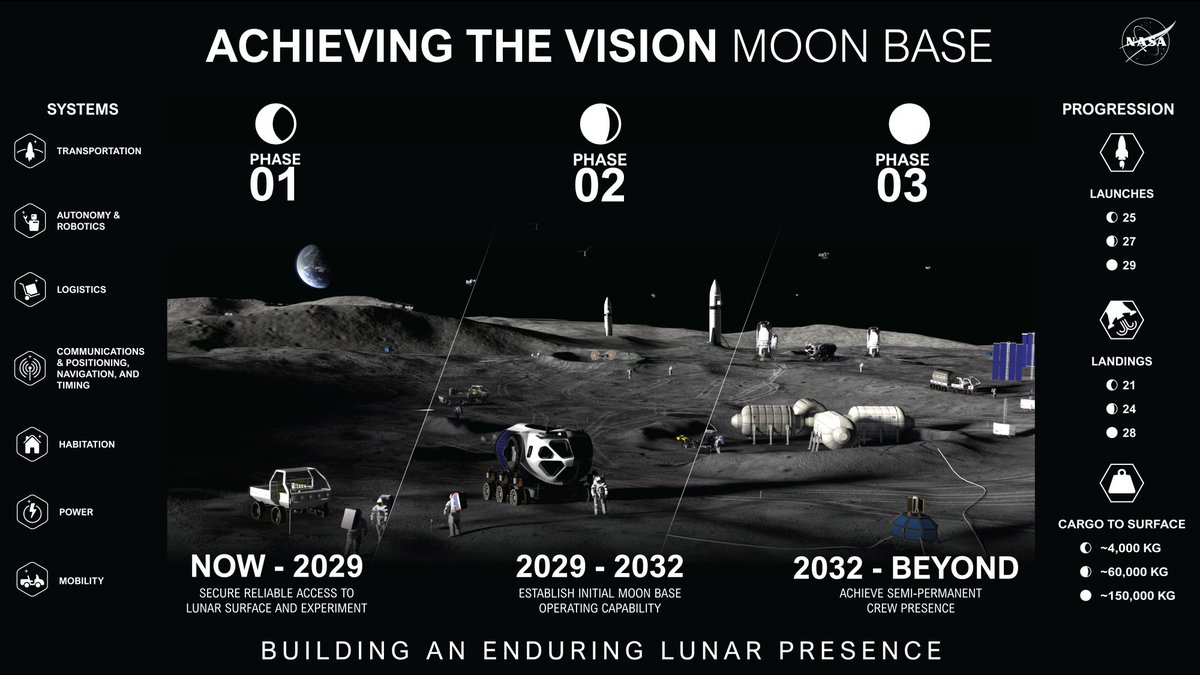
NASA just officially unveiled their master plan for a permanent Moon Base at the lunar South Pole
This is not just about flags and footprints. NASA is moving to establish an enduring, sustained human presence, and they are heavily relying on commercial innovators to build it
The roadmap is highly aggressive:
• Phase 1: Heavy robotic missions and commercial payload deliveries
• Phase 2: Semi-permanent infrastructure, including fission surface power and lunar drones
• Phase 3: A sustained, permanent human outpost
The most important takeaway is NASA explicitly stated this base is the ultimate proving ground to prepare humanity for missions to Mars
While legacy aerospace companies are still struggling to reliably get a small capsule to the ISS, NASA is setting the stage for massive lunar infrastructure....which is exactly the kind of heavy-lift planetary deployment SpaceX’s Starship was designed for
The multi-planetary economy is officially kicking off
Jayden Daniels made VR training a condition for any team drafting him.
Now he's NFL Rookie of the Year and 1 game away from the Super Bowl.
His edge? Training his brain at 1.75x speed.
The story of the first QB 2.0:🧵
Jerry Seinfeld was once thinking about golf announcers whispering.
He then found something in his notebook about how people whisper when they talk about tipping.
"Now we make what's called a charm bracelet," Seinfeld says in this 144-second masterclass on the creative process:
When you notice a commonality between two or more things, Seinfeld explains,
"You say, 'Oh there's something there.' And now we make what's called a charm bracelet: You take these things and you find a way to associate them."
"So that's the process: I'm thinking about this [one] thing and then remember this [other] thing, and then you go, 'Oh there's something there—let me connect those 2 things.'"
Takeaway 1:
Whether it's in a notebook like Seinfeld, on notecards, in Apple Notes or a Notion database—many great artists have a habit of capturing the interesting thoughts or ideas they come across.
The comedian George Carlin said his capture habit started because...
“I had a boss in radio when I was 18 years old, and my boss told me to write down every idea I get even if I can’t use it at the time...and have a system for filing it away—because a good idea is of no use to you unless you can find it…"
A lot of creativity, Carlin said, “is discovery. A lot of things are lying around waiting to be discovered and that’s our job is to just notice them and bring them to life.”
That's what Seinfeld did: he noticed the various contexts in which people whisper and brought them to life.
Takeaway 2:
The great fantasy and science fiction writer Brandon Sanderson says,
“The way that human creativity works is by combination. That’s what we’re really good at. We don’t come up with a completely new creature. We put a horn on a horse and go, ‘Look at that, that’s cool.’ That’s how we create on a fundamental level.”
- - -
“Creativity equals connecting previously unrelated experiences and insights that others don’t see.” — Steve Jobs
Follow @bpoppenheimer for more content like this!
An incomplete sculpture of Lakota Warrior Crazy Horse has been under construction since 1948, with an estimated completion date of 2037, including the addition of the warrior's body and the horse he will be riding. During the 19th century, numerous Native American tribes engaged in well-known conflicts with the American Government, particularly in the latter half of the century. One of the most significant battles in U.S. history was the Battle of Little Bighorn, where Crazy Horse, a Sioux leader, and his warriors triumphed over General George Custer.
Crazy Horse displayed bravery in leading his tribes in several significant battles throughout the 1800s, but eventually had to surrender to American forces. Following his surrender, his death on September 6, 1887, while in government custody, remains a subject of controversy. Fast forward to 1939, Lakota Chief Henry Standing Bear corresponded with Polish-American architect Korczak Ziolkowski, requesting the creation of a monument to honor Crazy Horse's legacy. The warrior was remembered and revered by his people for his courage, leadership, and unwavering spirit.
When construction commenced in 1948, Ziolkowski estimated that completing the monument would take approximately 30 years. However, this projection proved to be a significant underestimation, as the project remains unfinished even after seven decades (Ziolkowski passed away in 1982). Numerous challenges have contributed to the delays, including the complexity of carving the sculpture into the side of a mountain, requiring appropriate equipment and contending with adverse weather patterns. Funding has also been an ongoing issue.
Currently, there is no set deadline for the completion of the monument. Only the head of Crazy Horse has been finished, with the hand, arm, shoulder, hairline, and the top of the horse's head slated for completion within the next 15 years.