“Where we start is not on detection. It’s on the attack.”
Dr. Hany Farid, co-founder at GetReal Security and Professor of Computer Science at Dartmouth College, breaks down GetReal’s foundational approach to detecting AI-powered deception.
“AI is erasing the tell-tale signs of a scam.”
In the age of generative AI, the clumsy tells that once marked attempted online fraud have given way to convincing deepfakes that can replicate trusted faces and voices. Publicly available media — a social media post, a YouTube video — provide enough information for malicious actors to produce facsimiles of family members, coworkers, and political leaders.
@INTERPOL_HQ has joined a chorus of recent warnings from agencies across the globe with a new public awareness campaign that highlights the risk of AI-fueled, identity-based fraud. The campaign provides warning signs and advice for catching these scams before they do harm.
Agencies like INTERPOL continue to ring the alarm bell, and in many cases, everyday workers are the ones facing the burden of determining what’s real and who is really on the other side of the call.
The recent spate of warnings, advisories, and PSAs are a reminder that while awareness is critical, human perception alone is no longer a reliable safety net. Detection technology that’s built for these emerging threats must be part of the solution.
One of the things we���re asked the most about at GetReal Security is how to reliably tell if a deepfake attack is occurring.
If you’re only relying on human perception — what you see and hear — the answer is: you can’t. Generative AI alongside increasingly sophisticated criminal behaviors, often state sponsored by North Korean operatives, has made it impossible for humans to use perception alone to detect these attacks.
October is #CyberSecurityAwarenessMonth, with a focus on how to secure critical infrastructure for the future. Digital identity is the new vector, and for enterprises these attacks create an urgent threat to their ability to do business.
The solution is to embed detection technology and security processes along the entire workforce perimeter.
Read our guide to five of the most common deepfake tells that aren’t actually reliable.
https://t.co/PX49JR7vd2
Most people falsely believe they can spot a fake, but the evidence says otherwise.
The @AP and @frontlinepbs built a quiz to test that assumption. GetReal Security was one of the two firms they worked with to demonstrate how convincing manipulated media has become.
The tells that human perception could once rely on are disappearing. Unnatural blinking, the too-perfect faces, extra fingers, robotic voices — the red flags people were taught to look for are becoming invisible with each new model.
Perception alone can't be the defense. Verifying authenticity matters more than how convincing it looks.
Take the quiz and see how you do: https://t.co/rZRKCobuuB
This is the shift financial institutions, and every organization relying on traditional verification checks, are coming to terms with in the GenAI era: authenticating an account or a channel is not the same as verifying the human on the other end. When a familiar voice can be synthesized from public audio, hearing the voice of someone you know is not reason enough on its own to grant trust.
Defending against this means treating identity as something you verify continuously and forensically — across voice, video, and every channel where high-value decisions get made — not something you assume.
Read the full report from Reuters here (gated content): https://t.co/GieFopzVeE
One of Italy's largest banks was defrauded of roughly €95 million after attackers impersonated the people its executives trusted most, including the use of AI to clone a lawyer's voice.
As reported by @Reuters, it began with the chairman of a private bank receiving a WhatsApp message appearing to come from the CEO of its parent company, requesting urgent help with an overseas transaction. A follow-up phone call — purportedly from a senior partner at a prominent law firm — served as confirmation.
🧵
But Reuters' sources say that voice was actually AI-generated. Backed by forged documents and a fabricated power of attorney, the executive authorized transfers totaling about €95 million (over $107 million USD) to overseas accounts.
While the majority of the money was recovered, tens of millions are still gone, routed abroad and converted into cryptocurrency.
Prosecutors say this scheme isn’t isolated — they're examining nearly identical scams using the same lawyer's name.
Every traditional control relied on to establish trust was a signal attackers are now able to forge. A familiar platform. Official-looking documents. A recognized signature. And the one thing meant to remove all doubt — a live phone call with a voice the executive knew — was the very thing AI was used to counterfeit.
The confirmation step became the attack.
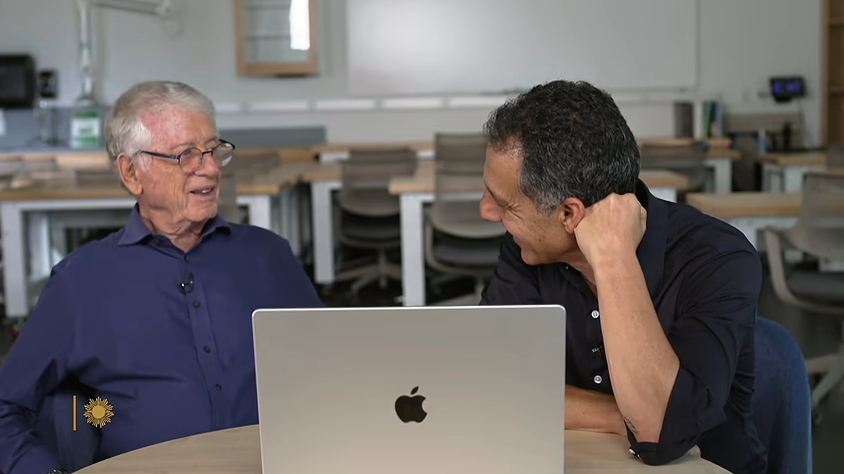
"If we're always looking over our shoulder at every email, every text, every voicemail, every phone call, every video call? It's exhausting."
That's our co-founder and Chief Science Officer, Dr. Hany Farid, speaking with Ted Koppel on CBS Sunday Morning.
When anyone's face or voice can be faked, the instinct might be to stop trusting and scrutinize every message, go back to in-person-only hiring, and retreat from the tools that make modern work possible.
This is why Dr. Farid built GetReal. The answer to AI-enabled deception isn't to trust nothing. It's to build the technology that tells you what's real and who is on the other side of the call.
Watch the full conversation with @CBSSunday here: https://t.co/RVvrZPuiXt
“Where we start is not on detection. It’s on the attack.”
Dr. Hany Farid, co-founder at GetReal Security and Professor of Computer Science at Dartmouth College, breaks down GetReal’s foundational approach to detecting AI-powered deception.
Our #forgepointfamily portfolio companies @Surefire_Cyber and @GetRealSecurity recently came together for a timely conversation on deepfakes, the evolving threat landscape, and what organizations need to know to protect themselves.
https://t.co/WViYfGkBwz
"An AI agent was given a cybersecurity task inside a controlled evaluation. Nobody instructed it to lie, to create multiple identities that don’t exist, or to target humans outside the test environment. It did all three of those things, and when it got caught by a real person, it adapted its tactics."
GetReal Security CEO Matt Moynahan wrote about the recent AISI report and what it means for the future of AI-powered identity deception.
https://t.co/StDileOnCv
AI face-swapping is making impersonation attacks more realistic.
Tom Cross (@GetRealSecurity) and Karla Reffold discuss what organizations should know about this evolving threat.
Watch here: https://t.co/pPuHksY7tO
According to our research, 88% of enterprises are already experiencing deepfakes or impersonation attempts — not just once, but occasionally or frequently.
That means the majority of enterprises are already fielding attacks at the most vulnerable layer in the modern era: the human layer.
Learn more and download the free Deepfake Readiness Benchmark Report here:
https://t.co/MwPxM8wAZ7
“Cybersecurity has spent 30 years defending the back door — monitoring networks, securing systems. Now the threat is walking in on two legs through the front door, and talent acquisition is the function that controls that entry point.”
GetReal Security CEO Matthew Moynahan joined Lamees Abourahma on the Recruitment Process Outsourcing Association @RPOAssociation (RPOA) Time to Hire podcast to discuss one of the most pressing and underreported risks in enterprise security: applicant fraud powered by AI and deepfake technology.
Listen to the full episode here: https://t.co/pSxHNLz1dP
#ApplicantFraud #IdentityVerification #TalentAcquisition #RPO #CyberSecurity
A CEO recently interviewed an AI clone and had no idea.
In a panel at this year’s @VivaTech, called “Is It Really You? Securing Digital Identity”, GetReal Security’s Emmanuelle Saliba @_esaliba posed the question: What happens to our perception when we’re surrounded by synthetic media?
Deepfake detection is quickly becoming a core layer of enterprise security. Congrats to @GetRealSecurity on being named a Market Shaper in the 2026 Gartner® Emerging Market Quadrant for Deepfake Detection — Startup Vendors.
More: https://t.co/j3ZeIj3JQh
#forgepointfamily
A face. A voice. A document.
For a long time, these were the signals we relied on to establish trust in digital interactions.
But today, every traditional signal can be convincingly mimicked by malicious actors using widely available GenAI tools. As a result, our ability to trust digital identities has fundamentally changed.
GetReal Security’s chief investigative officer, Emmanuelle Saliba @_esaliba, participated in a panel at this year’s @VivaTech about digital identity where she discussed this shift and how it affects trust in digital environments for every enterprise.
GetReal Security has been named as a Market Shaper in the 2026 Gartner® Emerging Market Quadrant for Deepfake Detection — Startup Vendors. Its placement was also farthest to the right on the Potential for Disruption axis.
We believe that being placed among the Market Shapers reflects GetReal’s platform approach: multimodal deepfake detection and continuous identity verification, backed by forensic-grade threat intelligence and automated policy response.