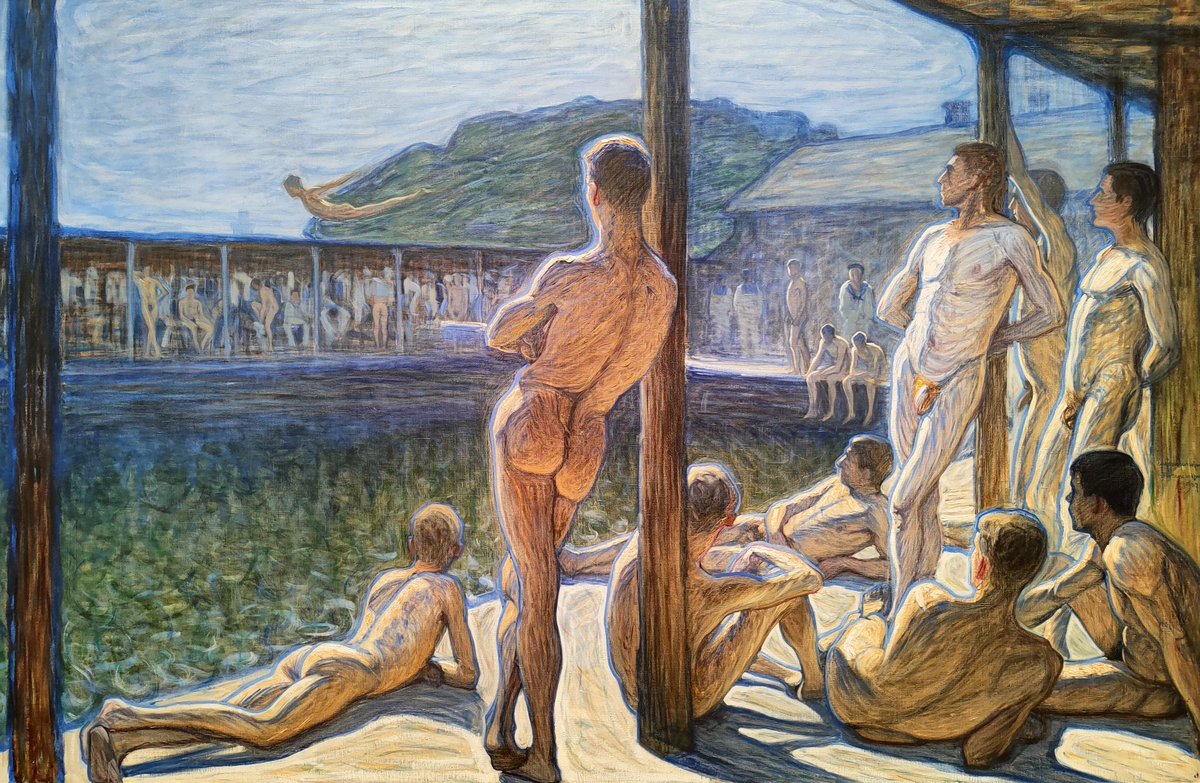
Naval Bathers (Flottans badhus), 1907
Eugène Jansson (1862–1915)
Oil on canvas
This painting marks a dramatic turning point in the career of the Swedish artist Eugène Jansson. Having become famous for his atmospheric blue-toned cityscapes of Stockholm, Jansson shifted around 1904 to painting the male figure. Naval Bathers (1907) is among the defining works of this later period and depicts sailors and young men relaxing at the Swedish naval bathhouse on Skeppsholmen in Stockholm. At the center, a diver is frozen in mid-air, while the surrounding figures watch from the bathing platform, creating a scene of quiet observation rather than dramatic action.
Significance in its time
When exhibited in 1907, the painting was strikingly modern and controversial for several reasons:
A new ideal of masculinity. Across Europe, the early twentieth century saw the rise of vitalism—a cultural movement celebrating physical health, athleticism, sunlight, and the disciplined body as an antidote to the perceived ills of industrial urban life. Jansson's muscular sailors embodied this ideal, making the work both contemporary and socially relevant.
The male nude as the primary subject. While female nudes had long been accepted in Western art, Jansson presented the male nude with an unprecedented level of sustained attention. Rather than using classical heroes or mythological figures, he depicted ordinary modern men, transforming an everyday naval bathhouse into a monumental scene worthy of history painting. Contemporary audiences found this both innovative and unsettling.
A coded expression of queer identity. Today the painting is also understood as an important work in LGBTQ+ art history. Homosexual acts were illegal in Sweden until 1944, making open expression impossible. The naval bathhouse functioned not only as a sporting venue but also as a social space where men who desired other men could meet. Jansson's lingering attention to the male body can therefore be read as both an artistic celebration of physical beauty and a discreet expression of personal desire, carefully framed within the acceptable language of athletics and health.
Why it matters today
Naval Bathers stands at the intersection of modernism, changing ideas about the body, and queer cultural history. It demonstrates how artists could communicate personal identity through apparently conventional subjects while navigating the legal and social constraints of their era. At the same time, its luminous handling of light, rhythmic composition, and sculptural treatment of the human figure make it one of the most important Scandinavian paintings of the early twentieth century.
Man on a Beach
Lovely oil on canvas sketch of a naked man on the beach by the Master of Falmouth, Henry Scott Tuke, https://t.co/Zr2l07odqI
If you are interested in commissioning an oil painting on canvas of this art print, please send me an email at [email protected]
@postpastoral Been there! Probably several hundred times over. I always felt I could do whatever I wanted with my own body and it wasn't really anyone else's business.
Eric Trump: "The LGBT community, they are incredible. And you should see how they come out in full force for my father every single day. I'm part of that community, and we love the man."
LGBTQ: I wouldn't say we LOVE him, but many of us do piss on him in effigy.
I can't even fathom living in a world where someone divisive & hateful can be elected president, but a talk show host who promotes joy/love/kindness is under attack. @TheEllenShow