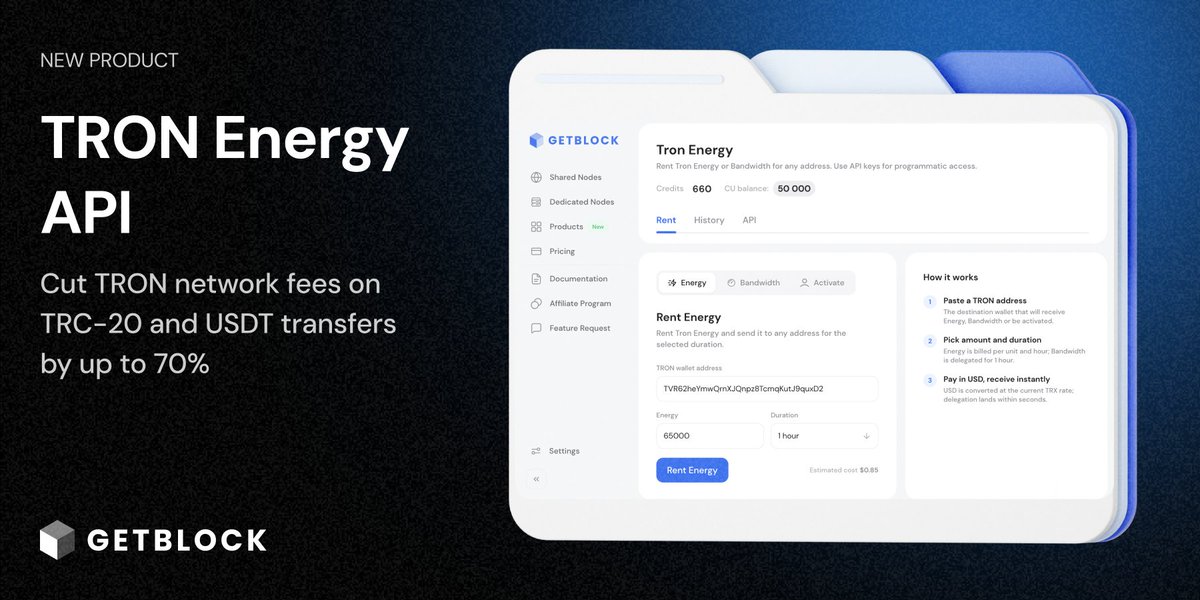
New on GetBlock: TRON Energy and Bandwidth Rental.
Stop burning TRX on USDT transfers. Rent Energy on demand, pay in USD, and cut TRON fees by up to 70%.
→ Delivered in < 2 seconds
→ No staking, no frozen funds
→ Energy 1h-14d, Bandwidth 1h
→ API or dashboard
Get started: https://t.co/fVsS8eO25B
@TRON_INC@trondao@justinsuntron
Latergram from Solana Summit Germany, courtesy of our Berliner-in-chief @GetBlockProd
Great time with cracked guys from @velia_net - server infrastructure done right! - and Solana powerhouse @triton_one
Always better in person. Berlin delivers.
Danke vielmals @SuperteamDE 🇩🇪
.@raptor_trade is building frontier data infrastructure on Solana with new storage engine, incremental deltas, 600K TPS, 6ms P98.
Architecture, reinvented = trades execution, blazing-fast.
We're proud to be among their first partners, powering it with our Solana RPC.
And yes, that 6ms P98 is on our infrastructure, now confirmed in production by a customer (@colosseum cypherpunk honorable mention btw) under real load.
The answer is raptor[dot] trade.
@SuperteamMY@ns@tuakdotsol
Everyone said @solana's data infrastructure was solved.
Our co-founder, Dominique spent 15 years in databases and knew it wasn't.
Birdeye and Codex proved the market existed. They built a great product. But here's what happens to every successful company: as they grow, they move further away from the builders actually using the data. Feedback loops slow down. Edge cases get ignored. Power users emerge, who don't fit the original product. The pricing model stops making sense. The latency stops being good enough.
This is where raptor[dot]trade found our opening.
Databases have been used the same way for 40+ years. ingest → recalculate → serve stale data. repeat. nobody challenged it because the pain wasn't visible enough, until a few seconds of latency (post-compute) can catastrophic for anyone running serious strategies.
So we built a new storage engine from scratch. incremental deltas only. No recalculation. ACID guarantees. 600K transactions per second. P98 latency of 6ms.
the result: 99.7% lower cost-to-serve. one URL swap to switch from Birdeye, and we will work with @getblockio and @Shyft_to as our first partners to launch this.
PayPal led to Stripe. Adobe led to Figma. Birdeye and Codex led to raptor[dot]trade.
The first generation proves the market. The second reimagines the architecture for the power users the first generation left behind.
That's where we aspire to be🔥
🏦 Why do traditional banks reject Web3 projects, and how can on-chain identity permanently solve the "debanking" crisis? 🛑💼
@januar@MaMolleskov
00:00 🎙️ Introduction to GetBlock Podcast and Guests
02:02 🧠 Understanding Januar and Its Unique Position
06:09 ❌ The Debanking Issue in Crypto
10:08 🛡️ Risk Assessment and Client Onboarding
14:58 🌍 The Crypto-Friendly Banking Landscape
20:10 🛑 Misconceptions About Crypto Compliance
23:52 📊 Challenges of MiCA Regulation
30:42 🚀 The Future of Global Crypto Regulation
36:14 🇪🇺 Navigating European Crypto Regulations
38:07 ⛓️ The Challenge of Decentralized Regulation
39:33 🇩🇰 Regulating Decentralized Entities: A Danish Perspective
42:13 🛒 The Future of Decentralized Marketplaces
44:57 🆔 The Role of UnchainID in Digital Identity
49:02 🔑 The Need for On-Chain IDs
53:08 📈 Banking's Growing Interest in Crypto
58:09 🪙 Tokenization of Financial Assets: Opportunities and Challenges