🚀 Justin Sun & TRON (TRX): From Visionary Founder to Global Blockchain Powerhouse @justinsuntron
👤 Who Is Justin Sun?
Justin Sun is one of the most influential figures in the cryptocurrency industry. He founded TRON in 2017 with the goal of creating a decentralized internet and a global blockchain-based payment infrastructure. Over the years, he has built a massive ecosystem that includes TRON, BitTorrent, HTX, and multiple DeFi projects. (Wikipedia)
Recently, Sun gained significant global attention after being featured by Forbes as "Crypto's Billionaire Barker," highlighting TRON's growth and its ambition to become a worldwide payment network with over 300 million users. (Forbes)
🔥 1️⃣ Massive Network Growth
➡️ TRON has surpassed 300 million user accounts worldwide, becoming one of the largest blockchain ecosystems in crypto. (Binance)
➡️ The network processes billions of transactions and has accumulated over $17 trillion in transfer volume. (Binance)
➡️ Low transaction fees and fast settlement speeds have made TRON one of the preferred networks for stablecoin transfers globally. (Binance)
💰 2️⃣ TRX Price & Market Position
➡️ TRX has evolved from a small altcoin into a top-tier cryptocurrency by market capitalization.
➡️ The token remains one of the strongest performers among large-cap blockchain assets thanks to increasing network activity and stablecoin adoption. (FX Leaders)
➡️ Key factors supporting TRX growth:
→ Growing transaction volume
→ Expanding DeFi ecosystem
→ Strong USDT dominance on TRON
→ Continuous user growth
→ Increasing network revenue
3️⃣ Why TRON Is Important Today @trondao
➡️ More than half of the circulating USDT supply is processed through the TRON network, making it a critical infrastructure layer for global crypto payments. (Binance)
➡️ TRON handles thousands of transactions per second while maintaining extremely low fees. (Binance)
➡️ The ecosystem's Total Value Locked (TVL) has approached $20 billion, reflecting strong DeFi adoption. (Binance)
➡️ Monthly blockchain transactions continue to grow rapidly as businesses and users seek efficient payment solutions. (Binance)
📈 Current TRON Strengths
✅ Fast Transactions
➡️ Near-instant settlement for payments and transfers.
✅ Low Fees
➡️ Costs are significantly lower than many competing blockchains.
✅ Global Adoption
➡️ Hundreds of millions of accounts across multiple regions.
✅ Stablecoin Leadership
➡️ One of the largest networks for USDT transactions worldwide.
✅ Expanding Ecosystem
➡️ Growth in DeFi, staking, gaming, and digital payments.
🎯 Conclusion
Justin Sun has transformed TRON from an ambitious startup project into one of the largest blockchain ecosystems in the world. With over 300 million users, massive transaction volume, strong stablecoin dominance, and continuous ecosystem expansion, TRON is positioning itself as a major player in the future of global digital payments.
🚀 TRON's vision remains clear: build a decentralized financial network that is fast, scalable, affordable, and accessible to users worldwide.
@justinsuntron@trondao #TRONEcoStar
From a visionary to a global force — honored to be featured on Forbes as Crypto’s Billionaire Barker. TRON’s journey continues, powering a global payment system with 300 million users and counting. Decentralization will prevail.
🌐 AI and Web3 are opening up new possibilities across the digital landscape.
This week's TRON Eco Weekly News brings together fresh developments in #AI, #DeFi, digital assets, and infrastructure, showcasing an ecosystem advancing on multiple fronts.
Explore this week's #TRONEco highlights! 👇
Is 2.3% APR on WBTC Supply One of the Better Yields Available in DeFi Right Now?
Current (CurrentSUI) is offering Bitcoin holders a way to put WBTC to work without selling it. Users can supply WBTC to earn yield or use it as collateral to borrow USDC.
Current rates:
- Supply WBTC: 2.3% APR
- Borrow USDC against WBTC: 4.4%
The platform works together with WrappedBTC to expand options for BTC holders who want on-chain utility while keeping exposure to Bitcoin.
Personal view: A 2.3% supply APR on WBTC is modest compared with higher-risk strategies, but it sits in a range that some holders consider reasonable for relatively straightforward lending exposure. The more interesting part is the ability to borrow against WBTC at 4.4%, which lets users access stablecoin liquidity without fully exiting their Bitcoin position. Whether this ranks among the better WBTC yields depends on how it compares with alternatives on other chains and protocols after factoring in risks, liquidity depth, and actual utilization. For holders who already hold WBTC and want to generate some yield or borrow against it, the rates are clear and the path is direct. As always, the numbers are only useful after checking current conditions and doing your own research.
Supply or borrow: https://t.co/5PhlY0v47U
@justinsuntron@CurrentSUI@WrappedBTC #TRONEcoStar
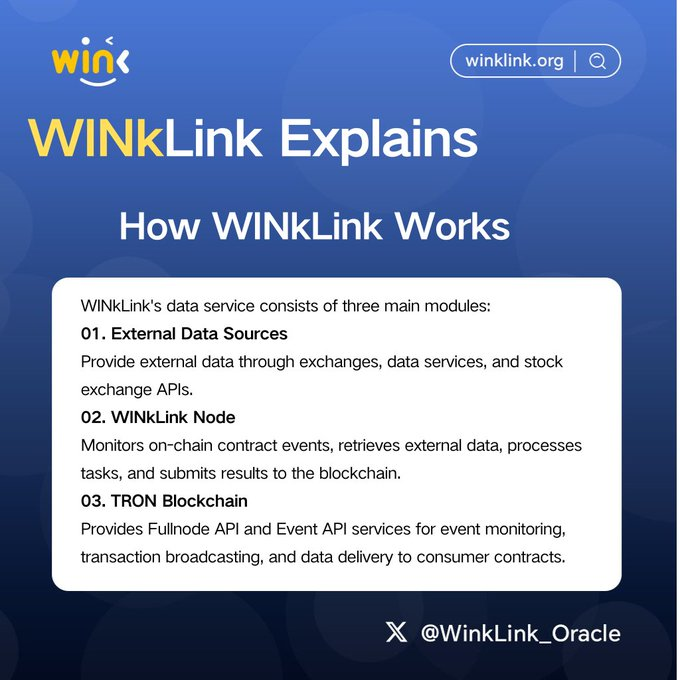
How Does External Data Actually Reach a Smart Contract on TRON Through WINkLink?
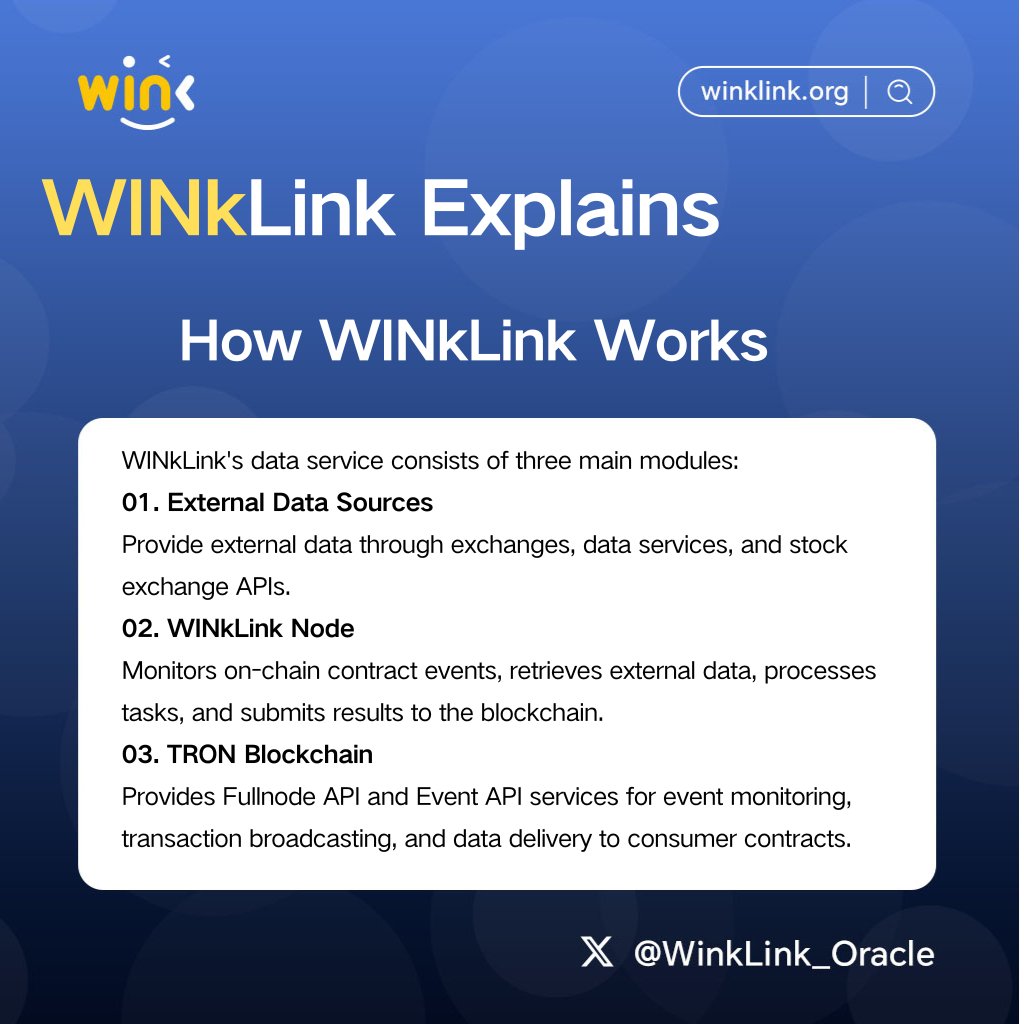
WINkLink functions as the oracle layer that connects off-chain data to on-chain smart contracts on TRON. Its data service is organized into three main modules that work in sequence.
The flow works as follows:
- External Data Sources: Exchanges, data services, and stock exchange APIs supply the raw external information.
- WINkLink Node: The node monitors on-chain contract events, retrieves the requested data from those external sources, processes the tasks, and submits the results back to the blockchain.
- TRON Blockchain: Fullnode API and Event API services handle event monitoring, transaction broadcasting, and final data delivery to the consumer contracts.
This structure allows a smart contract on TRON to request and receive external data without the contract itself needing direct access to off-chain sources.
Personal view: Oracles are only as useful as their reliability and clarity of process. WINkLink’s three-module design makes the path from external source to on-chain contract relatively straightforward to understand: the node acts as the active intermediary that listens for requests, fetches data, and posts results. For developers building applications that depend on prices, events, or other external inputs, the practical question is how consistently the node retrieves and submits accurate data under different network conditions. When that link holds, it expands what smart contracts on TRON can reliably do beyond purely on-chain logic.
@justinsuntron@WinkLink_Oracle #TRONEcoStar
WINkLink Explains: How WINkLink Works
How does external data make its way to a smart contract on #TRON?
A #WINkLink node monitors on-chain contract events, retrieves the requested data from external sources, and submits the results back to the blockchain through API services.
This connects external data with on-chain smart contracts.
Does https://t.co/DEE6NmoER2 Make Exploring DeFi on TRON More Practical?
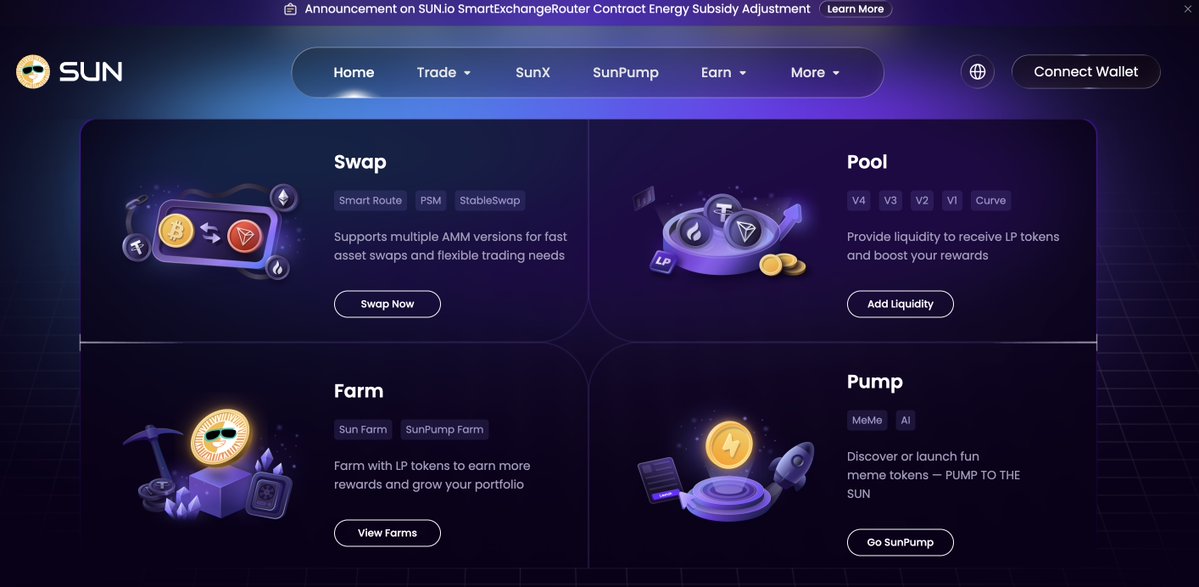
https://t.co/DEE6NmoER2 consolidates a range of DeFi applications in one place, giving users a single entry point to interact with liquidity, trading, and related products on TRON instead of jumping between multiple interfaces.
Key points of the setup:
- Users can access various DeFi tools through one platform (https://t.co/DEE6NmoER2).
- The design aims to reduce friction when moving between different DeFi activities.
- It sits within the broader TRON DeFi stack that includes lending, stablecoins, and other protocols.
Personal view: Having multiple DeFi applications under one roof is useful only if it actually shortens the path from idea to action. For users who already operate on TRON, a unified interface can lower the barrier to trying different products without managing separate wallets or dashboards for each. The practical value depends on how deep the integrations are and whether the tools available on https://t.co/DEE6NmoER2 cover the main activities people want to perform (swap, provide liquidity, earn, or manage positions). If the platform keeps adding functional depth while remaining simple to navigate, it strengthens the case for using TRON-native DeFi instead of fragmented alternatives.
Explore: https://t.co/qN6HcoZSpt
@justinsuntron@OfficialSUNio #TRONEcoStar
There's always more to discover in DeFi. 🌞
With a range of DeFi applications in one place, https://t.co/Yc2rgzjlOF gives you more room to explore.
Ready when you are. 😎
🔗 https://t.co/svV7mD9HvD
Can JustLend SBM V2’s Adaptive Curve Interest Rate Model Keep Utilization Near the Optimal Level?
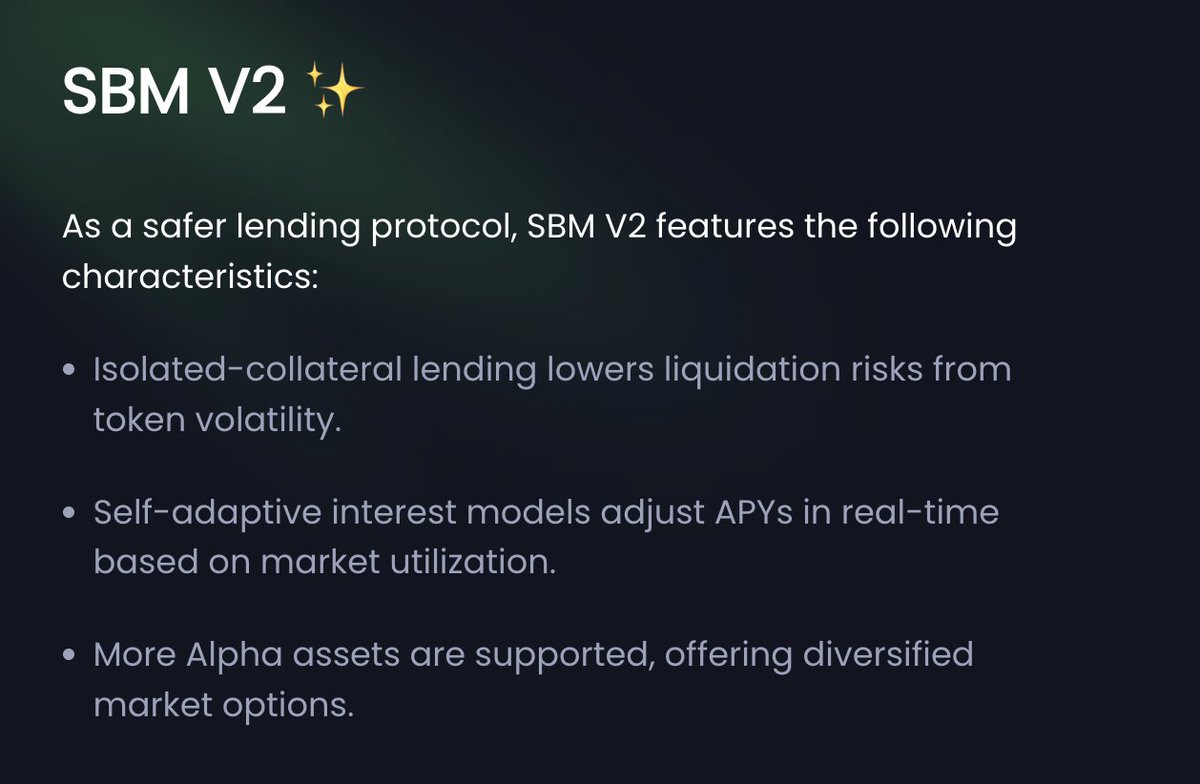
SBM V2 introduces an Adaptive Curve Interest Rate Model that builds on the Jump Curve used in SBM V1 but adds dynamic adjustment. The goal is to keep market utilization closer to a target level instead of relying only on a fixed kink point.
Key mechanics:
- The model still uses a jump-style curve: borrow rates rise gradually up to a kink and then steepen sharply once utilization exceeds that point.
- On top of this, the entire curve can shift vertically in real time. When utilization is low, rates move lower to attract borrowers. When utilization is high, rates move higher to encourage repayment or new supply.
- Interest paid by borrowers continues to flow back to the linked Vault and is shared among depositors according to their contribution.
Compared with the more static parameters in V1, the adaptive layer is designed to respond faster to changes in supply and demand inside each Isolated Market.
Personal view: Smarter rates and better capital efficiency are the intended outcomes. A protocol that can automatically push utilization toward a healthy range should, in theory, reduce idle liquidity while avoiding liquidity shortages. The practical test is whether the adjustments are smooth enough to avoid rate volatility that deters users, and whether the model actually keeps utilization in a better band than the previous Jump Curve. For suppliers, the adaptive rates can translate into more consistent yield. For borrowers, they can mean borrowing costs that better reflect real-time demand. The mechanism looks sound on paper; sustained utilization and rate stability data will determine if it meaningfully improves capital efficiency on TRON.
@justinsuntron@DeFi_JUST #TRONEcoStar
There's always more to discover in DeFi. 🌞
With a range of DeFi applications in one place, https://t.co/Yc2rgzjlOF gives you more room to explore.
Ready when you are. 😎
🔗 https://t.co/svV7mD9HvD
Does JustLend SBM V2’s Vault + Isolated Market Design Actually Improve Risk Control?
JustLend DAO launched SBM V2 in June 2026 as an isolated-collateral lending protocol on TRON. The core change is a dual-layer structure that separates liquidity provision from borrowing risk.
How it works:
- Suppliers deposit a single asset (for example USDT or USDD) into a corresponding Vault. The Vault aggregates liquidity and can allocate it across multiple connected markets.
- Borrowers access that liquidity through Isolated Markets. Each Market supports only one collateral type, is linked to a specific Vault, and operates with its own risk parameters (including LLTV).
- Borrowing and liquidation stay contained inside the individual Market. Interest paid by borrowers flows back to the Vault and is distributed to depositors.
This is a clear shift from SBM V1’s cross-collateral model, where multiple assets shared a common risk pool. In V2, a sharp drop or liquidation event in one collateral asset is intended to stay isolated rather than cascade across the protocol.
Personal view: The Flexible Lending Framework is the practical outcome of this design. Depositors get exposure to yield from multiple markets through a single Vault without having to pick every market themselves. Borrowers get clearly defined, isolated markets. The architecture reduces contagion risk, which is the main weakness of shared-pool lending. Whether it delivers better overall capital efficiency still depends on how liquidity is actually allocated across markets and how actively users use the isolated options. On paper the risk separation is cleaner; real usage data will show if the framework lives up to the claim.
@justinsuntron@DeFi_JUST #TRONEcoStar
A different approach to lending markets is available on #JustLend.
SBM V2 combines Vaults and isolated Markets.
Suppliers deposit assets into Vaults, while borrowers access liquidity through individual markets backed by specific collateral types. It also features an Adaptive Curve Interest Rate Model.
What's your experience with SBM V2? 👀
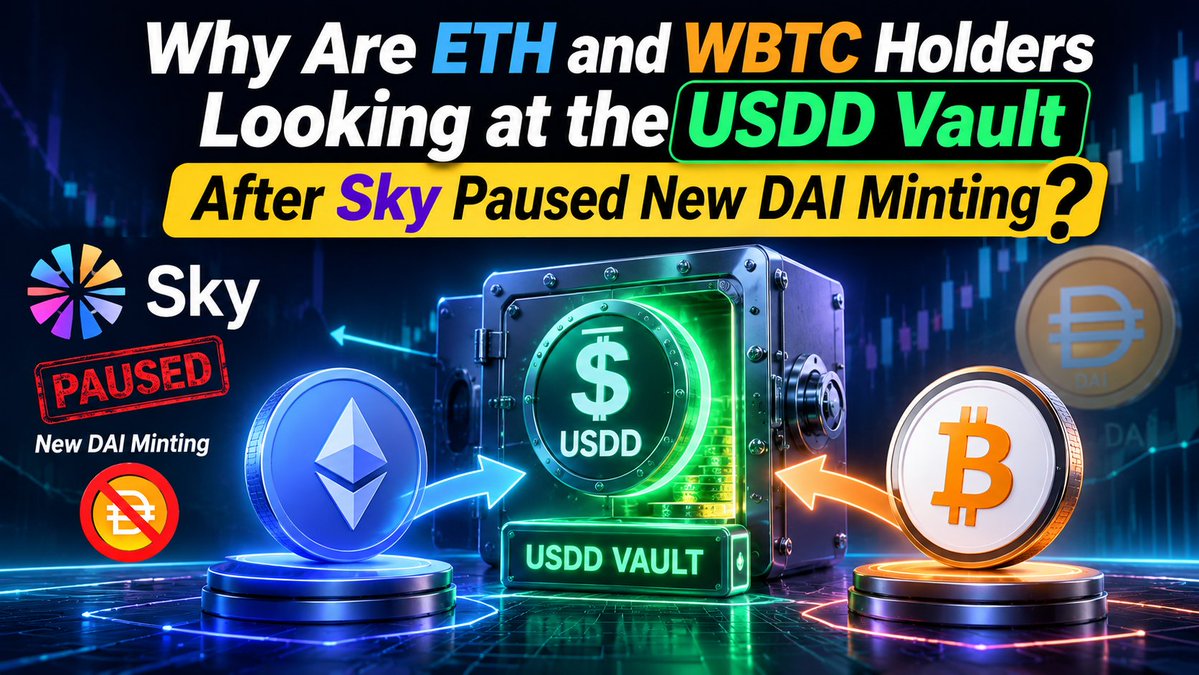
Sky Paused New DAI Minting Against ETH Vaults Does the USDD Vault Offer a Practical Alternative?
Sky has paused new DAI minting through its related ETH and wstETH vaults by setting their debt ceilings to zero. Existing borrowers can still repay and manage positions normally, but no new DAI can be generated via these vaults. Combined with the earlier zeroing of WBTC vault ceilings in August 2024, traditional collateralized minting routes for both ETH and WBTC into DAI have become more limited.
USDD continues to support minting against ETH and WBTC collateral on Ethereum. Holders do not need to sell their assets; they can collateralize them to access stablecoin liquidity.
Key vault parameters:
- ETH Vault: 130%–150% collateral ratio, 4.25%–5% fixed stability fee
- WBTC Vault: 135%–155% collateral ratio, 4%–4.5% stability fee
As of November 24, 2026, USDD maintains roughly 1.49 billion tokens in circulation, backed by approximately $2.01 billion in reserve assets at a 134.90% collateral ratio.
Personal view: For ETH and WBTC holders who regularly use collateralized borrowing, the practical difference right now is simple — new DAI minting through the affected Sky vaults is paused, while USDD’s vaults remain available. The lower end of USDD’s collateral ratios and the fixed fee structure may appeal to users seeking relatively predictable borrowing costs. At the same time, the overall system collateral ratio sitting around 135% is worth monitoring, as it reflects the buffer between circulating supply and reserve value.
Whether this becomes a meaningful alternative depends on how many users actually prefer the current USDD parameters over other remaining DeFi borrowing options. The data shows the vaults are open and the reserves are over-collateralized; usage will determine if the gap left by the Sky adjustment translates into sustained demand.
Official details and vault workflow: https://t.co/MoPpIH9iSe
@justinsuntron@USDDecentralize #TRONEcoStar
Your $ETH collateral is still yours. Your borrowing need didn't disappear.
While legacy vaults close and push users into shared lending pools, ethereum:0x4f8e5de400de08b164e7421b3ee387f461becd1a Vault on Ethereum keeps the native CDP door open.
Here’s why ETH and $WBTC holders should choose USDD vaults over traditional lending pools 🧵👇
BitTorrent DePIN vs Render: Who Is Ahead in Decentralized GPU Infrastructure?
When comparing BitTorrent’s DePIN direction (BTFS + BTTInferGrid) with Render Network, the clearest difference is not the concept, but the stage of execution and the degree to which paid demand has been proven.
Key comparison data:
- Render Network: Has rendered more than 82.5 million cumulative frames, with approximately 5,600 nodes since inception. October 2026 recorded around $834,000 in GPU job fees (DefiLlama/Foundation reports). Market cap is in the $660–720 million range.
- BitTorrent: Over 590 million client installations, with an average of ~8.7 million DAU. BTFS once peaked at over 800 PB of storage and more than 2 million nodes (2025). BTTInferGrid launched in June 2026. In Q3 2026, it burned approximately 21.62 trillion BTT (~$7.6 million) from decentralized service revenue. BTT market cap is around $290 million.
Render’s strengths:
- Already has real revenue from users paying for GPU compute (rendering + expanding into AI).
- Burn-and-Mint Equilibrium mechanism is relatively tightly linked to actual jobs.
- Deep integration with the OctaneRender ecosystem, creating a workflow advantage for professional users.
- Longer operating history in the GPU DePIN segment.
BitTorrent’s strengths:
- Massive user distribution foundation from a P2P network that has existed for decades something most new DePIN projects lack.
- Attempting to combine multiple layers: data distribution (P2P), storage (BTFS), AI compute (BTTInferGrid), and settlement (BTTC) under a single token.
- The revenue-funded buyback & burn mechanism is the right direction, even though the scale is still small.
Personal view: Render is currently ahead in terms of “proving that users are paying for GPU.” BitTorrent has a stronger distribution advantage and a broader ecosystem, but BTTInferGrid is still new and has not yet demonstrated clear paid usage at the level Render has achieved.
If BitTorrent can convert even a small portion of its millions of existing users into paying users for storage or compute, the potential would be significant. Conversely, if it remains at the stage of having infrastructure without real revenue, the gap with DePIN GPU projects that already generate revenue will continue to widen.
I am tracking two main metrics on both sides: actual job revenue each month and the conversion rate from existing users to paying users.
@justinsuntron@BitTorrent #TRONEcoStar
Why Are ETH and WBTC Holders Looking at the USDD Vault After Sky Paused New DAI Minting?
On November 24, Sky (formerly MakerDAO) set the debt ceiling to zero for five ETH and wstETH collateral vaults, pausing new DAI borrowing through those vaults. Existing positions can still be managed and repaid, but users can no longer mint new DAI via these traditional ETH vaults. Earlier in August 2024, Sky had already zeroed the debt ceilings for the WBTC-A/B/C vaults.
This narrows the traditional routes for obtaining DAI against ETH or WBTC collateral.
In this context, the USDD Ethereum Vault remains open. ETH and WBTC holders can still mint USDD against their collateral without needing to sell the underlying assets.
Current parameters (as of November 24, 2026):
- USDD ETH Vault: Collateral ratio 130%–150%, fixed stability fee 4.25%–5%
- USDD WBTC Vault: Collateral ratio 135%–155%, stability fee 4%–4.5%
Broader USDD metrics:
- Circulating supply: approximately 1.49 billion tokens
- Reserve assets: around $2.01 billion
- Collateral ratio: 134.90%
Personal view: When a long-standing protocol like Sky pauses new borrowing against major collateral types, it creates a practical liquidity gap for holders who want stablecoin exposure without selling their ETH or WBTC. USDD’s vaults are currently filling part of that gap with relatively straightforward parameters and an over-collateralized design. The key question for users is not just availability, but whether the collateral ratios, fees, and overall reserve transparency meet their risk preferences compared with other options still open in the market.
This does not mean DAI has stopped entirely new minting is paused only through the affected vaults. For those specifically looking to mint against ETH or WBTC on Ethereum, the USDD Vault is one of the remaining direct options.
@justinsuntron@USDDecentralize #TRONEcoStar
Does BitTorrent Actually Have a Competitive Advantage When Moving from P2P to Web3 and AI Infrastructure?
From an analytical perspective, BitTorrent has several notable advantages compared to many newer DePIN and AI infrastructure projects. The biggest difference is not the idea itself, but the foundation that has already existed for a long time.
Key data and factors:
- BitTorrent clients have surpassed 590 million cumulative installations, with an average of around 8.7 million daily active users (BitTorrent Client Matrix, November 2026).
- In 2025, BTFS peaked at over 800 PB of storage capacity, more than 2 million nodes, and over 196 million storage contracts.
- In June 2026, the project launched BTTInferGrid a decentralized compute network for AI inference, built on the technical foundation of BTFS.
- In Q3 2026, BitTorrent used 100% of revenue from decentralized services to buy back and burn more than 21.62 trillion BTT (approximately $7.6 million, or ~2.18% of total supply).
- BTT staking on BTTC currently offers APY up to around 6.9%.
Main competitive advantages I see:
1. Long-standing technology foundation with a real operating history
Unlike many Web3 projects that start with a blockchain idea and then look for users, BitTorrent already had a widely used P2P network for decades before integrating a token. This is a real user distribution advantage that very few new DePIN projects possess.
2. Ability to connect multiple growth sectors at the same time
The project is trying to combine three major directions:
- DePIN: utilizing distributed physical resources (storage, bandwidth, GPU).
- AI Infrastructure: providing compute resources and model distribution.
- Web3: blockchain, payments, staking, and settlement on BTTC.
If successful, BTT could serve as the economic layer across the stack instead of being the token of a single product.
3. Multiple paths to create real demand for BTT
If BTFS, BTTInferGrid, and BTTC develop actual usage, BTT can be tied to service payment demand (storage, compute, acceleration) rather than relying mainly on speculative demand. This is an important difference from many tokens that depend primarily on incentives.
4. Buyback & Burn mechanism creates a link between revenue and the token
Using revenue from decentralized services to buy back and burn BTT is a notable step in long-term economic design. It creates a direct connection between business activity and token supply. However, the effectiveness of this mechanism depends entirely on the scale of real revenue and the ability to sustain the program across multiple consecutive quarters.
Personal view: BitTorrent’s biggest current advantage is that it already has users and a distributed infrastructure, rather than having to build everything from zero like most new DePIN projects. But this advantage only has value if the project can convert a portion of its existing users into paying users, and convert that revenue into sustainable BTT demand. At the moment, the buyback & burn mechanism is the strongest positive signal, though the scale is still small relative to the massive user base BitTorrent already holds.
I still prioritize tracking actual revenue and paid usage over new product announcements.
@justinsuntron@BitTorrent #TRONEcoStar