Peaceful anarchist.
Interested in criminology, international relations, 20th century history, evolutionary biology/psychology, philosophy and economics.
Atlanticist elites don't like Modi having a good relationship with Russia, when Russian weapons prevented his country from being dominated by Pakistan and China and cheap Russian oil puts food and medicine in the mouths of poor Indian children.
With the Soviet Union's threat to South Asia gone (with Pakistan as the counter), the immense latent power of China and the Pakistani economy frozen while India develops, the dubiousness of America not actively and persistently courting New Delhi.
https://t.co/2214AAb5kR
@Ichbins8 Plus, the individual right interpretation of the Second Amendment, and concealed carry, simply has a lot of historical and legal pedigree.
There is nothing comparable in Canada, for example.
https://t.co/d5C0oAbjZp
Nonpartisan legal and historical scholarship overwhelmingly supports the contention the second amendment secures an individual right.
So much so this is simply called the “standard model”, even by the dissenting minority.
@Ichbins8 It has little to do with any of this.
The United States already had high gun ownership, which makes extensive control difficult because gun rights people have higher motivation than gun control people (Kleck, 1997).
Same reason it is difficult in Switzerland and Finland.
Sports journalists naively claim if PEDs were legalized the sport would turn into a clash of the best doctors, when Lance Armstrong won the Tour de France 7 times in part due to paying over a million dollars to the doping doctor Michele Ferrari.
The dubious ethics of the anti-doping regime: cyclists began to switch to the more dangerous blood doping method after a test for the performance-enhancing drug EPO was developed and end up taking smaller doses of EPO, anyways, as a masking agent.
https://t.co/5s2Moq3xLS
An alliance with Moscow being too uncomfortable, the best thing to do is to try to sic the Nazis and Bolsheviks on each other, which Britain tried to do.
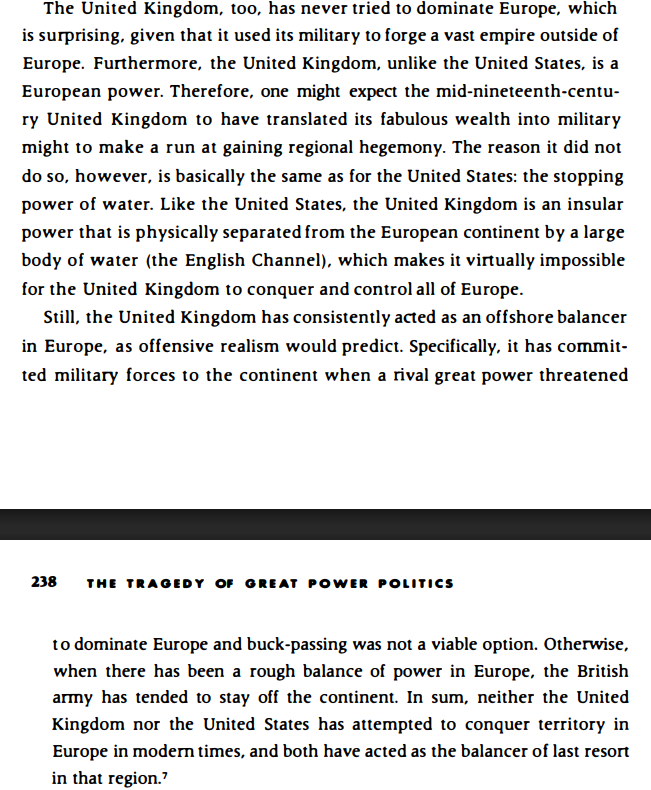
The basic English grand strategy through centuries: the English Channel makes dominating Europe impractical, but offshore balancing is possible to prevent a continental hegemon.
For example, England supported Portugal against both Spain and France.
In the 1930s, British grand strategy is caught between two potential hegemons, Nazi Germany and the Soviet Union, and elite anti-communism leads to the sabotage of an alliance with Moscow, despite Berlin being most aggressive, wealthier and geographically closer.
In international relations, realist scholars are the most politically diverse, in fact they are the only school where there isn't a crushing left-of-center and leftist majority, while Marxist/feminist scholars are the least, in this international survey of over 2,000.
@AndyMasley For example, Japanese, German and Polish espionage against the Soviet Union were important inputs into the mass arrests and mass executions in the Soviet Union in 1937-1938, while the Soviet regime survived for decades afterwards and collapsed via indigenous nationalism.
@AndyMasley Attempts to foment uprisings or coups allow the regime to portray opposition as foreign-controlled and cause repression, often large-scale repression, to stop the conspiracy, while still often failing.
I read a book on the economics of the news media recently that is 20 years old but is nevertheless relevant to this issue.
The author explained that, until pretty late in the 19th century, newspapers were almost exclusively partisan and economically dependent on subsidies by political parties.
The development of a non-partisan press was prompted by technological progress, which caused the cost of production of newspaper to fall dramatically, making it possible for newspapers to reach a much larger audience.
This allowed them to expand their advertising market, but in order to do so, they needed to attract readers across party lines, which in turn incentivized a non-partisan coverage of the news.
Obviously, this doesn't mean that the press was not biased, but it was still very different and less partisan than in earlier periods. I think social media have largely reversed that by incentivizing people to cater to specific ideological bubbles.
It remains to be seen how AI will affect the news sector, but I'm sure it will have a large effect on it so it seems important to think about it.
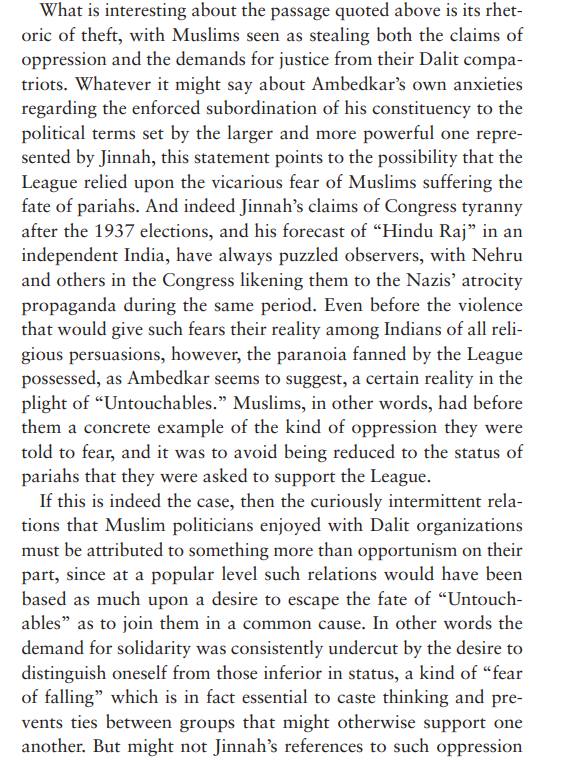
The apparent role of Dalits in the mind of Pakistan activists: potential allies to splinter from the Hindu majority, warnings of the oppression that could befall them and social pariahs, Muslims being too embedded in Indian society, to keep below them.
The Soviet OGPU-NKVD was fairly successful in its covert battle with Japanese intelligence, which was recruiting emigrés to Europe, despite the Empire working with the Polish regime.