@MohsinI13658106 @OpenGradient@OpenGradient allows Builders. Thinkers. Creators. All can contribute, audit, fork, and rebuild.
That’s the AI future I believe in❤️
@OpenGradient is reshaping AI.
Instead of closed-door model development, @OpenGradient means sharing weights, datasets, and training processes. It lets researchers verify how models learn, empowers developers to fine-tune more precisely, and enables the community to audit and improve without gatekeepers. It’s AI moving from controlled by a few to built by many���and the shift is accelerating.
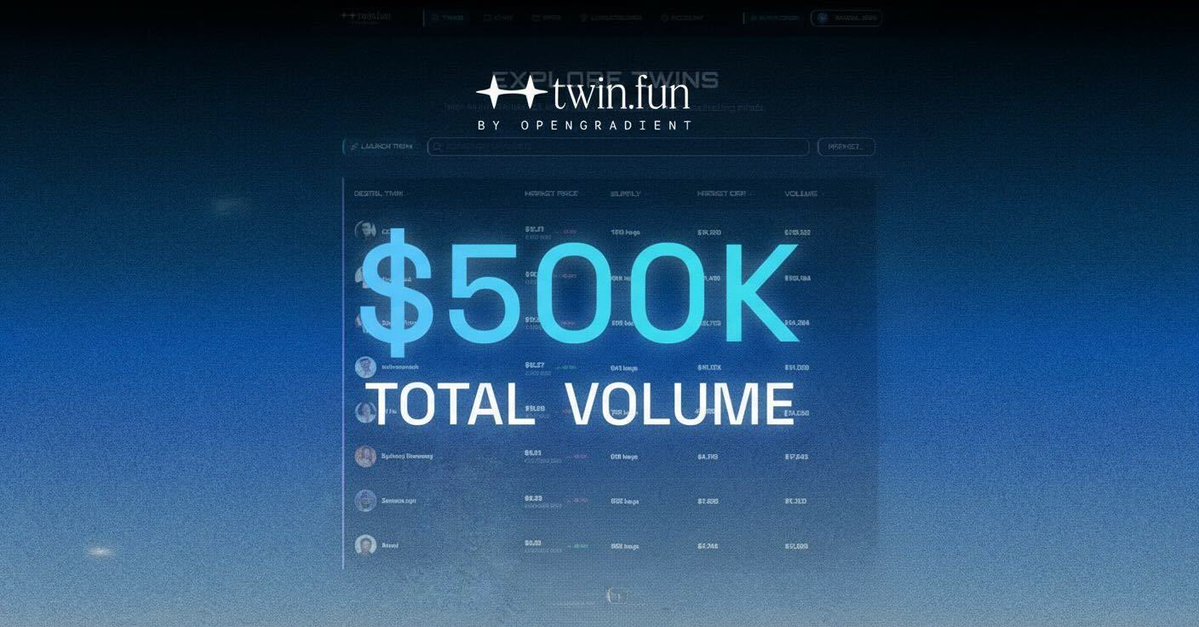
twin dot fun just crossed $500k+ in volume. 👯
Thank you to every collector, creator, and trader exploring this new mind-native economy.
More minds and more updates coming soon.
Explore twins and rank up on the leaderboard: https://t.co/z0c9zO2pjK
We’re entering a new era of @OpenGradient systems — going way beyond open-sourcing model weights. Now the entire training process becomes transparent: gradient flows, loss landscapes, optimization trajectories… all of it.
This unlocks something exciting: gradient archaeology.
Instead of only seeing what a model learned, we can trace how and when it learned it. Researchers can pinpoint the exact training moments where capabilities emerged or biases formed.
Some of the coolest developments so far:
Gradient checkpointing tools that expose intermediate training states
Open training runs where teams live-stream metrics and gradient dynamics
Gradient attribution methods that show which data shaped specific behaviors
And here’s the wild part: with open gradients, you can literally fork a model’s training at any checkpoint like branching a GitHub repo, but for learning itself.
This level of transparency could be a game-changer for AI safety and alignment, giving us a window into emergent behaviors long before they crystallize.
The future of open AI might not just be open weights but open learning.
AI is finally breaking out of the black box and @OpenGradient is moving faster than anyone.
They just rolled out:
MemSync: memory that persists across every AI assistant
Decentralized Model Hub: publish & run models without gatekeepers
OG-SDK: build agents + verifiable inference onchain
Neuro Stack: AI-powered blockchains as plug-and-play frameworks
The future of AI isn’t centralized.
It’s open, transparent, and owned by the people building it.
If you’re not paying attention to OpenGradient yet… you will be soon.