WE SAW IT IN ODISHA: THE PLAYBOOK NOW UNFOLDING IN KARNATAKA
Dear friends at @KA_HomeBuyers and fellow homebuyers across Karnataka,
What you are witnessing with the Karnataka Apartment Bill draft is not new. We in #Odisha lived through this exact sequence, stage by stage, until Odisha became the first state in the country to enact a fully RERA-compliant Apartment Ownership and Management Act in 2023.
1️⃣THE ERA OF DELIBERATE NEGLECT (1972–2016)
For decades, buyers believed builders knew the law and authorities would enforce it. An older, perfectly usable statute lay dormant because the government never appointed a “Competent Authority”. It was a simple, effective trick and it worked flawlessly for nearly 45 years.
2️⃣THE RERA AWAKENING (2017)
Enactment of the RE(R&D)Act in 2016-17 changed everything. Buyers suddenly started asking questions about title transfers, registration of Association, Declaration, common amenities and common area ownership. Accountability was no longer optional.
3️⃣THE POLITICAL PROMISE PHASE
Faced with this awakening, every political party in 2023 promptly added “Apartment law” to its election manifesto. Politicians knew the game perfectly well.
4️⃣THE CONVENIENT REDISCOVERY
The new elected government suddenly discovered the “merits” of the long forgotten old law. Overnight, those dormant clauses became the centrepiece of official defence in courts and in public statements.
And of course, fringe elements were fielded to challenge the validity of a KAOA and title transfer.
5️⃣THE DELAY TACTICS (SINCE 2024)
When sustained public pressure made a new law unavoidable, the familiar lines appeared on cue:
“We will look into it.” and “We are in the process of drafting…”
Each phrase bought time. The objective had quietly changed: from blocking the law TO delaying its implementation for as long as possible.
6️⃣DEVELOPERS’ STRATEGIC SILENCE
Have you noticed the complete silence from real estate developers throughout this commotion. They do not make noise. In this game, invisibility (but present) is the sharpest weapon.
💯KARNATAKA, THIS IS WHERE YOU STAND TODAY........from now on.....
7️⃣Govt. STRATEGY
The current draft contains provisions that deliberately contradict core RERA requirements (especially Section 17 on transfer of common areas), OC, SBUA, Separate Parcel. Those who drafted it know these contradictions will invite court challenges, challenges that will consume years.
8️⃣THE FUTURE CHAPTERS OF DELAY
Even if the draft is corrected under public pressure, the next acts are already scripted:
Cabinet approval ➡️ Introduction in Assembly ➡️ Withdrawal after discussion ➡️ Constitution of a Committee ➡️ Re-introduction
And then, showing extreme urgency: Ordinance versus full Assembly route
But in all this, you will definitely get the new Apartment law in the state before 2028, the next state election....they understand your desperation very well by now.
Each stage is carefully designed to gift the industry a few more years of comfortable lawlessness.
9️⃣ODISHA HAS ALREADY LIVED THIS SCRIPT
#Odisha has passed through every single one of these phases.
Homebuyers had to file 4 writs in the HC and 2 appeals in the SC before the Act was finally enacted.
Even today, multiple PILs are pending to stop the government from diluting the hard won provisions through amendments and “office order” notifications.
🔟THE STORY NEVER ENDS
The enactment of the law is not the end. It is merely the signal for the next round of dilution attempts.
👬To my brothers and sisters in Karnataka,
Your patience must be strategic and your fire must stay steady. The path is long, but it is not endless. Odisha’s experience proves that sustained, informed and united advocacy eventually forces the balance towards transparency and accountability.
The script is old. The ending is still being written by those who refuse to look away.
With solidarity,
From someone who has seen this story before. -Bimalendu Pradhan, Odisha-
WARNING
Massive AI hype being built in a sudden burst
(and most of it fake)
1) A scary article: I was surprised to read a long article on Twitter (X) claiming it's just 6-12 months before a Covid-like event changes this world. It claims this will be the AI-event, where most white-collar jobs worldwide would be gone, because AI is that good now. That article got 100 M plus views. Clearly, people are spooked (naturally). So the psy-op has worked.
(and I saw other similar dark articles too)
2) Suddenly many influencers are pushing the same narrative, and it so turns out that media reported many are being paid heavy sums by AI firms to push their story (that AI singularity is arriving). But if AI is "revolutionary", does it need an influencer push? No. This should be a clear signal it's hyped.
3) A correction in IT stocks' and SaaS stock's prices is suddenly creating a doom scenario about these companies dying any moment now, with second- and third-order effects on entire economy. Stock investors who haven't studied AI technicals are automatically assuming it's all over, dead, gone, finished. WRONG. NO.
4) What is the truth, and what's most likely to happen?
In my opinion, based on years of observing AI trends, reading and learning AI technology, and doing AI at various levels, my take is as follows. I urge you to read this, and preserve your sanity. Please don't panic, nothing catastrophic is happening anytime soon.
A) IPO pressure: AI firms are going crazy pushing their God-narrative, as many giant IPOs are lined up soon. They need public to buy their paid subscriptions or else the story goes kaput. So they are creating a false hype. It's shameful, anti-social and deeply hurtful.
(Almost all AI firms released doom-scenarios just before their next funding rounds; investors who haven't learnt technology fall for it; pure FOMO. This playbook is so repetitive it's comical)
B) OpenAI is spooked: Sam Altman has lost the lead he temporarily managed to build against Google and others, and now his loss-making enterprise isn't the darling of any investor any more. He's terrified.
C) Elon Musk's Grok does not have the traction in consumer space anyway near what's needed to make it a profit-making entity. So with many other capex-heavy AI firms. But the GPU / TPU hungry AI ops need more capex each day, not less. It's a dead-end for most except cash rich Googles.
D) Enterprise AI is patchy, lagging, slow, choppy: Anyone who has ever built a company, or run a large department, or consulted a business enterprise knows how random, undefined, tacit, and unstructured most of the real world work actually is. No way is AI ever going to replace humans doing those very complex things on a daily basis. No way. Not tomorrow, not in 10 years. NO.
(I am not even beginning to get into 'regulated' industries' needs)
E) Consumer AI is cool, but has limits: The more AI regular humans (of all ages) use, the more the artificiality of it becomes apparent to anyone. The novelty cannot sustain the commercial numbers needed to make AI (foundation models) profitable. OpenAI and Perplexity would never have given free tiers for most Indians otherwise. They desperately need folks to stick to this opium.
F) LLMs aren't solved, Hallucinations aren't zero: The structure of any LLM is such that it will ALWAYS hallucinate, no matter how much fine-tuning humans do. In most sensitive business operations, you cannot allow LLMs to control the core data at all. Can you run an airline with a Generative AI system (LLM-based) that's 98% accurate? Can you run a precision-mfg. operation at 97% accuracy? Can you run a financial services firm with 95% accuracy? NO. NEVER. So the deterministic, old-fashioned computer software ERP will go nowhere. Nowhere at all. LLMs will be good as a top layer on those ERPs to glean insights, nothing more.
[ None can 'train away' hallucinations in a probabilistic LLM model, using larger datasets. You are actually claiming I'll build a dice that lands a 4, or a 6, each time ]
G) Agents aren't magical, humans aren't going anywhere: Multi-step agentic AI is being touted as the final solution where one founder sitting alone can run 100 agents and build an empire. Try doing that once, experience the frequent breakdowns, see the regular edges and new complexities, and you will realize that other than the most mundane of tasks, nothing else will be seamless. Yes, Voice AI agents are good, and many in the developing world are now deploying those, but that's hardly a cutting-edge technology that'll replace all humans.
H) IT and SaaS firms are going nowhere: Ironically, the more AI happens in enterprises, the more will be the need for humans to supervised and orchestrate those bits and pieces of AI, to ensure nothing flies off the rails. The complex software code that Claude and Codex can write only changes the nature of work for the human coders who now have to check the AI code thoroughly for the many edge cases in real world. The nature of IT and SaaS work will change, some companies that can't innovate and adapt will vanish, but many new ones will emerge in their place. (Yes, there'll will be some much-deserved disruption in short-term, and the non-innovating IT firms will have deserved every bit of it)
I) If IT and SaaS are dead, why are AI firms hyping: Ask this simple question - if AI is indeed killing IT and SaaS, then why are AI firms spending massive sums hyping their wares? They need spend nothing and still earn the spoils. But they know the truth.
J) The China angle: Models from China - many of them open-sourced - are getting better and more competitive. Many of them are cheaper, or free (for now). OpenAI complained recently that they are stealing from American models (via "distillation"). Imagine, just imagine - OpenAI that stole entire internet work of creative work is complaining the Chinese are stealing from it. A dacoit crying that thieves broke into his house. Rich. You think these are signs of singularity? Ha! The judicial backlash on stolen content and profiteering off of it hasn't even begun in most jurisdictions.
(now imagine what happens to American LLM-makers when Chinese models gain traction everywhere)
K) Downside of mindless AI already visible: Take just one example: In education everywhere, students, parents and teachers are all realizing that mindless AI use is harming the process of learning, not aiding it. The sensible, guarded and limited way AI should be brought into pedagogy hasn't even been given a proper thought. Students are just doing "cognitive offloading", and turning into non-thinking beings. This is bound to collapse sooner than later. Humans as species don't learn this way - it's a long, tortuous and slow process, always.
L) AI is normal technology: Serious researchers from the AI field have for years argued that AI is being hyped unnecessarily out of proportion, turned into Snake Oil like propositions, and most of AI's predictive powers are anyway not better than that of astrology. AI's ability to talk to use like humans has totally stumped normal people, and anthropomorphism has kicked in. Since no ERP talked to use like a human would, the computer revolution came about without the singularity fears.
M) AI in law and judiciary: The impact will be on the grunt work. It will be cut down substantially. But no judge will outsource their cognition to AI, now will any lawyer. The fact that an LLM can read a complex document fast and summarise it means nothing if it hallucinates. And LLMs will forever hallucinate; that's their structure. (so you'll need humans to sign off on LLM outputs)
N) Enterprise AI's lessons: Every company that has mindlessly gone in on AI has learnt that employees just stopped using it if it didn't adapt to the existing workflows. AI cannot magically alter anything: it can speed things up (with hallucinations), it can generate beautiful stuff (needed or not) and it can help save some time, but the company-to-company needs are so different, it cannot be force-fit on all in one shot. (that is what foundation LLM firms are trying to do). Remember: Enterprise work is not just code. It’s messy data, old legacy systems, compliance needs, multiple integrations, business context, human complexities, and more. Services firms are going nowhere.
O) AI has no solutions for the human situation: Fertility rates everywhere are dropping. Humans are being converted into permanently marketable selves. Consumption comfort has made us soft, and our morality is totally adrift. AI doesn't solve any of this, it just force-multiplies most of it. We built it. It reflects what we are.
5) So what should you do?
a) Read up on AI. Its technical side. How LLMs are created. What they just cannot do. What they can. Why they aren't superhuman at all. Why AI is a good but normal set of technologies.
b) Think why regulated industries (at least 25) cannot hand over their future to AI, LLMs, and GenAI.
c) Check the history of Indian IT and how it kept rebooting itself to suit a new era (from Y2K, to outsourcing, to SaaS backend support, to much more).
d) Check how human societies eventually revolt when artificiality starts overpowering natural human interactions.
e) Be prepared for more hype and nonsense. Sadly, the AI firms won't stop at it at all. They need more humans to subscribe to their paid tiers, and fear seems to be the chosen weapon. Tragic.
[I am subscribed to more than 10 such paid AI tools currently, and know exactly what's good and what's not, and why no singularity is arriving]
f) Adapt your work, and bits of it, to AI tools that can adjust to the workflow well. Let your discretion be supreme.
g) If AI is the shiny new tap, IT is the plumbing behind it.
Remember:
Elon Musk's predictions have mostly gone wrong
Geoffrey Hinton's predictions have gone wrong
Mustafa Suleyman's predictions have gone bust
Yet they keep predicting.
Sad part:
We are living in an age of bullshit. And LLMs are excellent bullshitting machines. The reason the AI Bros are continuing doing so is no one is holding them accountable for their nonstop lies.
But what about AGI:
If AGI is ever built, it won't be by any one company. The technology diffuses rapidly each day. So multiple AGIs in multiple hands. Goes without saying governments will capture (claim) that technology almost immediately. If that day ever arrives, UBI is happening too.
Finally:
Your brain, running on just 20 watts, continues to outthink LLMs fueled by the energy of an entire planet. Never underestimate yourself. And stop falling prey to AI hype.
The Coming Collapse of Indian IT: Real Industry Insights
1. IT contributed 7.3% to India’s GDP in FY25
2. 1.5M engineering graduates every year; 83% without jobs
3. TCS/Infosys were in denial mode: "There is still time; AI will augment, not replace humans."
INDUSTRY INSIGHTS:
3 Assumptions of Indian IT Industry Gone Wrong
Assumption 1: “AI will augment people”
REALITY:
a. “Augmentation” has collapsed into “substitution.” AI agents are doing a lot of heavy lifting already and replacing human coders on a mass scale.
b. Productivity gains are real and measured – up to 60% for all repetitive work, boilerplate code, testing, and fixing which TCS/Infosys teams were doing.
c. For example, “manual testing” headcount is down by 70% in banking & insurance, and L1/L2 support bots are handling 80% of support tickets in mature implementations.
Lesson for Indian IT: AI is not stopping at “assisting” or “augmenting” humans. It keeps learning until humans become the bottleneck.
Assumption 2: “Clients will want humans”
REALITY:
a. Clients do not want humans. They want quality, speed, lower cost, and above all, predictability (AI does not fall sick, does not want holidays, does not have burnouts, and does not make mistakes).
b. Fortune 500 clients are building internal AI-enabled engineering teams that are 50% smaller, but deliver faster & better than outsourced teams. Moreover, AI tools provide audit trails, explainability, and logs where humans are inconsistent.
c. Result: Vendor contracts of TCS, Infosys, Wipro and others are now being rewritten to reduce headcount, tie fees to outcomes (instead of billing hours), and penalize (not reward) manual effort.
Lesson for Indian IT: Clients only have one motive: profit maximization. They don’t care whether humans or AI delivers it.
Assumption 3: “Transition to AI will be gradual”
REALITY:
a. Transition to AI is occurring 10X faster than what happened with cloud. Cloud needed big server shifts and systems redesign. But with AI, no change in physical infrastructure is required. AI tools run in existing cloud. Just sign in, plug, and play.
b. Cloud rollouts were top-down (big planning, pilots, governance, approvals). AI is spreading bottom-up: one developer or a small team sees a quick win, tells others, and it spreads enterprise-wide at lightning speed. AI pilot projects are converting to production in weeks, not years.
c. Individual engineers are adopting AI “without permission.” It means developers are using free/cheap AI tools personally to deliver solutions. This creates “shadow AI” (unofficial AI) with obvious and immediate value for the industry.
Lesson for Indian IT: Technology adoption does not move in a linear manner when the costs of switching to new technology collapse. Change appears slow at first, but once the curve tips, entire teams and companies disappear at once.
Systemic Cause of the Downfall of Indian IT: Cultural Complacency
Why Indian IT organizations were unable to move at AI speed even when the enemy was at the doorstep? What looks like “slow moving” from outside is actually a self-reinforcing system of incentives that makes change impossible inside Indian IT companies.
Cash Cow Protection
a. Indian IT giants likes TCS and Infosys generate over 70 to 80% of their sales revenue from top 200 accounts (many of these clients are 10-20 years old).
b. Any change within the organization that risks destabilizing these accounts is treated as a threat. As a result, the top management prioritizes contract renewal over reinvention.
c. Account leaders are rewarded not for innovation, but for ensuring no disruption to delivery, headcount, and predictable billing. If you attempt to innovate in this environment, it is seen as a threat to stability.
Innovation is Career-Negative
a. Business unit heads in top Indian IT companies are trained for large program delivery. Their expertise lies in managing thousands of people, not building platforms or products. If they adopt AI to dismantle labour arbitrage models, it would invalidate their own skills that made them powerful.
b. The organization does not incentivize innovation. There is no upside for a senior leader in an Indian IT firm to destroy/disrupt their own revenue engine and invest in long-term strategies. To the contrary, their compensation and bonuses are linked to quarterly margin and quarterly growth.
c. Inside Indian IT companies, AI tools are generally limited to “assistive” use. Scaling AI is delayed until clients demand it. Why? Because the traditional IT services model is: Revenue = People x Rate x Time. Any AI model that reduces “people” or “time” directly hurts topline numbers.
Product Thinking Threatens Stock Prices
a. Product thinking goes against the stock price-driven quarterly economics that defines Indian IT companies. Product building requires large, upfront R&D investments, high-end teams, and long payoff horizons.
b. By design, IT service companies in India focus on low capital risk, predictable margins, and immediate billing (instant cash flows). Stock markets love that.
c. From board level to middle management, there is no disruption mindset, which is critical for product development. Why? Because disruption will hurt margins in the short run, and thus the stock prices, dividends, and bonuses will be impacted.
Just like Kodak and Nokia in the olden days, Indian IT companies have reached a dead end because their internal culture punishes the very behaviours (innovation and failure tolerance) that survival now requires.
ENDQUOTE:
“How did you go bankrupt?” Bill asked. “Two ways,” Mike replied. “Gradually, then suddenly.” – Ernest Hemingway, “The Sun Also Rise” (1926)
@arabicatrader
June 1989: 1:1 〰️ 1,600
September 1991: 3:5 〰️ 2,560
October 1993 1:1 〰️ 5,120
July 2015 1:1 〰️ 10,240
Current price is ₹3,100.
Total value: 10,240 shares × ₹3,100 = ₹31,74,40,000
🔹Your ₹1,500 investment in 1978 is nw worth ₹31.74CR
We worked out a systematic withdrawal plan (SWP) for a retired government employee.
The client gets Rs. 45,000/month as pension & needed an additional cash flow of Rs. 25,000/month to sustain her lifestyle in Mumbai.
She had following investments:
Rs. 30,00,000 in Fixed deposits (7.25% p.a.)
Rs. 42,00,000 in Savings account (2.70% p.a.)
She had one condition:
Principal amount should stay intact after 10 years (she was okay with the short term volatility)
Our solution:
- We kept aside Rs. 5,00,000 in the savings account for absolute emergency purposes. Since FD is with multiple banks & client doesn't want net banking access, it will be difficult to realize these in case of extreme emergency.
- Parked Rs. 6,00,000 in Arbitrage Funds to cover the SWP for next 2 years (Arbitrage is not linked to Markets)
- Invested Rs. 15,00,000 in Multi Asset Funds (Blend of Equity, Debt & Commodities) (Expected IRR: 9%)
- Invested Rs. 16,00,000 in Flexi Cap Funds (Predominantly large cap oriented) (Expected IRR: 12%)
- At the end of 10 years, Portfolio is estimated to be worth around Rs. 40,00,000
- Total Withdrawals during the period: Rs. 30,00,000
- Client will keep on receiving interest on FD on annual basis to be retained with her to manage any cost inflation.
The plan has been executed & we added one more happy client @NandiNivesh
If you are,
- in India
- in your 20s
- have the urge to get into manufacturing
Get a small set-up going & start manufacturing engineering goods for exports. Cater to the OEMs and large exporters. You will thank me in 10 years.
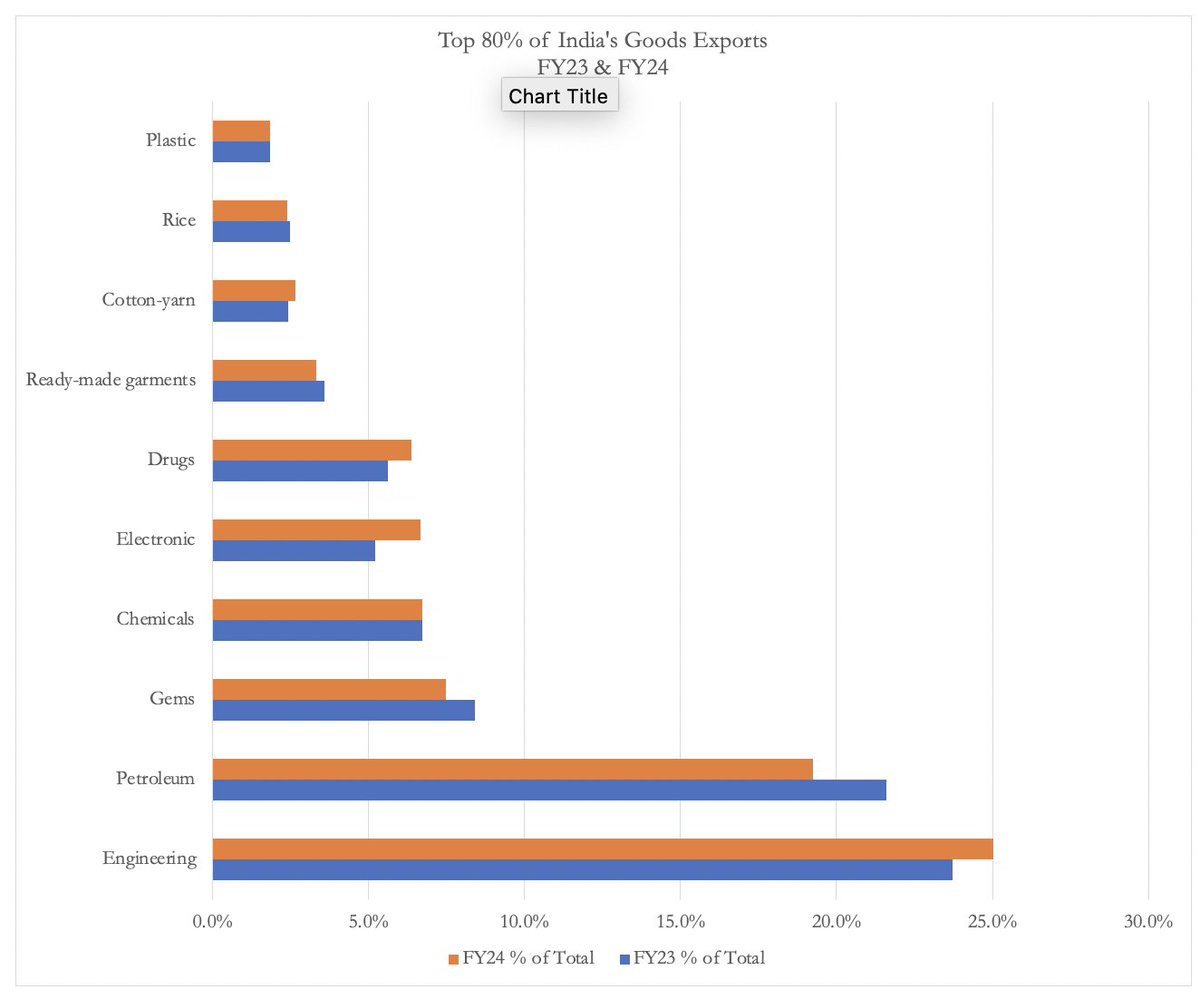
India's engineering exports is a $100 Bn industry anticipated to quadruple in next 6 years to ~$400Bn. It's place in India's growth-story can never be overemphasized.
Even if you start with 25lacs annual turnover you will grow to a 5cr business in reasonable time. This is way better than fighting for roles at enslavement centers.
One can manufacture everything from fasteners, valves, pumps to machineries. (See exhibit for list)
IF YOU CAN SEE THIS TWEET, PLEASE RETWEET THIS🙏
My account is being reported on a mass level by radical Islamists and leftists.
Lost reach of my account.
It is a very crucial time and me and my team are trying our best to debunk fake news.
Please support 🙏
How SAFE are we locals in Namma Bengaluru ????
Dear all, after a lot of thought ive decided to share a horrifying experience i had in Namma Bengaluru a couple of days ago. I initially thought i would let go of it after talking to my friends
Should I start to make videos on YouTube to expose lies and fake propaganda of people like Dhruv Rathee and Ravish Kumar with facts and figures?
They are fooling their followers with twisted facts and trauma psychology.
10k RT and I will start to expose them completely.
It has come to notice that misleading information related to new tax regime is being spread on some social media platforms. It is therefore clarified that:
👉 There is no new change which is coming in from 01.04.2024.
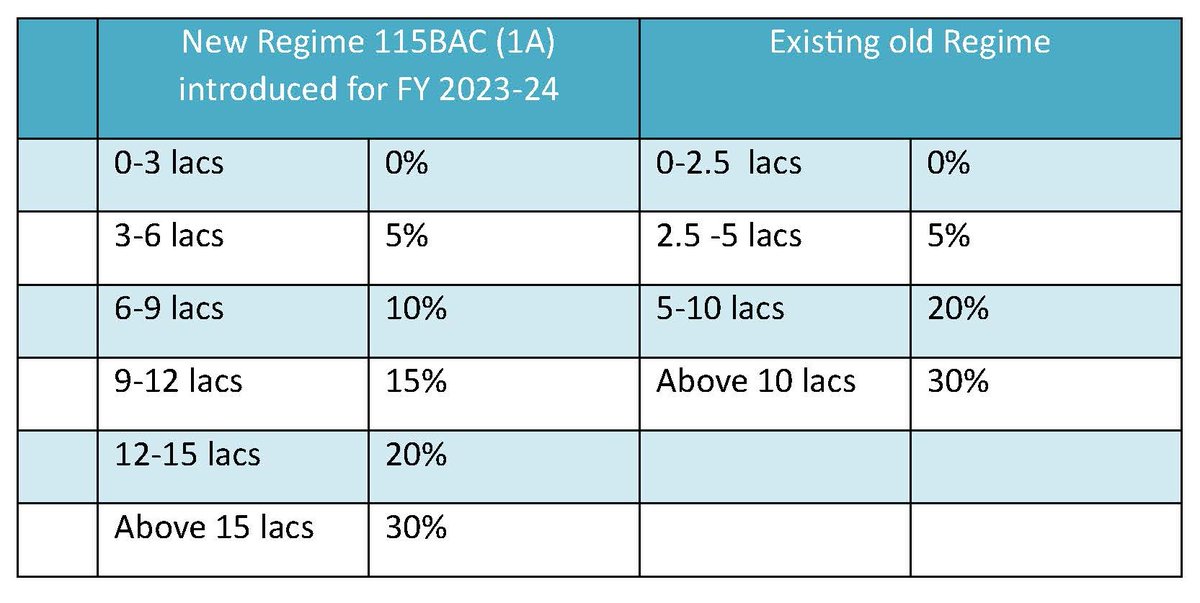
👉 The new tax regime under section 115BAC(1A) was introduced in the Finance Act 2023, as compared to the existing old regime (without exemptions) (SEE TABLE BELOW)
👉 New tax regime is applicable for persons other than companies and firms, is applicable as a default regime from the Financial Year 2023-24 and the Assessment Year corresponding to this is AY 2024-25.
|👉 Under the new tax regime, the tax rates are significantly lower, though the benefit of various exemptions and deductions (other than standard deduction of Rs. 50,000 from salary and Rs. 15,000 from family pension) is not available, as in the old regime.
👉 New tax regime is the default tax regime, however, tax payers can choose the tax regime (old or new) that they think is beneficial to them.
👉 Option for opting out from the new tax regime is available till filing of return for the AY 2024-25. Eligible persons without any business income will have the option to choose the regime for each financial year. So, they can choose new tax regime in one financial year and old tax regime in another year and vice versa.