@FijianIndex This isn’t new.
It began with the 1987 coup, which brought in the first wave of patronage recruits.
Merit was diluted. In its place rose familiarity, loyalty, and alignment.
4 decades on, those early patronage recruits now lead — and they have dismantled meritocracy everywhere.
@FijianIndex@Grok:
Let X = total number of employees.
If 8.6% of X = 177, what is the value of X?
Then, given a total labor cost of $161 million, what is the average cost per employee?
@elonmusk By your own actions—and the markets you serve—you’ve moved far from where most people live: close to struggle, community, and meaning.
Happiness can’t exist up there because people don’t.
Use a little of your fortune to pull others up. Happiness comes from human connection.
@haniya_445 Men deal with women dealing with periods, pregnancy, menopause, mood swings, sudden tears with no visible trigger, emotional weather changes, and the occasional “I’m fine” that clearly means something else entirely.
@fijitimes Simple test:
The best energy supply model for Fiji is one where households can freely choose, substitute, self-supply, or exit.
Until EFL proves its plan survives household freedom, these investments are policy choices—not technical necessities.
@fijitimes Chugoku acq. 44% of EFL for ~FJD 440M, valuing EFL at ~FJD 1.25B.
Then load ~FJD 5B dbt via centralized generation/grid expn. Locks tariffs to service it.
Result: EFL valuation rises to ~FJD 6.25B; 44% stake now worth ~FJD 2.75B.
Balance-sheet magic—consumers locked.
Sell & exit
@fijitimes Welcome pause—but this isn’t a tariff debate.
It’s a energy path-dependency problem.
No new debt-funded generation should proceed without transparent comparison to distributed home solar + storage.
EFL must shift from gatekeeper to open-access grid enabler.
@fijitimes The issue may be the law itself. Fiji’s iTaukei land system, via the TLTB, protects ownership but slows village-scale development. The answer isn’t weaker protection, but completion: modern governance that keeps land secure while enabling village enterprise guided by master plan.
Rooftop solar + EVs don’t need foreign investors, mega-projects, or billion-dollar loans.
They need political will, clear policy, and a mindset shift.
EFL must move from gatekeeper to enabler.
Fix incentives. Remove obstacles. Step aside.
Let every Fijian home power itself.
@fijitimes 80–85% of illness in Fiji is NCD-related — and largely preventable.
Obesity, poor diet, excess sugar, refined carbs…
Yet policy is upside down.
We build hospitals instead of preventing disease.
Treatment instead of fixing the food plate.
Health policy or failure management?
@fijitimes Fiji’s ~FJD 400m annual trade deficit with NZ isn’t about capability — it’s about policy failure.
We import basic food while NZ food makes up nearly half of Fiji’s food-import bill, despite our ability to produce it locally.
Name the policy that justifies this.
@fijitimes A rocket and a drilling machine are built for completely different journeys.
Until we agree on the destination, arguing about the vehicle specs makes no sense.
That’s what happens when constitutional reform runs ahead of national vision.
Vision first. Constitutional reform second
@fijitimes A playground is prevention — the first line of public health.
A hospital is treatment — the last line.
Both matter. But when you remove the former to justify the latter, you shift the burden to the next generation.
Is Valelevu Ground the best site — or just the easiest to take?
@fijitimes Meeting healthcare needs is challenging,” the President says.
He’s right, but the fix won’t be overnight.
The NDP 2019–2029 lacked a Health & Well-being pillar — not oversight, but a strategic failure.
The Health Transformation Summit is just the beginning.
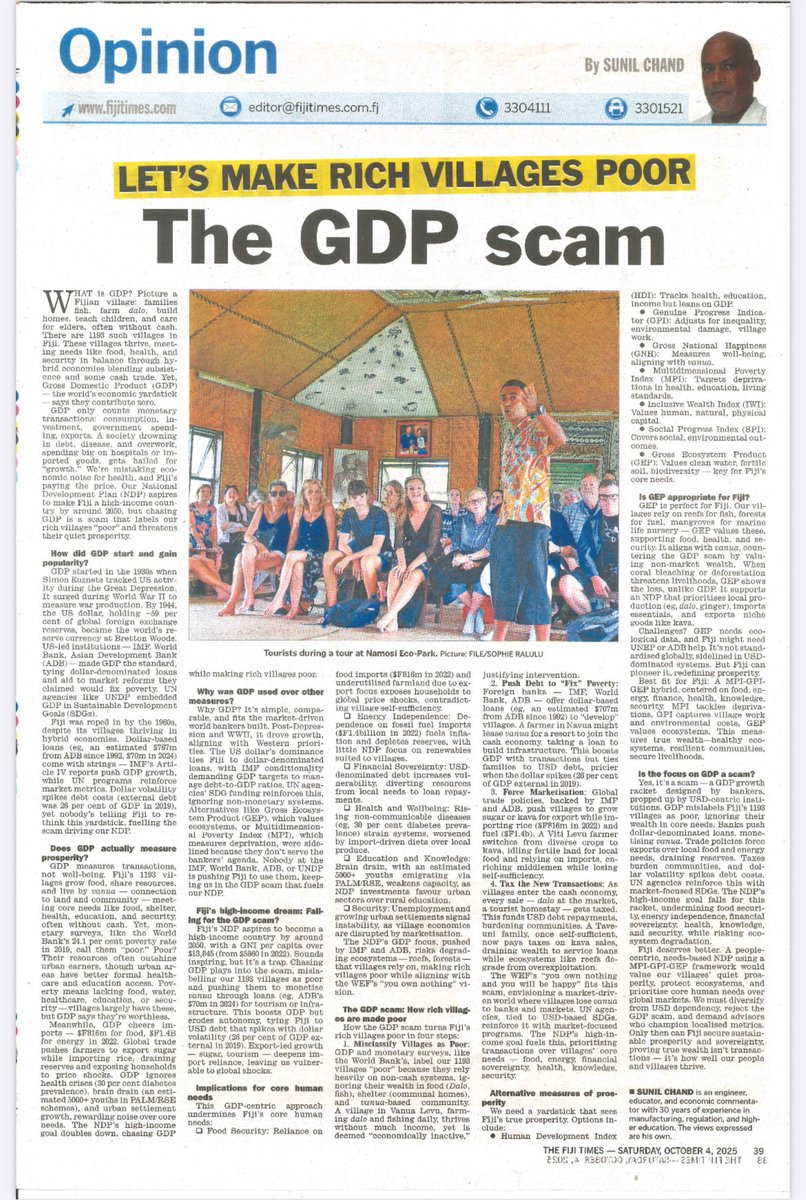
@fijitimes GDP celebrates wrong things, punishes right ones.
Grow food? GDP=0
Share resources? GDP=0
Care work & village labor? GDP=0
Borrow, import, spend? GDP “growth.”
FRCS calls untaxed livelihoods “losses.”
GDP Scam: independence looks “poor,” dependency looks like “growth.”